
Non-FictionStudent's ShortcutInterview Skills
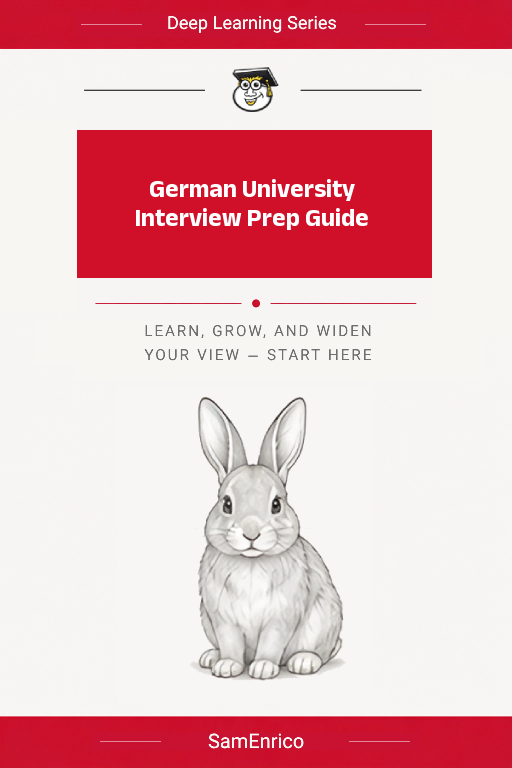
German University Interview Prep Guide eBook
Practice selection interviews for competitive tuit
by Hales Jeromy
Practice selection interviews for competitive tuition free programs like medicine, dentistry, or psychology.
Formats
Free sample
Chapter 1: The 1.0 Trap--Every year, approximately fifteen thousand applicants with Abitur scores of 1.0 or 1.1 are rejected from German medical programs. That is not a misprint. Fifteen thousand. These are students who have mastered every exam, memorized every fact, and sacrificed years of their adolescence in pursuit of academic perfection. And they are turned away.Not because they are not smart enough.
Not because they are not dedicated enough. Not even because there are no seats available—though competition is fierce. They are rejected because they misunderstand how German university admissions actually work. They believe their grades have earned them a place. They believe the interview is a formality, a polite conversation to confirm what the numbers have already decided.
They are wrong.This chapter dismantles the single most dangerous misconception in German university admissions: that a perfect or near-perfect grade point average guarantees admission. Drawing on admissions data from Charité Berlin, LMU Munich, Heidelberg University, and multiple psychology programs across Germany, we will expose the weighted formula that truly determines who gets in and who does not. We will introduce you to two fictional applicants—Maria and Jonas—whose stories illustrate exactly why thousands of 1.0 students fail while their lower-scoring peers succeed. And we will give you the first tool in your preparation arsenal: a self-diagnostic quiz that will reveal whether you are on track for admission or walking directly into the 1.0 Trap.By the end of this chapter, you will understand why your grades have already done their job—they got you to the interview—and why the interview is where admissions decisions are made, not confirmed. More importantly, you will understand why the tuition-free nature of German public education creates a competitive dynamic unlike anywhere else in the world, and how to use that dynamic to your advantage rather than falling victim to it.Let us begin with a story.The Tale of Two Applicants Maria and Jonas are both applying to the same medical program at Charité Berlin.
Both have strong Abitur scores. Both have completed the TMS (Test for Medical Studies). Both have submitted their letters of motivation on time. From the outside, they look like identical candidates.But when the admissions committee releases its decisions, Maria receives a rejection letter while Jonas receives an offer.Let us look at their profiles more closely.Maria holds a 1.0 Abitur. She has been a top student since primary school, never receiving a grade below 2.0 in any subject.
Her parents are both physicians, and she has known she wanted to study medicine since she was twelve years old. She spent her final year of Gymnasium studying six to eight hours per day, sacrificing extracurricular activities, social time, and sleep to maintain her perfect record. She scored in the 85th percentile on the TMS—respectable, but not extraordinary. When she receives her interview invitation, she assumes it is a formality. She spends approximately two hours preparing, reading through her application materials and practicing a few answers in front of a mirror.Jonas holds a 1.3 Abitur.
He was a strong but not exceptional student throughout Gymnasium, earning a mix of 1.0s, 1.3s, and occasional 1.7s. He spent significant time on extracurricular activities: volunteering at a senior home, participating in a biology olympiad, and shadowing a general practitioner in his hometown for three weeks. He scored in the 94th percentile on the TMS—significantly stronger than Maria. When he receives his interview invitation, he treats it as the most important assessment of his life. He spends forty hours preparing: studying the Studienordnung of Charité Berlin, researching current healthcare legislation, practicing role-plays with friends, and recording himself answering questions.Now let us see how each performed in the structured interview.Maria enters the room with confidence.
She smiles warmly at the three professors on the panel. When asked, "Why do you want to study medicine?" she responds with the answer she has practiced: "I have always wanted to help people. Medicine is the most direct way to make a difference in patients' lives. My parents are both doctors, and I have seen how rewarding their work can be." The panel nods, but their pens do not move—because nothing she said is scoreable. She has offered no evidence, no specific experience, no longitudinal narrative.
She has described a sentiment, not a qualification.When asked about a time she failed, Maria says, "I am a perfectionist, so I struggle when things are not perfect." This is a red flag. The panel has heard this exact phrase hundreds of times, and they know it is a humblebrag, not a genuine weakness. She stumbles on the ethical scenario about vaccine refusal, defaulting to "the doctor knows best" without considering the parent's perspective or offering a shared decision-making framework.Jonas, by contrast, enters the room noticeably nervous but composed. When asked why he wants to study medicine, he responds with a structured narrative: "When I was fourteen, my grandmother was diagnosed with dementia. Watching her navigate the healthcare system—the confusion of appointments, the difficulty of communicating with specialists, the emotional toll on my family—I saw that medicine is not just about curing disease.
It is about guiding people through uncertainty. That was the spark. Since then, I have volunteered at a senior home for two years, where I learned to listen before acting. I participated in a biology olympiad, which confirmed my love for the science underlying medicine. And I shadowed a GP for three weeks, where I saw the non-glamorous realities of the profession—the paperwork, the time pressure, the difficult conversations—and I still wanted to continue.
That is why I am applying to Charité specifically: your focus on Grundlagenforschung aligns with my interest in the basic science of neurodegeneration."The panel writes notes. They have just heard evidence of longitudinal commitment, specific experiences, and program-specific knowledge. Jonas has given them scoreable material.When asked about a time he failed, Jonas describes misjudging a resident's cognitive capacity during his senior home volunteer work, leading to frustration for both of them. He explains what he learned (assess capacity before giving complex instructions) and how he changed his behavior (always asking clarifying questions first). The panel recognizes this as genuine self-awareness, not a rehearsed trick.The result?
Jonas receives an admission offer. Maria does not.This is not an isolated case. This pattern repeats thousands of times every admissions cycle. And it is entirely preventable.The Weighted Formula: How Your Grade Became Just One Number To understand why Maria lost and Jonas won, you must understand the weighted formula that German universities use to evaluate applicants. Unlike systems where A-levels or baccalaureate scores dominate selection, German programs in medicine, dentistry, and psychology operate on a multi-factor model.The typical allocation looks like this:40 to 50 percent to your Abitur or international equivalent grade (the NC threshold)25 to 35 percent to cognitive test scores (TMS for medicine, Ba Psy-DGPs for psychology)25 to 40 percent to structured interview performance These percentages vary by university and by program.
Some universities place greater weight on the interview; others prioritize the cognitive test. But the underlying principle is consistent across all competitive programs: your grade is only one piece of the puzzle, and it…
This is the end of the free sample. Get the eBook to keep going. Buy now
About this book
Details
- Author
- Hales Jeromy
- Publisher
- SamEnrico
- Language
- English
- Genre
- Non-Fiction, Student's Shortcut, Interview Skills
- Released
- 2026-05-27
- Pages (approx.)
- 156
- Available as
- eBook, Audiobook

Read better in the ZLOADR app
Your eBooks on your phone or tablet. Sign in with your SamEnrico account and start reading.
More by Hales Jeromy
 Self Hypnosis For Sleep InsomniaHales Jeromy$11.99
 Child Memory Palace GuideHales Jeromy$11.99
 The Empathy Card DeckHales Jeromy$11.99
 The ED and Self EsteemHales Jeromy$11.99
 REIT Interest Rate RiskHales Jeromy$11.99
 Afternoon Slump BusterHales Jeromy$11.99
 Neurodivergent Parent Self CareHales Jeromy$11.99
 ED for Older MenHales Jeromy$11.99
 The Siege of Vienna That Never Was: Suleiman the Magnificent's Final Gambit (1532 AD)Hales Jeromy$11.99
 The Cossack Revolt of 1916: Betrayal in the CarpathiansHales Jeromy$11.99
 Levered Free Cash Flow GuideHales Jeromy$12.99
 How to Start a Film Studios Business (Beginners Guide)Hales Jeromy$11.99
You may also like
 Hong Kong Handover 1997Dunn Johnnie$11.99
 Zumba For Postnatal Recovery CourseNeal Christian$11.99
 Zumba for BeginnersLadner Nikia$11.99
 YouTube Comment Mining GuideHumes Pandora$12.99
 Worry Box MeditationCarlin Rudy$11.99
 Workplace Stress MeditationNguyen Lynn$11.99
 Workplace Stress and Sleep RepairHawley Ivory$11.99
 Workplace Perfectionism CureDelaney Jeffry$11.99
 Workplace Injustice Anger GuideWallen Isabelle$11.99
 Work Addiction and Burnout LinkGreenwood Ester$11.99
 Women in Yoga and WellnessBeattie Galina$11.99
 Women in Stand Up ComedyChun Evangeline$11.99