

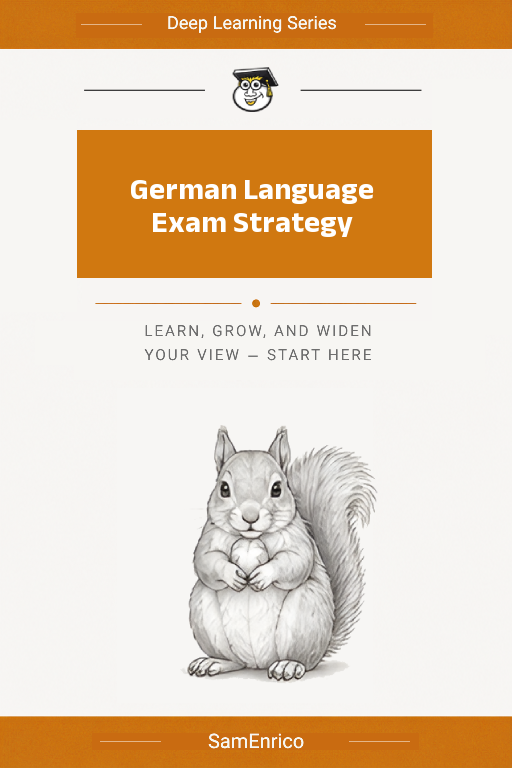
Non-FictionStudent's ShortcutLanguage ProficiencyExam Prep
German Language Exam Strategy eBook
Achieve TestDaF or Goethe C1 scores faster using p
Achieve TestDaF or Goethe C1 scores faster using past papers and speaking templates aligned with university admission thresholds.
Formats
Free sample
Chapter 1: The Admissions Trap–- Anna had done everything right. She had completed C1 German courses at the Goethe-Institut, scored 85% on their placement test, and spent six months living in Berlin, where her roommates complimented her “flawless” conversational German. She could order coffee, argue about politics, and even joke in the subjunctive II. When she sat for the Test Da F, she felt confident. Three weeks later, the results arrived: TDN 3 in writing, TDN 3 in speaking.
TDN 4 in reading and listening. Overall score: not eligible for direct admission to any German university.The rejection letter from TU Berlin didn’t say “your German is bad.” It said: “Your academic language proficiency does not meet the minimum requirements for enrollment.” Anna was devastated. She had done everything the internet told her to do. She had memorized vocabulary lists, completed grammar drills, and practiced with language exchange partners. No one had told her that the exam she was about to take did not test “German” at all—at least not the German she had learned.This chapter is for every Anna.
For every learner who has spent hundreds of hours and thousands of euros on language courses, only to receive a score that feels like a personal failure. The truth is far less dramatic and far more useful: you are not failing because your German is bad. You are failing because you are playing the wrong game. The Test Da F and Goethe C1 exams are not language tests in the traditional sense. They are tests of academic ritual, pattern recognition, and strategic time allocation.
And once you understand that, the path to TDN 4 becomes not just possible, but predictable.This book exists because most preparation materials—including the bestsellers—teach you more German. You do not need more German. You need better strategy. You need to understand what a German professor actually looks for when they assign TDN 4 (the minimum for university admission). You need to diagnose your specific bottleneck (grammar or vocabulary?
reading or listening?) and attack only what yields points. And you need to learn the difference between fixed templates (memorize exactly) and flexible frames (memorize the structure, not the content)—a distinction that will appear throughout every chapter of this book.By the end of this chapter, you will understand why conversational fluency is irrelevant to exam success. You will know exactly what TDN 4 and “gut bestanden” mean in practical, rubric-based terms. You will have a clear map of the difference between B2 and C1 academic German. And you will adopt the template philosophy that will save you hundreds of study hours.
Let us begin.The Great Misconception: Fluency Is Not Your Friend Every year, thousands of learners walk into Test Da F and Goethe C1 examination rooms believing that their ability to “speak German well” will carry them through. They are wrong. And the data proves it.The Goethe-Institut and Test Da F Institute publish annual reports on score distributions. The pattern is consistent: candidates with self-assessed “advanced conversational” skills often score lower than candidates who explicitly prepare for exam formats, even when the latter group has objectively weaker spoken German. Why?
Because the exams do not reward what you think they reward.Let us examine the most common failure pattern: high listening and reading scores, low writing and speaking scores. Anna’s pattern. This is not a coincidence. Reading and listening are receptive skills—you can train them passively, through immersion, podcasts, and Netflix. Writing and speaking are productive skills under time pressure.
They require you to generate academic register on demand, without a dictionary, without a teacher, and without the safety net of conversational fillers (“äh… also… weißt du…”).Here is the brutal truth: a native German speaker who never attended university would fail the Test Da F writing section. Not because their grammar is incorrect, but because they do not know the rituals of academic writing—the nominalizations, the impersonal passive constructions, the logical connectors that signal a structured argument. A taxi driver in Berlin speaks fluent, idiomatic German. But ask them to write a 250-word essay comparing two charts on Studiengebühren, and they will produce a text that examiners mark as B2 at best. The exam does not test “German.” It tests academic German, which is a separate dialect with its own vocabulary, syntax, and rhetorical rules.This is liberating.
Because if the exam tests a specific dialect, you do not need to become “fluent” in all of German. You need to become proficient in approximately 500 high-frequency academic words, 15 grammatical structures, and 20 template frames. That is not fluency. That is strategic competence. And it is achievable in 8 weeks.The Numerical Target: What TDN 4 Actually Means Let us talk numbers, because vague goals produce vague results.
“I want to pass the Test Da F” is not a target. “I want to achieve TDN 4 in all four sections” is a target. But even that is insufficiently precise. You need to understand what TDN 4 looks like on the examiner’s rubric.The Test Da F scale runs from TDN 3 (too low for university) to TDN 5 (excellent). TDN 4 is the minimum for direct admission to most German universities, though some programs (law, medicine, German literature) require TDN 5.
The Goethe C1 equivalent is “gut bestanden” (roughly 80-90% score), which maps to TDN 4. “Bestanden” (pass) is often insufficient for university admission.But what does TDN 4 mean in practice? Here is the examiner’s internal checklist, distilled from published rubrics and interviews with former Test Da F examiners:Reading (LV) – TDN 4:Can identify main arguments and supporting details in texts of 400-600 words.Can distinguish between explicit statements (Aussage) and implied meaning (Textimplikation).Can correctly answer 14-16 out of 20 questions (70-80% accuracy).Common failure: “Nein/Nichts” confusion (Task 1), where candidates mark a statement as “false” when the text simply does not mention it.Listening (HV) – TDN 4:Can follow a structured academic lecture (6-8 minutes) and take notes simultaneously.Can identify rhetorical signals (thesis, example, counter-argument, conclusion).Can correctly answer 14-16 out of 20 questions.Common failure: losing the thread after a single unknown word, then panicking and missing the next three questions.Writing (SA) – TDN 4:Can produce a 250-300 word essay with a clear introduction, data description, comparison, argumentation, and conclusion.Uses nominalizations and varied sentence openings (not only Ich finde, dass…).Provides justified arguments (cause-effect chains, not opinions without evidence).Common failure: describing the chart but failing to transition to argumentation, or offering pro/con points without logical connection.Speaking (SA) – TDN 4:Can complete all 7 tasks (Test Da F) or 3 tasks (Goethe C1) without long pauses.Uses subjunctive II for speculation (Es wäre wünschenswert, wenn…).Structures responses with clear beginnings, middles, and endings.Common failure: running out of time on Task 3 (chart description) or using conversational register (“also” instead of “zunächst”).Here is the most important number in this book: 70%. You do not need 90% or 100%. You need to correctly answer approximately 70% of each section.
That is TDN 4. That is university admission. Perfection is not required. Consistency is.The Gap Analysis: B2 vs. C1 – What Actually Changes Most learners believe the jump from B2 to C1 is about vocabulary size.
It is not. A B2 speaker knows approximately 4,000 words. A C1 speaker knows 6,000-8,000. But you could memorize 4,000…
This is the end of the free sample. Get the eBook to keep going. Buy now
About this book
Details
- Author
- Wiggins Marquetta
- Publisher
- SamEnrico
- Language
- English
- Genre
- Non-Fiction, Student's Shortcut, Language Proficiency, Exam Prep
- Released
- 2026-05-29
- Pages (approx.)
- 143
- Available as
- eBook, Audiobook

Read better in the ZLOADR app
Your eBooks on your phone or tablet. Sign in with your SamEnrico account and start reading.
More by Wiggins Marquetta
 Conversation Starters for Job InterviewsWiggins Marquetta$11.99
 Roam Research RemindersWiggins Marquetta$11.99
 ADHD Distraction Management GuideWiggins Marquetta$11.99
 CrossFit Box BusinessWiggins Marquetta$11.99
 The Abandonment FearWiggins Marquetta$11.99
 Bipolar Journaling WorkbookWiggins Marquetta$11.99
 Essay Exam MemoryWiggins Marquetta$11.99
 Child Loss And NatureWiggins Marquetta$11.99
 Emotional Resilience EQ WorkbookWiggins Marquetta$11.99
 The Art of the Steal: How a Billion-Dollar Art Scam Laundered Money Through the EliteWiggins Marquetta$11.99
 The Exile of the Sun King: Louis XIV’s Lost HeirWiggins Marquetta$11.99
 The Iron Discipline: Prussia’s March to Military and Administrative MasteryWiggins Marquetta$11.99
You may also like
 Hong Kong Handover 1997Dunn Johnnie$11.99
 Zumba For Postnatal Recovery CourseNeal Christian$11.99
 Zumba for BeginnersLadner Nikia$11.99
 YouTube Comment Mining GuideHumes Pandora$12.99
 Worry Box MeditationCarlin Rudy$11.99
 Workplace Stress MeditationNguyen Lynn$11.99
 Workplace Stress and Sleep RepairHawley Ivory$11.99
 Workplace Perfectionism CureDelaney Jeffry$11.99
 Workplace Injustice Anger GuideWallen Isabelle$11.99
 Work Addiction and Burnout LinkGreenwood Ester$11.99
 Women in Yoga and WellnessBeattie Galina$11.99
 Women in Stand Up ComedyChun Evangeline$11.99