
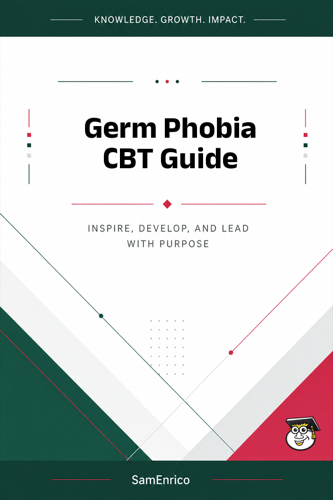
Germ Phobia CBT Guide eBook
Challenge contamination thoughts using probability
Challenge contamination thoughts using probability and evidence.
Formats
Free sample
Chapter 1: The Probability Trap--–- Maria’s hands were bleeding again. Not from a cut or a scrape, but from the sixteenth handwashing of the day. She stood at the kitchen sink, watching the raw, cracked skin on her knuckles ooze faintly, and she thought: I know this doesn’t make sense. She held a master’s degree in public health. She could recite the chain of infection from memory.
She knew, with absolute scientific certainty, that the shopping cart handle she’d touched two hours ago posed a near-zero risk of making her sick. And yet, as she dried her hands, a voice inside her whispered: But what if?That voice—the one that ignores degrees, data, and diplomas—is the subject of this book. It is not a voice of reason. It is the voice of the Probability Overestimation Error, and it is the single engine driving your germ phobia.If you picked up this book, you already know the feeling. You avoid public restrooms even when you desperately need them.
You wash your hands until the soap feels like acid on your skin. You have a “clean” side of the house and a “dirty” side, and the border is guarded like a Cold War checkpoint. You have thrown away food because it touched the counter for three seconds. You have declined a hug from someone you love because they sneezed yesterday. You have lain awake at night calculating the odds that the doorknob at the coffee shop gave you norovirus—even though you feel fine.Here is the truth that your anxiety has been hiding from you: Your brain is not broken.
It is running an outdated, hyper-vigilant risk analysis program that was designed for a world that no longer exists. Ten thousand years ago, a caveman who underestimated the risk of a rotting carcass might die of poisoning. A caveman who overestimated the risk—who avoided anything slightly suspicious—lived to pass on those cautious genes. You inherited the software of that over-cautious ancestor. The problem is that you are now using caveman software to navigate a world of hand sanitizer, vaccines, sewage treatment, and pasteurization.This chapter will do three things.
First, it will introduce you to the Probability Overestimation Error—the core malfunction that makes a 0.001% risk feel like a 90% certainty. Second, it will draw a hard line between Subjective Contamination (how dirty something feels) and Objective Risk (how likely it actually is to hurt you). Third, it will give you your first tool: a self-assessment that calculates your personal Probability Overestimation Score, which will serve as your baseline for the rest of the book.By the end of this chapter, you will understand why your brain lies to you about germs—and you will have the first piece of evidence that you can learn to stop believing those lies.The Anatomy of a False Alarm Let us begin with a simple experiment. Do not do it yet—just read.Imagine a public restroom. The floor is wet.
The air smells of bleach and something less pleasant. There is a paper towel on the floor near the trash can. You need to use the toilet. As you reach for the stall handle, a thought arrives: If I touch this, I will get sick.Now answer this question honestly: What probability does your gut assign to that thought? Not your rational brain—your gut.
Most people with germ phobia will say something between 50% and 90%. Some will say 100%.Now here is the actual, evidence-based probability from the CDC and epidemiological research: The risk of contracting a significant illness from touching a dry restroom stall handle in a community setting, assuming you wash your hands afterward and do not touch your face, is approximately 0.001% to 0.01%. That is one in ten thousand to one in one hundred thousand.The gap between what you feel (90%) and what is real (0.001%) is the Probability Overestimation Error. It is not a small error. It is a 90,000-fold overestimation.
If you made that same error in any other domain of your life, you would never get on an airplane (actual fatality risk: 0.00001% per flight), never eat at a restaurant (food poisoning risk: 0.03% per meal), and never get out of bed (fall risk: non-zero).And yet, you do all those things. Because your brain has a special, hyper-reactive circuit for contamination that it does not have for plane crashes or restaurant meals. That circuit evolved to keep you alive. But in the modern world, it is a fire alarm that goes off when someone burns toast.The Two Kinds of “Dirty”: Subjective vs. Objective To understand the Probability Overestimation Error, you need to understand a distinction that will appear throughout this book.
It is the difference between Subjective Contamination and Objective Risk.Subjective Contamination is the feeling that something is dirty. It is visceral, immediate, and often irrational. You can feel subjective contamination from a piece of sterile plastic that was manufactured in a clean room. You can feel it from a photograph of a latrine. You can feel it from a memory.
Subjective contamination does not care about bacteria counts or infection statistics. It cares about what your brain has learned to associate with disgust and danger.Objective Risk is the actual, measurable probability that an object or situation will make you sick. It is calculated using epidemiology, microbiology, and infectious dose research. Objective risk is almost always dramatically lower than subjective contamination. A public restroom floor has a high subjective contamination (it feels disgusting) but a low objective risk (you would need to lick it repeatedly to get sick).
A raw chicken cutting board has a moderate subjective contamination but a higher objective risk (salmonella is real). Your own unwashed hands after using your phone have low subjective contamination (they feel clean) but a moderate objective risk (phones carry more bacteria than toilet seats).The core problem of germ phobia is that your brain has learned to treat subjective contamination as if it were objective risk. You feel dirty, so you believe you are in danger. This is the Probability Overestimation Error in action: the feeling of dirtiness becomes proof of the probability of illness.Here is a concrete example. Imagine two scenarios:Scenario A: A dry public doorknob in an office building.
You touch it. Subjective contamination: 70 out of 100. Objective risk of illness: 0.001%.Scenario B: Your own phone screen, which you have not cleaned in a week. You touch it. Subjective contamination: 10 out of 100.
Objective risk of illness: 0.05% (phones are genuinely germy, but still very low risk).Notice the inversion. The object that feels much dirtier (the doorknob) is actually safer. The object that feels clean (your phone) is slightly riskier. Your subjective contamination meter is not just inaccurate—it is often backwards.This is not your fault. Your brain learned these associations through a combination of evolution, media messaging, social learning, and personal experience.
But now that you know the distinction, you can begin to retrain your brain. The goal of this book is not to make you stop feeling disgust. The goal is to teach you to stop treating the feeling of disgust as evidence of danger.The Probability Overestimation…
This is the end of the free sample. Get the eBook to keep going. Buy now
About this book
Details
- Author
- Mcnamara Dorene
- Publisher
- SamEnrico
- Language
- English
- Genre
- Non-Fiction, Health & Wellness
- Released
- 2026-06-10
- Pages (approx.)
- 136
- Available as
- eBook, Audiobook

Read better in the ZLOADR app
Your eBooks on your phone or tablet. Sign in with your SamEnrico account and start reading.
More by Mcnamara Dorene
 Color Dream Symbolism HandbookMcnamara Dorene$11.99
 Tavus Personalization GuideMcnamara Dorene$11.99
 The High Functioning Alcoholic Recovery PlanMcnamara Dorene$11.99
 Meth Identity Reconstruction WorkbookMcnamara Dorene$11.99
 The Line in the Sand: How a Fishing Dispute Nearly Started a WarMcnamara Dorene$11.99
 How to Become a Mud BossMcnamara Dorene$11.99
 Ecommerce Regional Spending GuideMcnamara Dorene$12.99
 Academic Proofreading Side HustleMcnamara Dorene$12.99
 Understanding Indomethacin Antenatal InfectionMcnamara Dorene$17.99
 Apothecary AssistantMcnamara Dorene$11.99
You may also like
 Hong Kong Handover 1997Dunn Johnnie$11.99
 Zumba For Postnatal Recovery CourseNeal Christian$11.99
 Zumba for BeginnersLadner Nikia$11.99
 YouTube Comment Mining GuideHumes Pandora$12.99
 Worry Box MeditationCarlin Rudy$11.99
 Workplace Stress MeditationNguyen Lynn$11.99
 Workplace Stress and Sleep RepairHawley Ivory$11.99
 Workplace Perfectionism CureDelaney Jeffry$11.99
 Workplace Injustice Anger GuideWallen Isabelle$11.99
 Work Addiction and Burnout LinkGreenwood Ester$11.99
 Women in Yoga and WellnessBeattie Galina$11.99
 Women in Stand Up ComedyChun Evangeline$11.99