
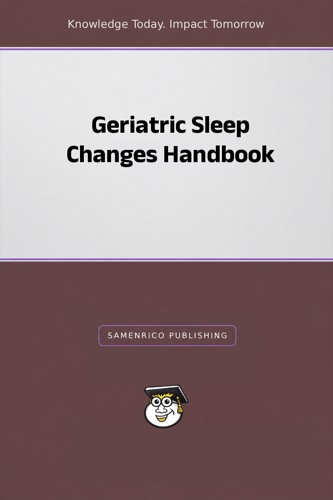
Non-FictionHealth & WellnessSenior Sleep
Geriatric Sleep Changes Handbook Audiobook
Adapt to lighter, shorter sleep with earlier bedti
Adapt to lighter, shorter sleep with earlier bedtimes and morning light exposure.
Formats
Free sample
Chapter 1: The Eight‑Hour Lie--–- Margaret, a 68‑year‑old retired teacher, had not slept past 4:00 AM in nearly four years. Every night, she followed the same ritual: lights out at 10:00 PM, eyes wide open by 2:30 AM, then two and a half hours of tossing, turning, and bargaining with the ceiling. By morning, she was exhausted, irritable, and convinced that her body had betrayed her. “I only slept five hours,” she told her doctor. “I think I have severe insomnia.”Her doctor nodded, prescribed a low‑dose sleeping pill, and sent her home.
The pill helped her fall asleep faster, but it did nothing for the 3:00 AM wake‑up. If anything, she felt more groggy and confused during the day. Margaret’s story is not unusual. In fact, it is the most common sleep complaint among adults over sixty. And yet, almost everything about the way Margaret – and millions like her – are thinking about their sleep is based on a misunderstanding.
That misunderstanding begins with a single, deeply entrenched cultural belief: the eight‑hour night.The Origin of an Obsession The idea that every adult needs eight solid hours of uninterrupted sleep is surprisingly modern. Before the industrial revolution, sleep was far more flexible. People slept in two distinct segments – a “first sleep” after dusk, then a waking period of an hour or two for reading, praying, or visiting neighbors, followed by a “second sleep” before dawn. Eight‑hour blocks were neither expected nor common. The shift toward a single, compressed night of sleep came with electric lighting, factory schedules, and the rise of a 9‑to‑5 work culture.
By the mid‑twentieth century, “eight hours” had become gospel, reinforced by everything from parenting manuals to workplace wellness posters.But here is the problem: that gospel was written for young and middle‑aged adults. The sleep studies that established the eight‑hour norm enrolled participants in their twenties and thirties. Those studies did not include large numbers of healthy seventy‑year‑olds. When researchers finally began looking at geriatric sleep patterns in the 1990s and 2000s, they discovered something remarkable: healthy older adults do not need eight hours of continuous sleep to function well. They need less total sleep, but more importantly, they need a different kind of sleep – and a different attitude toward what “good sleep” looks like.The Efficiency Revolution Let us introduce the most important concept in this entire book: sleep efficiency.Sleep efficiency is…
This is the end of the free sample. Get the Audiobook to keep going. Buy now
About this book
Details
- Author
- Snipes Rosalva
- Publisher
- SamEnrico
- Language
- English
- Genre
- Non-Fiction, Health & Wellness, Senior Sleep
- Released
- 2026-06-07
- Pages (approx.)
- 135
- Available as
- eBook, Audiobook

Listen in the VoxFlicks app
Audiobooks and audio dramas wherever you go. Sign in with your SamEnrico account and press play.
More by Snipes Rosalva
 Metta for Prejudice ReductionSnipes Rosalva$11.99
 NSAID Gut Protection GuideSnipes Rosalva$11.99
 Meditation For WhiplashSnipes Rosalva$11.99
 The Caravels of Courage: Portugal’s Voyage to the UnknownSnipes Rosalva$11.99
 How to Produce Business Card BooksSnipes Rosalva$11.99
 ForesterSnipes Rosalva$11.99
 US LLC Formation for Non Resident ArtistsSnipes Rosalva$12.99
 How to Start a Liquor Store BusinessSnipes Rosalva$11.99
You may also like
 Hong Kong Handover 1997Dunn Johnnie$11.99
 Zumba For Postnatal Recovery CourseNeal Christian$11.99
 Zumba for BeginnersLadner Nikia$11.99
 YouTube Comment Mining GuideHumes Pandora$12.99
 Worry Box MeditationCarlin Rudy$11.99
 Workplace Stress MeditationNguyen Lynn$11.99
 Workplace Stress and Sleep RepairHawley Ivory$11.99
 Workplace Perfectionism CureDelaney Jeffry$11.99
 Workplace Injustice Anger GuideWallen Isabelle$11.99
 Work Addiction and Burnout LinkGreenwood Ester$11.99
 Women in Yoga and WellnessBeattie Galina$11.99
 Women in Stand Up ComedyChun Evangeline$11.99