
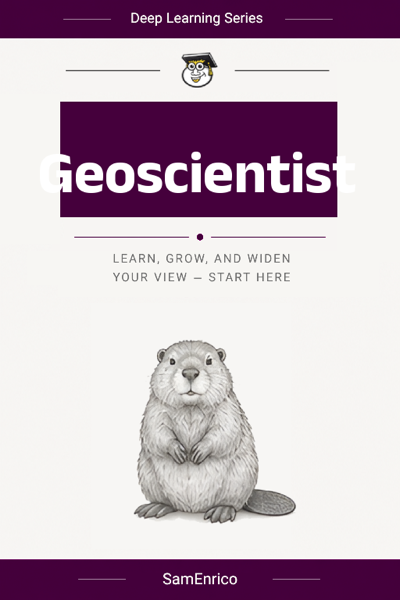
Non-FictionInformativeEducational
Geoscientist eBook
A Coursebook on Geoscientist
by Olsen Cordie
A Coursebook on Geoscientist
Formats
Free sample
Chapter 1: The Silent Roar...--You are standing on a million-mile-an-hour planet. The ground beneath your feet—whether it is polished concrete, forest soil, or beach sand—is screaming through space at a velocity that would turn your body to mist if you were suddenly exposed to the vacuum outside. You do not feel it. You have never felt it. And that is the first and most important lie that geology must correct: the Earth feels still, but it has never been still for a single second of its four-and-a-half-billion-year existence.Every morning, you wake up on a spacecraft.
It has a metal core spinning like a dynamo, a mantle of slowly churning rock hot enough to melt steel, a crust thin as an eggshell, and an atmosphere held in place by gravity just strong enough to keep you breathing but just weak enough to let satellites circle overhead. You are not standing on solid ground. You are standing on a thin, cracked shell wrapped around a furnace. And if you want to understand where your water came from, why some places shake and others do not, where the metals in your phone were born, or what will happen to your children’s climate, you must first learn to hear the silent roar of the deep Earth engine.This chapter is about that engine. It is about the layered structure of our planet, the forces that keep it hot and active after billions of years, and the invisible shield that allows life to exist at all.
It is also about a group of scientists who learned to listen to earthquakes as if they were a planetary heartbeat—and what they heard changed everything.The Most Useful Explosion in History On September 17, 1959, a magnitude 6.5 earthquake ripped through the Madison River Canyon in Montana. It was not the largest quake ever recorded, nor the deadliest. But it happened at the exact moment that a new generation of seismometers—instruments designed to listen to underground nuclear tests—had just been installed by the United States government. The Cold War paranoia about Soviet bombs had inadvertently built the most sensitive global listening network the world had ever seen.When the Montana quake shook the continent, seismometers from Alaska to South Africa recorded the same signal. And when scientists compared the arrival times of different types of seismic waves, they noticed something strange.
Some waves arrived earlier than expected. Others arrived later. Some did not arrive at all.That strange pattern was the first clue that the Earth was not a solid, uniform ball. It was layered. And the layers were moving.The CAT Scan of the Planet Here is what seismologists figured out, using nothing more than the speed of sound and the patience to compare millions of earthquake recordings.When an earthquake ruptures a fault, it releases energy in two main types of waves.
Primary waves—P-waves—are compressional waves that push and pull in the same direction they travel, like a slinky being squeezed and stretched. They are the fastest waves and the first to arrive at any seismometer. Secondary waves—S-waves—are shear waves that shake the ground perpendicular to their direction of travel, like a rope being whipped up and down. They are slower, but they tell a more important story.S-waves cannot travel through liquid. They simply stop.When seismologists realized that S-waves from earthquakes on one side of the planet never reached seismometers on the opposite side, they understood why.
There is a liquid layer at the center of the Earth—the outer core—that blocks shear waves entirely. P-waves, by contrast, travel through liquids, but they bend and slow down when they hit the core. By measuring how much the waves bent and where they emerged on the other side, scientists constructed the first map of the planet’s interior without ever drilling a hole deeper than a few miles.What they found was a world within a world.The Crust – The skin. On land, it is 20 to 50 miles thick. Under the oceans, it is only three to six miles thick.
The crust is to the Earth what the peel is to an apple—vanishingly thin, fragile, and the only part we have ever touched. All the mountains, all the oceans, all the cities, all the life that has ever existed lives on or within this paper-thin layer. If the Earth were the size of an apple, the crust would be thinner than the apple’s skin.The Mantle – Below the crust, extending down to about 1,800 miles, is the mantle. This is not liquid magma, as often imagined. It is solid rock—mostly silicate minerals rich in iron and magnesium—that behaves like an extremely viscous fluid over geological timescales.
A million years is enough time for the mantle to flow. The mantle is hot, roughly 1,000 to 3,700 degrees Celsius, and under immense pressure. It convects, meaning hot rock rises toward the crust, cools, and sinks back down, just like water boiling in a pot—except this pot is made of rock, and one complete convection cycle takes a hundred million years.The Outer Core – At 1,800 miles down, the mantle gives way to the outer core, a layer of liquid iron and nickel 1,400 miles thick. The temperature here is between 4,000 and 5,000 degrees Celsius—as hot as the surface of the Sun. The outer core is liquid because the pressure, while enormous, is not high enough to force the iron atoms into a solid crystal structure.
It is this liquid iron, swirling in complex convection currents, that generates Earth’s magnetic field.The Inner Core – At the very center of the planet, starting about 3,200 miles down, the pressure finally becomes so intense—over 3.5 million times atmospheric pressure—that iron freezes into a solid. The inner core is a sphere of solid iron and nickel about 1,500 miles in radius, roughly the size of Pluto. It is approximately 5,500 degrees Celsius, hotter than the surface of the Sun. It remains solid only because the pressure is so unimaginably high that atoms cannot break free into a liquid state.This is the machine. Four nested layers, each with a different composition, temperature, and physical state, interacting in ways that generate the magnetic field, drive volcanoes, move continents, and ultimately determine whether a planet is a living world or a dead rock like Mars.The Heat That Will Not Die Every machine needs an energy source.
The Earth’s engine has two: one ancient, one ongoing.The ancient source is primordial heat. When the Earth formed 4.5 billion years ago, it was built from the collision and accretion of countless smaller bodies—planetesimals, asteroids, and protoplanets—each slamming into the growing planet with enormous kinetic energy. That energy of impact was converted into heat. The entire planet was molten for the first tens of millions of its existence. Since then, it has been slowly cooling, radiating that primordial heat into space through volcanoes, hydrothermal vents, and simply through the crust by conduction.
But after billions of years, primordial heat alone would have long since dissipated. Mars, which is smaller and cooled faster, lost most of its primordial heat and its magnetic field billions of years ago.…
This is the end of the free sample. Get the eBook to keep going. Buy now
About this book
Details
- Author
- Olsen Cordie
- Publisher
- SamEnrico
- Language
- English
- Genre
- Non-Fiction, Informative, Educational
- Released
- 2026-06-02
- Pages (approx.)
- 146
- Available as
- eBook, Audiobook

Read better in the ZLOADR app
Your eBooks on your phone or tablet. Sign in with your SamEnrico account and start reading.
More by Olsen Cordie
 Blue Zone Spring Water GuideOlsen Cordie$11.99
 Pain Acceptance Sleep TrackOlsen Cordie$11.99
 Study Breath Focus GuideOlsen Cordie$11.99
 Alcohol Gut Health GuideOlsen Cordie$11.99
 The Bush Ballad: Henry Lawson and the Birth of Australian IdentityOlsen Cordie$11.99
 Discrimination Claims from First HireOlsen Cordie$12.99
 How to Produce Cabinet and Furniture Keyhole EscutcheonsOlsen Cordie$11.99
 How to Become a Base-filler OperatorOlsen Cordie$11.99
You may also like
 Hong Kong Handover 1997Dunn Johnnie$11.99
 Zumba For Postnatal Recovery CourseNeal Christian$11.99
 Zumba for BeginnersLadner Nikia$11.99
 YouTube Comment Mining GuideHumes Pandora$12.99
 Worry Box MeditationCarlin Rudy$11.99
 Workplace Stress MeditationNguyen Lynn$11.99
 Workplace Stress and Sleep RepairHawley Ivory$11.99
 Workplace Perfectionism CureDelaney Jeffry$11.99
 Workplace Injustice Anger GuideWallen Isabelle$11.99
 Work Addiction and Burnout LinkGreenwood Ester$11.99
 Women in Yoga and WellnessBeattie Galina$11.99
 Women in Stand Up ComedyChun Evangeline$11.99