
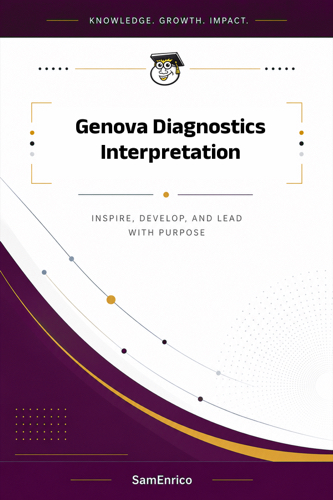
Non-FictionHealth & WellnessGenova Diagnostics
Genova Diagnostics Interpretation eBook
Decodes GI Effects comprehensive profile.
by Card Newton
Decodes GI Effects comprehensive profile.
Formats
Free sample
Chapter 1: Beyond Pathogen Hunting--The first time a patient hands you a stool test report, what do you see? If you are like most clinicians trained in the conventional model, your eyes dart immediately to the section labeled “Pathogens.” You search for the red boxes, the asterisks, the words “abnormal” or “detected.” And when you find none, you close the folder and say, “Everything looks normal. It must be stress.”That patient leaves your office with a diagnosis of exclusion—IBS, functional dyspepsia, or simply “anxiety”—and you both feel a quiet sense of failure. You have done what you were trained to do. You ruled out infection.
But the patient still bloats after every meal, still runs to the bathroom with urgent diarrhea, still suffers from brain fog so severe they cannot finish a workday, still battles joint pain that rheumatologists have called “seronegative” and therefore imaginary.The problem is not your clinical skill. The problem is the diagnostic lens you were given.Conventional stool testing—the kind ordered by most primary care physicians and gastroenterologists—was designed for the acute care model. Ova and parasite exams, routine aerobic cultures, and even many PCR panels were built to answer one question: Is there a single, identifiable pathogen causing an acute infection? That model works brilliantly for Giardia in a returning traveler, for Salmonella in a summer picnic outbreak, for C. difficile in a post-antibiotic hospitalization.
But it fails catastrophically for the chronic, low-grade, multi-factorial gut dysfunction that now afflicts millions of people worldwide.This chapter will dismantle that old lens and replace it with a new one. You will learn why the gut is not a simple tube but an ecosystem—a rainforest of microbial life that communicates directly with your brain, your immune system, and every organ in your body. You will understand the three technological pillars that make the GI Effects Comprehensive Profile different from every other stool test on the market. And most importantly, you will begin the shift from pathogen hunting to functional assessment—a paradigm that will transform not only how you interpret this single test but how you think about chronic disease itself.The Gut as an Ecosystem, Not a Pipe For much of medical history, the gastrointestinal tract was conceptualized as a relatively simple conduit. Food went in, nutrients were absorbed, waste came out, and occasionally bad things—bacteria, parasites, toxins—interrupted this process.
The solution was equally simple: identify the invader and eradicate it. This is the pathogen-hunting model, and it has saved countless lives. We do not mean to diminish it. Antibiotics for cholera, metronidazole for amebiasis, antiparasitics for hookworm—these interventions have pulled humanity back from the brink of mass suffering.But the pathogen-hunting model has a fatal blind spot. It assumes that the gut is sterile except for transient invaders.
We now know this is catastrophically false.The human gut contains approximately 100 trillion microorganisms—bacteria, archaea, fungi, viruses, and protozoa—collectively weighing about two pounds, roughly the same as the human brain. This community, known as the gut microbiome, encodes 150 times more genes than the human genome. It is not a passive passenger. It is an active organ, one that we are only beginning to understand.Consider these foundational facts that every clinician must internalize before interpreting a GI Effects report:First, the gut microbiome produces hundreds of metabolites that enter the bloodstream and influence every organ system. Short-chain fatty acids like butyrate fuel colonocytes and regulate immune tolerance.
Secondary bile acids modulate lipid metabolism and activate nuclear receptors. Tryptophan metabolites shape serotonin production—over 90% of the body's serotonin is synthesized in the gut, not the brain. When the microbiome is disrupted, these metabolic pathways falter.Second, the gut is the largest immune organ in the human body. Approximately 70 to 80 percent of all immune cells reside in gut-associated lymphoid tissue. The microbiome trains these immune cells, teaching them to distinguish friend from foe.
A disrupted microbiome—what we call dysbiosis—leads to a confused immune system, one that attacks harmless food antigens (food allergies), attacks self-tissues (autoimmunity), or fails to attack real pathogens (chronic infections).Third, the gut communicates bidirectionally with the brain through the vagus nerve, the hypothalamic-pituitary-adrenal axis, and circulating microbial metabolites. This is the gut-brain axis. Disrupted microbiomes are now linked not only to irritable bowel syndrome but also to anxiety, depression, Parkinson's disease, and even autism spectrum disorders.The pathogen-hunting model misses all of this because it asks the wrong question. It asks, "Is there a single bad guy?" The functional assessment model asks, "Is this ecosystem functioning properly?" These are fundamentally different inquiries, and they require fundamentally different diagnostic tools.The Three Major Limitations of Conventional Stool Testing To understand why the GI Effects profile represents such a leap forward, you must first understand what conventional stool testing misses. We will examine three common test types—ova and parasite exams, routine aerobic cultures, and basic PCR panels—and dissect their specific deficiencies.Limitation One: Ova and Parasite Exams Are Remarkably Insensitive The traditional ova and parasite (O&P) exam requires a technician to manually examine a stained smear of stool under a microscope, looking for the characteristic eggs, cysts, or trophozoites of parasites.
This method, developed in the late nineteenth century, has not fundamentally changed in over a hundred years. Its sensitivity is abysmal.For Giardia lamblia, one of the most common parasitic infections worldwide, a single O&P exam detects only about 50 to 70 percent of cases. This means that a negative O&P exam gives you a false sense of security nearly half the time. For Dientamoeba fragilis, which is increasingly recognized as a cause of chronic diarrhea and fatigue, the sensitivity drops to less than 40 percent. For Cryptosporidium, the organism that causes explosive watery diarrhea in immunocompromised patients, routine O&P misses it entirely unless a special acid-fast stain is requested separately.Why is O&P so insensitive?
Parasites shed intermittently. A patient may have Giardia cysts in their stool on Monday, none on Tuesday, and a few on Wednesday. A single sample captures only a snapshot. Even with three samples collected on alternate days—the so-called "three O&P" protocol—sensitivity only reaches approximately 90 percent for the most common parasites. For less common parasites, it remains poor.Beyond sensitivity, O&P cannot tell you anything about the rest of the microbiome.
It is a parasite-only test. It ignores bacteria completely.Limitation Two: Routine Aerobic Cultures Only Grow the Minority of Gut Bacteria The standard stool culture orders that populate electronic medical records—often labeled "Stool culture, routine"—are designed to grow only a handful of bacteria: Salmonella, Shigella, Campylobacter, and sometimes E. coli O157:H7. These are pathogens that cause acute, often bloody diarrhea. They are important to identify in outbreaks and severe illness.But here is the problem: Over 95 percent of the bacteria in the human gut are strict anaerobes.
They cannot grow in the presence of oxygen. A routine aerobic culture places stool on media that is exposed to room air, killing nearly all of the clinically relevant bacteria before they have a chance to grow. You are literally throwing away 95 percent of the information.Even when an aerobic…
This is the end of the free sample. Get the eBook to keep going. Buy now
About this book
Details
- Author
- Card Newton
- Publisher
- SamEnrico
- Language
- English
- Genre
- Non-Fiction, Health & Wellness, Genova Diagnostics
- Released
- 2026-06-10
- Pages (approx.)
- 154
- Available as
- eBook, Audiobook

Read better in the ZLOADR app
Your eBooks on your phone or tablet. Sign in with your SamEnrico account and start reading.
More by Card Newton
 Governor in the BunkerCard Newton$11.99
 iPhone Reminders Memory GuideCard Newton$11.99
 Bedroom Environment MeditationCard Newton$11.99
 Workplace Empathy HandbookCard Newton$11.99
 TM for Afternoon SlumpCard Newton$11.99
 Sleep Apnea MeditationCard Newton$11.99
 Pomodoro For ArtCard Newton$11.99
 Coppola GodfatherCard Newton$11.99
 The Plague Doctors of Marseille: France's Medical RevolutionCard Newton$11.99
 The Great Train Heist: The Untold Story of the 1963 Royal Mail RobberyCard Newton$11.99
 The Golden Road of Meroë: Kush's Iron Dynasty and Architectural MajestyCard Newton$11.99
 Project Risk Analysis and MitigationCard Newton$11.99
You may also like
 Hong Kong Handover 1997Dunn Johnnie$11.99
 Zumba For Postnatal Recovery CourseNeal Christian$11.99
 Zumba for BeginnersLadner Nikia$11.99
 YouTube Comment Mining GuideHumes Pandora$12.99
 Worry Box MeditationCarlin Rudy$11.99
 Workplace Stress MeditationNguyen Lynn$11.99
 Workplace Stress and Sleep RepairHawley Ivory$11.99
 Workplace Perfectionism CureDelaney Jeffry$11.99
 Workplace Injustice Anger GuideWallen Isabelle$11.99
 Work Addiction and Burnout LinkGreenwood Ester$11.99
 Women in Yoga and WellnessBeattie Galina$11.99
 Women in Stand Up ComedyChun Evangeline$11.99