
Non-FictionHealth & WellnessRheumatology
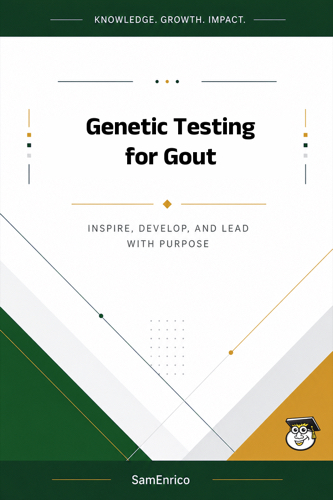
Genetic Testing for Gout eBook
Analyzes SLC2A9 and ABCG2 for uric acid regulation
Analyzes SLC2A9 and ABCG2 for uric acid regulation.
Formats
Free sample
Chapter 1: The DNA Alibi...--The first time I watched a patient’s face change from shame to relief, I was sitting in a small examination room at the University of California, San Francisco’s rheumatology clinic. The patient was a forty-seven-year-old Filipino-American man named Emmanuel. He had flown in from Honolulu after suffering through eleven gout attacks in eighteen months. He had seen four different doctors. He had been placed on three different diets.
He had been told, more than once, that he needed to “control himself.”Emmanuel was not overweight. He did not drink alcohol. He ate a traditional Hawaiian diet rich in fish and taro root, but he had already cut out the foods he thought were causing his problems: the poke bowls, the spam musubi, the occasional birthday cake. Nothing worked. His uric acid level, tested just that morning, was 9.7 milligrams per deciliter.
He had a tophus the size of a marble on his left elbow and another on his right big toe. He could no longer wear closed-toe shoes.The rheumatologist, Dr. Akiyama, pulled up Emmanuel’s genetic test results on her laptop. She had ordered a comprehensive pharmacogenetic panel two weeks earlier, after Emmanuel mentioned that his father and both of his grandfathers had also suffered from gout.“Emmanuel,” she said, turning the screen toward him, “you have two copies of the ABCG2 Q141K variant. That means your body has a very hard time getting rid of uric acid through your gut.
Your kidneys are working fine, but your gut can’t keep up. This is not your fault. This is in your DNA.”Emmanuel stared at the screen. He did not understand the notation—rs2231142, G to T substitution, glutamine to lysine at position 141—but he understood the word “fault.” Or rather, he understood its absence.“So the diets didn’t work,” he said slowly, “because they were targeting the wrong thing?”“Exactly,” Dr. Akiyama said.
“You’ve been trying to reduce how much uric acid you make. But your problem is that you can’t get rid of the uric acid you already have. It’s like having a bathtub with the drain partially blocked. You can turn down the faucet, but the water will still rise if the drain is clogged.”That was the moment. Emmanuel’s shoulders dropped.
His jaw unclenched. He let out a long, slow breath that seemed to carry years of frustration with it.“I thought I was going crazy,” he said. “I thought I was doing something wrong and just didn’t know what it was.”He wasn’t going crazy. He wasn’t doing anything wrong. He had a genetic condition.
And once he knew which gene was involved, the path forward became clear.The Most Important Sentence You Will Read in This Book Before we go any further, I need you to understand one sentence. It is the thesis of this book, the conclusion of thirty years of genetic research, and the foundation of everything that follows. Here it is:Your genes determine approximately sixty to seventy percent of your serum uric acid level. Your diet determines less than one percent.Let that sink in. If you have been blaming yourself for your gout attacks—if you have been torturing yourself with low-purine diets, cutting out every food you love, obsessing over every glass of wine—you have been fighting the wrong battle.
Your genes are the main character in this story. Your diet is an extra.I am not saying that diet has no effect. It does. If you eat an enormous amount of purines—say, a pound of sardines washed down with a six-pack of beer—you can raise your uric acid by one to two milligrams per deciliter for a few hours. That might be enough to trigger an attack in someone who is already on the edge.
But for the vast majority of gout patients, the underlying problem is not what they are eating. It is how their bodies are processing what they eat.This is not my opinion. It is the conclusion of multiple large-scale twin studies, genome-wide association studies, and Mendelian randomization studies. The heritability of gout has been consistently estimated at sixty to seventy percent. The remaining thirty to forty percent is explained by factors like kidney function, body mass index, blood pressure, and yes, diet—but diet is a small slice of that small slice.Let me give you a concrete example.
A study published in the Annals of the Rheumatic Diseases in 2018 followed more than forty-four thousand men over twenty-six years. The researchers calculated a genetic risk score for gout based on known variants, and they also collected detailed dietary data. The men with the highest genetic risk had a gout incidence nearly twelve times higher than the men with the lowest genetic risk, regardless of their diet. Among the men with high genetic risk, dietary factors made almost no difference. They were going to get gout no matter what they ate.This is the DNA alibi.
Your genes are not an excuse. They are an explanation. And once you have the explanation, you can stop punishing yourself and start treating the real problem.The Two-Thousand-Year History of Blaming the Patient The idea that gout is caused by gluttony and drunkenness is ancient. It appears in the writings of Hippocrates, who noted that “eunuchs do not take gout, nor do women become gouty until their menses are stopped.” He was right about the hormonal protection—estrogen really does lower uric acid—but he was wrong about the cause. He believed that gout was a disease of excess, a punishment for indulgence.This belief persisted for two thousand years.
In ancient Rome, the physician Galen described gout as “the disease of kings and the king of diseases.” In medieval Europe, it was associated with the wealthy and the idle. In Victorian England, it was a mark of status: only the rich could afford the rich foods and wines that supposedly caused it.The problem is that this belief was never based on evidence. It was based on observation and prejudice. The rich did get gout more often than the poor, but that was not because they ate more meat. It was because they had different genes.
The rich married the rich, and the children of the rich inherited the genetic variants that had been enriched in their families over generations. The poor, meanwhile, rarely had access to physicians at all, so their gout went undiagnosed and unrecorded.This is a classic example of confounding. The rich had both high genetic risk and high meat consumption. Researchers assumed that the meat was the cause, because they did not know about the genes. It was a reasonable assumption at the time.
But it was wrong. And it caused enormous harm.The harm continues to this day. I have heard from hundreds of gout patients who were told to lose weight, stop drinking, and give up red meat—even when they were not overweight, did not drink, and had already given up red meat. I have heard from patients who were denied urate-lowering therapy because their doctors wanted them to “try…
This is the end of the free sample. Get the eBook to keep going. Buy now
About this book
Details
- Author
- Fountain Morgan
- Publisher
- SamEnrico
- Language
- English
- Genre
- Non-Fiction, Health & Wellness, Rheumatology
- Released
- 2026-06-10
- Pages (approx.)
- 150
- Available as
- eBook, Audiobook

Read better in the ZLOADR app
Your eBooks on your phone or tablet. Sign in with your SamEnrico account and start reading.
More by Fountain Morgan
 Keto For High Blood PressureFountain Morgan$11.99Keto For High Blood PressureFountain Morgan$11.99
 Burnout Recovery Support Group GuideFountain Morgan$11.99
 Self Worth Bullying History GuideFountain Morgan$11.99
 The Silk Road's Secret Diplomat: The Untold Story of Rabban Bar SaumaFountain Morgan$11.99
 The Phantom Draft: How a 1970s NFL Gamble Redefined Football ForeverFountain Morgan$11.99
 Understanding Glaucoma, Primary Infantile Type 3bFountain Morgan$17.99
 Inline Skate TechnicianFountain Morgan$11.99
 I 9 Verification Trap ManualFountain Morgan$12.99
 Consumer Theory ExcelFountain Morgan$12.99
 How to Start a Printing Onto Metal Business (Beginners Guide)Fountain Morgan$11.99
You may also like
 Hong Kong Handover 1997Dunn Johnnie$11.99
 Zumba For Postnatal Recovery CourseNeal Christian$11.99
 Zumba for BeginnersLadner Nikia$11.99
 YouTube Comment Mining GuideHumes Pandora$12.99
 Worry Box MeditationCarlin Rudy$11.99
 Workplace Stress MeditationNguyen Lynn$11.99
 Workplace Stress and Sleep RepairHawley Ivory$11.99
 Workplace Perfectionism CureDelaney Jeffry$11.99
 Workplace Injustice Anger GuideWallen Isabelle$11.99
 Work Addiction and Burnout LinkGreenwood Ester$11.99
 Women in Yoga and WellnessBeattie Galina$11.99
 Women in Stand Up ComedyChun Evangeline$11.99