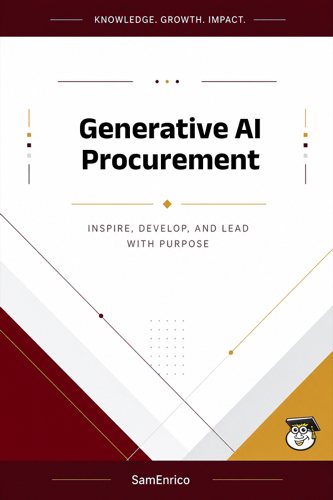
Generative AI Procurement eBook
Use large language models for supplier negotiation
by Goulet Jayne
Use large language models for supplier negotiation and contract generation with this projection.
Formats
Free sample
Chapter 1: The $2 Trillion Blindspot--–- Martine stared at the spreadsheet on her screen, the numbers blurring after ninety straight minutes of analysis. As procurement manager for Med Tech Dynamics, a mid-sized manufacturer of surgical instruments, she had just finished her quarterly supplier review. On paper, everything looked fine. Costs were flat. Delivery times were within tolerance.
Her team had hit their savings targets for the third quarter in a row.But something nagged at her.She pulled up the negotiation notes from the past twelve months—fifty-seven distinct supplier deals, ranging from $50,000 in office supplies to a $4.2 million contract for precision-machined components. As she scanned the pattern, she noticed something disturbing. In thirty-one of those negotiations, her team had made a concession in the first fifteen minutes of the conversation. In twenty-two of them, they had accepted the supplier's first counter-offer without pushing back. And in every single one, they had left the meeting feeling like they had won.Martine knew, with the kind of certainty that came from fifteen years in procurement, that they had left money on the table.
She just couldn't prove it—yet.She opened her laptop and typed a question into a simple chat window: "Based on typical B2B negotiation patterns, what percentage of potential value do buyers leave unrealized in supplier negotiations?"The response came in seconds: *"Research across multiple industries suggests that buyers leave between 8% and 12% of potential deal value unrealized due to cognitive biases, information asymmetry, and lack of real-time decision support. For a mid-sized manufacturing company with $50M in annual supplier spend, this represents $4M to $6M in lost savings every year."*Martine did the math. Med Tech Dynamics spent roughly $47 million annually with external suppliers. Eight percent was $3.76 million. That was not a rounding error.
That was the cost of three new product engineers, or a new manufacturing line, or the marketing budget for a product launch.That was the cost of being human.This chapter introduces the central transformation that every procurement organization must confront: the shift from viewing AI as a simple automation tool to embracing it as a strategic partner in negotiation. We will explore why most procurement teams are leaving millions on the table without realizing it, introduce the framework that separates best-in-class procurement from the rest, and meet the recurring protagonist whose journey will guide us through every chapter of this book.The Hidden Tax of Human Negotiation The problem is not that procurement professionals are unskilled. On the contrary, Martine and her team were highly trained, experienced, and motivated. They had attended negotiation workshops, read the classic texts, and practiced their techniques. The problem was not a lack of competence.
The problem was a set of structural and psychological factors that affect every human negotiator, regardless of experience level.Cognitive Biases That Sabotage Buyers The behavioral economics literature has identified dozens of cognitive biases that distort decision-making in negotiation. In the procurement context, four biases are particularly destructive:Anchoring Bias occurs when the first number mentioned in a negotiation exerts disproportionate influence over all subsequent discussion. When a supplier opens with a price of $100 per unit, every counter-offer from the buyer unconsciously orbits that $100 figure. Research by Tversky and Kahneman, replicated in procurement settings by the Institute for Supply Management, shows that anchoring alone can shift final prices by 20% or more in favor of the party who makes the first offer. Yet procurement professionals are often trained to let suppliers make the first move—a well-intentioned but systematically damaging piece of advice.Confirmation Bias leads buyers to seek out information that confirms their pre-existing beliefs about a supplier while ignoring contradictory evidence.
If Martine believes that a long-standing supplier is "reliable and fair," she will unconsciously discount warning signs like missed delivery dates or quality issues. This bias is particularly dangerous in contract renewals, where incumbency creates a powerful illusion of safety.Loss Aversion means that humans feel the pain of a loss approximately twice as intensely as the pleasure of an equivalent gain. In negotiation, this manifests as excessive risk aversion. Buyers will accept a suboptimal deal rather than risk walking away and ending up with nothing. The supplier knows this.
In fact, experienced supplier negotiators are trained to exploit loss aversion by creating artificial time pressure or threatening to walk away.Overconfidence Effect leads procurement professionals to overestimate their own negotiation ability. In study after study, buyers rate themselves as "above average" negotiators—a statistical impossibility. This overconfidence reduces preparation time, increases reliance on intuition, and makes buyers less likely to seek decision support. Martine's team felt like they were winning. They were not.Information Asymmetry: The Supplier's Unfair Advantage Even without cognitive biases, buyers face a structural disadvantage: the supplier almost always has better information.
The supplier knows their own cost structure, their capacity utilization, their alternative customers, and their walk-away price. The buyer knows none of these things with certainty. They rely on market research, historical data, and guesswork.This information asymmetry is not trivial. Research from the Harvard Business Review on B2B negotiation found that suppliers achieve outcomes that are, on average, 15% more favorable to them than the buyer's objective best alternative would suggest. In plain English: buyers systematically overpay because they lack the data to know what something should cost.The Time Pressure Problem Procurement professionals are overworked.
The average category manager at a mid-sized company handles between forty and sixty supplier relationships simultaneously. They have days, not weeks, to prepare for each negotiation. They cannot read every annual report, analyze every market trend, or simulate every concession scenario. They do the best they can with the time they have—and they consistently leave value on the table because of it.Martine's team spent an average of four hours preparing for each negotiation. That sounds like a lot until you consider what that preparation included: reviewing the last three months of email correspondence (thirty minutes), pulling historical pricing from the ERP system (forty-five minutes), searching for market benchmarks (sixty minutes), and drafting talking points (the remaining time).
They never had time for deep analysis of the supplier's financial health, competitive pressures, or negotiation history. They never had time to practice.And they were among the more prepared teams in their industry.Why Automation Is Not Enough Most procurement technology to date has focused on automation. E-sourcing platforms automate the RFP process. CLM tools automate contract storage and retrieval. ERP systems automate PO generation and invoice matching.
These tools have delivered real efficiency gains. A sourcing event that once took six weeks can now take three. A contract that once took two weeks to approve can now take three days.But automation does not address the core problem. Automation makes existing processes faster. It does not make them smarter.
A buyer with a cognitive bias who uses an automated RFP tool is simply a faster biased buyer. A buyer with information asymmetry who uses an automated contract repository is simply a faster uninformed buyer.The leap that defines the next generation of procurement is not from manual to automated. It is from automated to augmented. This distinction is so critical that it deserves a clear framework.The AAA Framework…
This is the end of the free sample. Get the eBook to keep going. Buy now
About this book
Details
- Author
- Goulet Jayne
- Publisher
- SamEnrico
- Language
- English
- Genre
- Non-Fiction, Forecast & Outlook, GenAI Logistics
- Released
- 2026-06-07
- Pages (approx.)
- 145
- Available as
- eBook, Audiobook

Read better in the ZLOADR app
Your eBooks on your phone or tablet. Sign in with your SamEnrico account and start reading.
More by Goulet Jayne
 Forgiveness After TraumaGoulet Jayne$11.99
 Mindfulness for Couples BeginnersGoulet Jayne$11.99
 Delegation for Home MaintenanceGoulet Jayne$11.99
 Team Creative Space GuideGoulet Jayne$11.99
 Anki Algorithm Deep DiveGoulet Jayne$11.99
 The OKR for Product TeamsGoulet Jayne$11.99
 SCAMPER for BusinessGoulet Jayne$11.99
 The Whispering Savannah: The Lost Naturalist of the Songhai EmpireGoulet Jayne$11.99
 The Great Unplug: How a Remote Village Beat Big TechGoulet Jayne$11.99
 How to Produce QuinoaGoulet Jayne$11.99
 US Business Credit Tiers HandbookGoulet Jayne$12.99
 Marketing Calendar One Page TemplateGoulet Jayne$12.99