
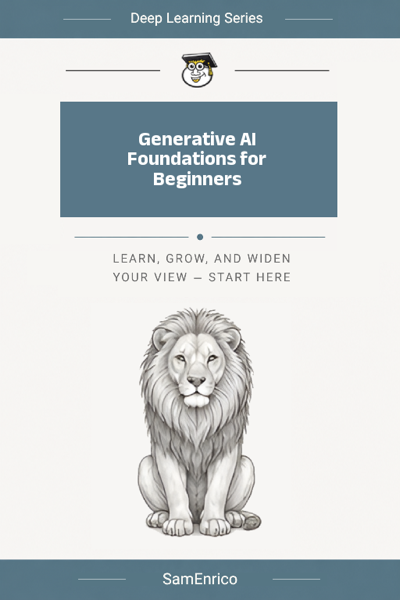
Non-FictionInformativeEducational
Generative AI Foundations for Beginners eBook
A Coursebook on Generative AI Foundations for Begi
A Coursebook on Generative AI Foundations for Beginners
Formats
Free sample
Chapter 1: The Silicon Muse...--– In the winter of 2022, something shifted in the collective consciousness of the human species. It wasn't a moon landing, a declaration of war, or the launch of a new smartphone. It was a chat box. A simple, unassuming interface with a blinking cursor that invited you to type anything. And when you did, something that had never happened before occurred: a machine talked back to you not as a broken toy or a scripted assistant, but as a curious, knowledgeable, occasionally mistaken, and remarkably creative entity.
Within five days of its release, Chat GPT had over one million users. By comparison, Instagram took two and a half months to reach that same milestone, and Netflix took three and a half years. This wasn't just another app launch. This was the public's first true encounter with Generative AI, and it forever divided history into two eras: before the conversational AI and after.This book is not about becoming a machine learning researcher or a Ph.D. in computer science.
It is a coursebook for everyone else—the curious professional, the aspiring creator, the entrepreneur, the student, and the concerned citizen. By the time you finish this chapter, you will understand not just what Generative AI is, but why it matters to you. You will see the clear lines separating Artificial Intelligence, Machine Learning, Deep Learning, and the specific creative subset that is changing everything. You will walk away with a mental map of the terrain ahead and a tangible sense of what this coursebook will enable you to build, use, and critique. Let us begin not with code or complex math, but with a story.The Day the Factory Moved Inside the Mind Before Generative AI, the world of artificial intelligence was largely a world of prediction, classification, and pattern-matching.
When you typed a destination into a navigation app, an analytical AI calculated the fastest route. When your email service filtered spam into a separate folder, an analytical AI examined thousands of past emails to decide which new ones were junk. When Netflix recommended a movie, an analytical AI compared your viewing history against millions of other users to guess what you would enjoy next. These were powerful, world-changing technologies, but they were all doing fundamentally the same kind of work: taking existing information and making a decision or a prediction about it. They were the factory workers of the digital age, sorting, labeling, and organizing the endless flow of data.Then came Generative AI, and the factory moved inside the machine's own imagination.
Instead of sorting existing photographs, a generative model could invent a photograph of a cat wearing a spacesuit on Mars—a picture that had never existed before. Instead of predicting the next word in a sentence, a generative model could write an entire poem in the voice of Emily Dickinson about the joys of electric cars. Instead of classifying a piece of music as jazz or classical, a generative model could compose a new piece that blended both genres in ways no human had ever conceived. For the first time, machines were not just analyzing or describing reality; they were contributing to it. They had become creators.This distinction between Analytical AI (extracting insights from existing data) and Generative AI (producing entirely new data) is the single most important conceptual split to understand.
An analytical model looks at a chest X-ray and says, "There is a 90% probability this is pneumonia." A generative model looks at thousands of chest X-rays and then produces a new, synthetic X-ray of a healthy lung that can be used to train medical students. One judges; the other imagines. One categorizes; the other composes. One answers "what is this?" while the other answers "what if?"The Great Hierarchy: AI, ML, Deep Learning, and Gen AILet us pause to build a clear, layered understanding of these terms. They are often used interchangeably in the media, but they have precise meanings, and confusing them is like calling a skyscraper a brick—technically related, but missing the crucial distinctions.Artificial Intelligence (AI) is the widest, most inclusive circle.
It is the grand ambition of creating machines that can perform tasks that normally require human intelligence. This includes everything from a chess-playing program in the 1990s to a self-driving car today to a chatbot that tells jokes. AI is the dream; it is the field of study founded at a famous workshop at Dartmouth College in 1956.Machine Learning (ML) is a subset of AI. Instead of programming a computer with explicit, step-by-step rules for every possible situation (an approach called "good old-fashioned AI"), machine learning gives the computer the ability to learn from data. You show the computer thousands of examples, and it figures out the underlying patterns on its own.
This is why spam filters can adapt to new tricks without being reprogrammed line by line. Nearly all of modern AI, including the generative tools we are discussing, sits inside this machine learning paradigm.Deep Learning is a subset of machine learning, and it is the real engine of the current revolution. Deep learning uses artificial neural networks with many layers (hence "deep") inspired loosely by the structure of the human brain. These multi-layered networks are remarkably good at finding patterns in messy, high-dimensional data like images, audio, and human language. If machine learning is a general toolbox, deep learning is the power drill—more specialized, more powerful, and responsible for most of the breakthroughs of the last decade.Generative AI is a subset of deep learning.
It uses those deep neural networks not just to recognize patterns but to generate new instances that follow those patterns. A deep learning model trained on ten thousand pictures of cats learns to recognize a cat. A generative AI model trained on those same ten thousand pictures learns to draw a new cat that has never existed. Generative AI sits at the very tip of this four-layer pyramid: AI → ML → Deep Learning → Generative AI. It is the most specialized, the most recent, and in many ways the most surprising.A Complete and Accurate History (Including the Missing Piece)To understand where we are, you need to know how we got here.
The story of Generative AI is not a straight line but a series of breakthroughs, dead ends, and rediscoveries. The history presented here is complete and will align with every subsequent chapter in this book, including our later discussion of Variational Autoencoders (VAEs), which are often omitted from popular accounts.The Dawn: Autoencoders (1980s–2000s). The earliest attempts at generation used a simple architecture called an autoencoder. Imagine trying to compress a high-resolution photograph into a tiny summary code (the encoder) and then reconstruct the photograph from that summary (the decoder). If the reconstruction is good enough, the model has learned a compact representation of the image.
The problem is that early autoencoders were not truly creative; they could only reconstruct variations of what they had already seen, not generate entirely new samples from scratch.The First True Generator: Variational Autoencoders (VAEs) – 2013. In 2013, Diederik Kingma and Max Welling introduced a crucial innovation: the Variational Autoencoder. A VAE still compresses data into…
This is the end of the free sample. Get the eBook to keep going. Buy now
About this book
Details
- Author
- Dancy Deangelo
- Publisher
- SamEnrico
- Language
- English
- Genre
- Non-Fiction, Informative, Educational
- Released
- 2026-05-04
- Pages (approx.)
- 152
- Available as
- eBook, Audiobook

Read better in the ZLOADR app
Your eBooks on your phone or tablet. Sign in with your SamEnrico account and start reading.
More by Dancy Deangelo
 Spending Triggers at WorkDancy Deangelo$11.99
 The Physics Nobel TopologyDancy Deangelo$11.99
 Elder Financial Planning GuideDancy Deangelo$11.99
 Nobel Laureates In CRISPR TechnologyDancy Deangelo$11.99
 Spatial Invasion as DominanceDancy Deangelo$11.99
 Sam Bankman Fried FTXDancy Deangelo$11.99
 Denali National Park MysteriesDancy Deangelo$11.99
 Beginner Mindfulness Of PainDancy Deangelo$11.99
 The Curse of the Diadochi: Ghosts of the Successors' WarDancy Deangelo$11.99
 Steel and Steam: The Titans of IndustryDancy Deangelo$11.99
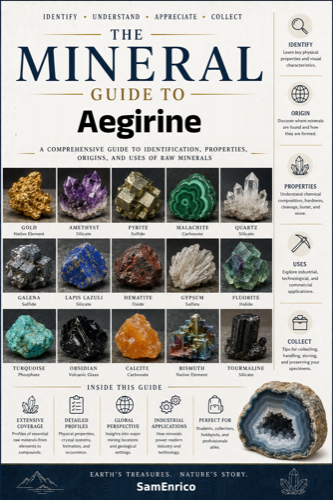 The Mineral Guide to AegirineDancy Deangelo$11.99
 How to Become a Brim RaiserDancy Deangelo$11.99
You may also like
 Hong Kong Handover 1997Dunn Johnnie$11.99
 Zumba For Postnatal Recovery CourseNeal Christian$11.99
 Zumba for BeginnersLadner Nikia$11.99
 YouTube Comment Mining GuideHumes Pandora$12.99
 Worry Box MeditationCarlin Rudy$11.99
 Workplace Stress MeditationNguyen Lynn$11.99
 Workplace Stress and Sleep RepairHawley Ivory$11.99
 Workplace Perfectionism CureDelaney Jeffry$11.99
 Workplace Injustice Anger GuideWallen Isabelle$11.99
 Work Addiction and Burnout LinkGreenwood Ester$11.99
 Women in Yoga and WellnessBeattie Galina$11.99
 Women in Stand Up ComedyChun Evangeline$11.99