
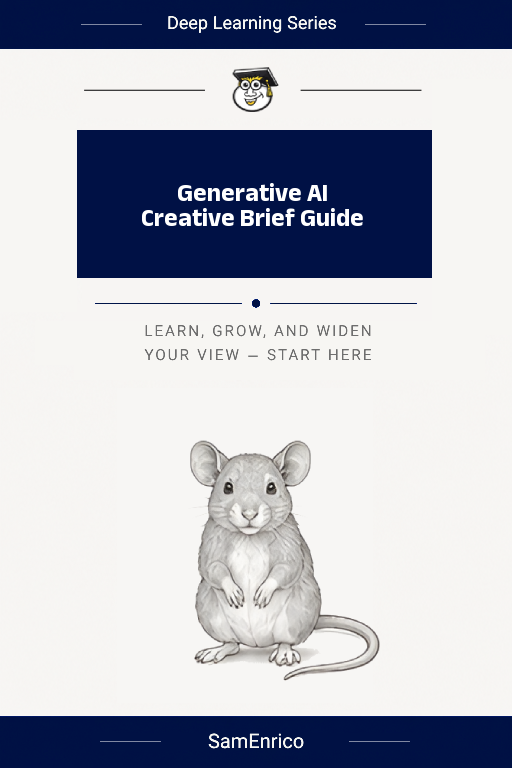
Non-FictionAI OperatorCreative Direction
Generative AI Creative Brief Guide eBook
Generate comprehensive creative briefs for designe
Generate comprehensive creative briefs for designers and agencies using AI.
Formats
Free sample
Chapter 1: The Bob Principle--–- It was 3:47 on a Tuesday afternoon when Sarah, a creative director with fifteen years of experience, finally admitted defeat. She had spent the last ninety minutes feeding prompts into Midjourney, generating forty-seven variations of a hero image for a luxury watch client. None of them worked. The first batch looked like stock photography from 2012. The second batch leaned too futuristic, all chrome and neon.
The third batch somehow merged the watch with a pineapple. She wasn't sure how. Neither was the AI. She had tried everything—adding "elegant," removing "elegant," typing in all caps, typing in lowercase, even politely asking "please." The results ranged from mediocre to hallucinatory.Sarah closed her laptop, stared at the ceiling of her Brooklyn apartment, and whispered a question that has been uttered in creative departments everywhere since generative AI went mainstream: "Why can't it just read my mind?"The answer, which this entire book exists to deliver, is both simple and brutal: because you wouldn't ask a human designer to read your mind, and AI is no different.Welcome to the single most important concept you will learn in these pages. I call it the Bob Principle.The Bob Principle: If You Wouldn't Say It to Bob, Don't Say It to AIImagine you have a talented junior designer named Bob.
Bob has a degree from a respectable art school. Bob knows the difference between kerning and tracking. Bob has seen a lot of good work and a lot of bad work. Bob wants to impress you. Bob also has absolutely no idea what you mean when you say "make it pop."If you walked up to Bob and said, "Hey, I need a logo.
Make it modern," Bob would stare at you. Then Bob would ask a series of increasingly uncomfortable questions: "What do you mean by modern? Like Bauhaus modern? Swiss modern? Mid-century modern?
Tech-startup modern? What industry is this for? Who is the audience? What colors does the client like? What colors do they hate?
Is there an existing brand identity? Can I see examples of modern logos you like? Can I see examples of modern logos you hate? What's the budget? What's the deadline?
Is this for print, web, or both? How will it be used? Can you give me something to start from? Please? Anything?"Bob asks these questions because Bob is a human being who knows his limitations.
Bob knows he cannot read your mind. Bob knows that "modern" could mean a thousand different things across a thousand different contexts. Bob has been burned before by vague directives and has learned—often the hard way—that asking clarifying questions upfront saves everyone from misery later.Now imagine you sit down at your computer, open an AI image generator, and type the exact same words: "Make a modern logo."The AI will not stare at you. The AI will not ask clarifying questions. The AI will not wonder if you meant Bauhaus or tech-startup.
The AI will not request examples or context or budget or deadline. The AI will simply generate something—almost instantly—based on the statistical average of every "modern logo" it has ever seen in its training data.And what is the statistical average of every modern logo? It is generic. It is forgettable. It is the design equivalent of beige paint.
It might be technically competent. It will almost certainly be wrong for your specific needs.This is the Bob Principle: If you wouldn't say it to Bob, don't say it to AI.The Bob Principle is not a metaphor. It is a practical test that you can apply to any prompt, any brief, any direction before you send it to an AI tool. Ask yourself: If I said these exact words to a human designer I respected, would they know exactly what to do? Would they need more information?
Would they be confused, frustrated, or annoyed? If the answer is anything other than "yes, they would know exactly what to do," then your prompt is not ready for AI.The Great Misconception: Why Smart People Keep Getting This Wrong Before we go any further, let me acknowledge something uncomfortable. You are smart. The people reading this book are smart. Creative directors, agency strategists, in-house designers—these are not people who lack communication skills.
So why does almost everyone struggle with AI briefing at first?Because we have been conditioned by a lifetime of interacting with other humans.Human communication is built on a foundation of shared context, implicit understanding, and constant feedback loops. When you say "make it pop" to a human designer, they might roll their eyes, but they will also probably figure out what you mean. They know your taste from previous projects. They know the client's brand voice from the brief you sent last week. They can see your facial expression and hear your tone of voice.
They can ask follow-up questions. They can show you three options and watch which one makes you nod.AI has none of this. None.An AI model has no memory of your previous projects unless you explicitly provide that context in the prompt. It cannot see your face. It cannot hear your tone.
It cannot ask follow-up questions (unless you design a multi-step workflow that includes question-asking, which we will cover in Chapter 4). It cannot watch you nod. It has no intuition about what you meant versus what you said.What an AI model has is pattern recognition at massive scale. It has seen millions of images and billions of words. It knows, statistically, what tends to follow what.
When you type "make it pop," the AI is not thinking about contrast, hierarchy, or visual energy. It is thinking: "In the training data, the phrase 'make it pop' is often associated with bright colors, drop shadows, and high saturation." So that is what it gives you.This is not intelligence. This is sophisticated pattern matching. And pattern matching, no matter how sophisticated, cannot read your mind.I call this the mind-reading fallacy—the deeply ingrained but completely wrong assumption that because AI produces human-like outputs, it must have human-like understanding. It does not.
Large language models and image generators are prediction engines, not understanding engines. They are exceptionally good at guessing what word or pixel should come next based on statistical probability. They are exceptionally bad at grasping context, intent, or meaning.Let me say that again because it is the most important sentence in this chapter: AI is a prediction engine, not an understanding engine.Once you internalize this, everything changes. You stop expecting AI to read your mind. You stop getting frustrated when it produces garbage.
You start doing the work that AI cannot do—the work of providing clear, specific, structured direction. And when you do that work, AI becomes an extraordinarily powerful tool instead of an endlessly disappointing one.The Economics of Briefing: Why 30 Minutes Saves 3 Hours There is a second reason smart people struggle with AI briefing, and it is not cognitive. It is economic.Most creative professionals operate under insane time pressure. The client wants the work yesterday. The account team promised a turnaround that…
This is the end of the free sample. Get the eBook to keep going. Buy now
About this book
Details
- Author
- Merchant Janita
- Publisher
- SamEnrico
- Language
- English
- Genre
- Non-Fiction, AI Operator, Creative Direction
- Released
- 2026-05-29
- Pages (approx.)
- 151
- Available as
- eBook, Audiobook

Read better in the ZLOADR app
Your eBooks on your phone or tablet. Sign in with your SamEnrico account and start reading.
More by Merchant Janita
 Worry Time Containment PracticeMerchant Janita$11.99
 The Working Memory for SeniorsMerchant Janita$11.99
 Post Acute Withdrawal Syndrome HelpMerchant Janita$11.99
 The Guilt ThermometerMerchant Janita$11.99
 Gratitude for Comparison CureMerchant Janita$11.99
 Purpose For Illness GuideMerchant Janita$11.99
 Islamic Medicine Golden AgeMerchant Janita$11.99
 Divorce and Alimony GuideMerchant Janita$11.99
 The Ghost of the Great North Road: Kenya's Prohibition-Era VigilantesMerchant Janita$11.99
 The Bloodied Fields of Nördlingen: Sweden’s Last Stand in the Thirty Years' WarMerchant Janita$11.99
 How to Produce Motorcycle Helmet Parts and AccessoriesMerchant Janita$11.99
 Co Founder Reddit CommunitiesMerchant Janita$12.99
You may also like
 Hong Kong Handover 1997Dunn Johnnie$11.99
 Zumba For Postnatal Recovery CourseNeal Christian$11.99
 Zumba for BeginnersLadner Nikia$11.99
 YouTube Comment Mining GuideHumes Pandora$12.99
 Worry Box MeditationCarlin Rudy$11.99
 Workplace Stress MeditationNguyen Lynn$11.99
 Workplace Stress and Sleep RepairHawley Ivory$11.99
 Workplace Perfectionism CureDelaney Jeffry$11.99
 Workplace Injustice Anger GuideWallen Isabelle$11.99
 Work Addiction and Burnout LinkGreenwood Ester$11.99
 Women in Yoga and WellnessBeattie Galina$11.99
 Women in Stand Up ComedyChun Evangeline$11.99