
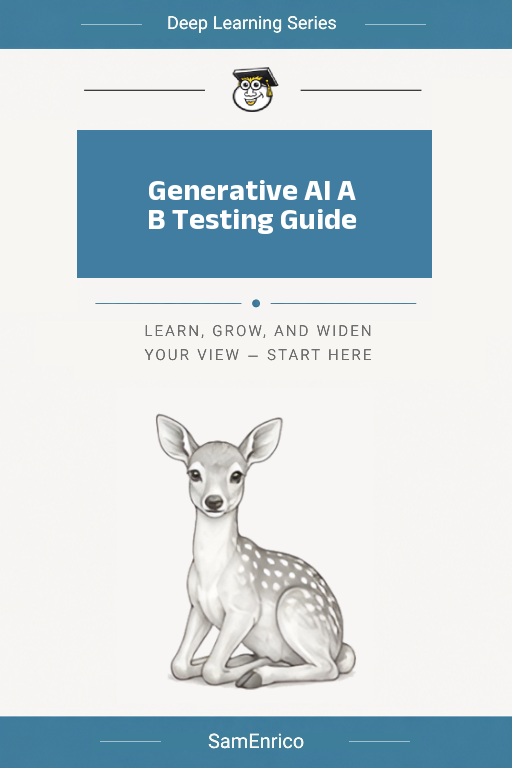
Non-FictionAI OperatorA B Testing
Generative AI A B Testing Guide eBook
Generate dozens of ad and email variants for rapid
by Pond Lavette
Generate dozens of ad and email variants for rapid A B testing with AI.
Formats
Free sample
Chapter 1: The Creation Bias--The marketing director stared at her screen in disbelief. Two weeks of work. Fourteen days of late nights, endless revisions, and the kind of perfectionism that had earned her a promotion last year. She had crafted what she believed was the perfect Facebook ad. The copy was clever.
The angle was fresh. The call-to-action was poetry. She had shown it to five colleagues, and all five had nodded approvingly.Then she launched the test.The control—a plain, almost boring ad she had thrown together in ten minutes while waiting for coffee—won by 300 percent.Three. Hundred. Percent.She had done everything right.
She had followed every best practice. She had written for her audience, tested for clarity, and polished every word until it gleamed. And yet, the ad she had barely thought about crushed the ad she had poured her soul into.This is not an anomaly. This happens every single day in marketing departments around the world. And it reveals a fundamental truth that most marketers refuse to accept: your judgment about what makes good copy is almost worthless.
The data is the only judge that matters.This book exists because the marketing world has shifted. The question is no longer "Can AI write copy?" That battle is over. AI can write copy—faster, cheaper, and at a volume that would have been unthinkable three years ago. The new question is: "How do we systematically test which AI copy actually works?"You are about to learn a systematic, repeatable, data-driven method for generating dozens—sometimes hundreds—of ad and email variants and letting statistics, not intuition, choose the winner. By the time you finish this chapter, you will understand why your gut has been lying to you.
By the time you finish this book, you will never launch another untested campaign again.The Myth of the Perfect Ad Every marketer suffers from what I call Creation Bias. It is the deeply ingrained belief that more time spent crafting copy leads to better performance. We assume that if we just find the right words, the perfect angle, the ideal turn of phrase, the market will respond. We treat copywriting like sculpture—chipping away at a block of marble until the masterpiece emerges.This is wrong.Performance is not a function of craftsmanship. It is a function of fit.
The question is not "Is this copy good?" The question is "Does this copy fit this specific audience at this specific moment in their decision journey?"A piece of copy that converts at 8 percent for one segment might convert at 1 percent for another. A headline that works on Monday might fail on Friday. An offer that resonates with first-time visitors might annoy returning customers. The variability is endless, and your intuition cannot account for it.Creation Bias manifests in predictable ways. You spend hours agonizing over a single word choice.
You rewrite the same sentence seventeen times. You show your draft to colleagues who, wanting to be supportive, offer gentle tweaks rather than honest criticism. You fall in love with your own cleverness. And then you launch a single ad—or maybe two variants if you are feeling ambitious—and pray.The data arrives. The ad flops.
You blame the algorithm, the audience, the phase of the moon. But the real culprit is your belief that your judgment could substitute for a test.The Paradox of Choice in Reverse There is a famous psychological concept called the Paradox of Choice. It suggests that too many options paralyze decision-makers. This is true for consumers choosing jam flavors. It is not true for marketers testing ad copy.Marketers suffer from the opposite problem: too few choices.
With only one or two ad variants, you cannot know if a different angle would have won. You are not making a choice among good options. You are guessing and hoping.Consider what happens in a typical marketing department. A copywriter is asked to write an email. They write one version.
Maybe, if there is time, they write a second version with a different subject line. They launch. They get a 2 percent open rate and a 0.5 percent click-through rate. They declare the campaign a success because those numbers are "within industry average." But here is the question they never ask: What if a completely different angle—not a tweaked version of the same idea, but a structurally different approach—would have gotten 5 percent opens and 2 percent clicks? They will never know.
They never tested it.AI collapses this limitation. A single prompt can generate fifty subject lines in thirty seconds. You are no longer constrained by human writing speed or creative energy. Your only constraint is your ability to design good experiments.The shift is profound. Instead of asking "Which headline is better between these two?" you can ask "Which category of headline—urgency, curiosity, benefit-driven, social proof—wins for this segment?" Instead of testing small differences like "Save 20 percent" versus "Get 20 percent off," you can test structural differences like feature-focused versus emotion-focused.This is not incremental improvement.
This is a complete reimagining of what marketing testing can be.Why Traditional A/B Testing Is Broken You have probably run A/B tests before. You might even feel proud of your testing culture. But let me ask you a question: How many variants do you typically test? Two? Three?
Four on a good day?Traditional A/B testing is broken for three reasons.First, manual variant writing is slow. A competent copywriter needs two to three days to produce two to four genuinely distinct variants. That timeline assumes they are not also working on other projects. In reality, most copywriters are juggling multiple campaigns, so that two-to-three-day timeline stretches into a week or more. By the time the test launches, the market has shifted, the offer has changed, or the campaign has lost momentum.Second, human writers suffer from anchoring.
Once a writer lands on a core idea—a theme, an angle, a hook—they find it almost impossible to generate truly different alternatives. They rewrite the same sentence. They swap synonyms. They change the order of paragraphs. But they rarely step back and ask "What if we led with a question instead of a statement?" or "What if we used fear instead of excitement?" The anchor holds them in place.Third, and most damaging, traditional testing incentivizes small differences.
When you have only two variants, you cannot afford to test radical differences because the risk is too high. What if the wild, creative, risky variant fails completely? You would have wasted the entire test. So you play it safe. You test "Save 20 percent" against "Get 20 percent off." You test "Learn More" against "Shop Now." These tests produce winners, yes, but the winners are rarely transformative.
You are optimizing for tiny marginal gains while ignoring the possibility of step-change improvements.AI removes all three barriers. Generation is instant, so time is no longer an excuse. AI has no anchor—it can generate structurally different variants because it has no attachment to any single idea. And because you can generate fifty variants, you can afford to include ten wild, risky, creative variants alongside forty safe ones. If…
This is the end of the free sample. Get the eBook to keep going. Buy now
About this book
Details
- Author
- Pond Lavette
- Publisher
- SamEnrico
- Language
- English
- Genre
- Non-Fiction, AI Operator, A B Testing
- Released
- 2026-06-01
- Pages (approx.)
- 129
- Available as
- eBook, Audiobook

Read better in the ZLOADR app
Your eBooks on your phone or tablet. Sign in with your SamEnrico account and start reading.
More by Pond Lavette
 Meditation for ClaustrophobiaPond Lavette$11.99
 LGBTQ+ Alcohol Recovery GuidePond Lavette$11.99
 The Career Change Self Esteem GuidePond Lavette$11.99
 The Memory Research ReviewPond Lavette$11.99
 Sudden Spouse Death GriefPond Lavette$11.99
 Legacy Purpose ManifestoPond Lavette$11.99
 Islamic Agriculture GuidePond Lavette$11.99
 Job Search After FiringPond Lavette$11.99
 The Last Letter: Ernest Hemingway's Lost WordsPond Lavette$11.99
 Falkenhayn's Gamble: The Verdun Bloodbath and the Art of AttritionPond Lavette$11.99
 How to Produce Motorcycle Protective GearPond Lavette$11.99
 How to Produce Mining MachineryPond Lavette$11.99
You may also like
 Hong Kong Handover 1997Dunn Johnnie$11.99
 Zumba For Postnatal Recovery CourseNeal Christian$11.99
 Zumba for BeginnersLadner Nikia$11.99
 YouTube Comment Mining GuideHumes Pandora$12.99
 Worry Box MeditationCarlin Rudy$11.99
 Workplace Stress MeditationNguyen Lynn$11.99
 Workplace Stress and Sleep RepairHawley Ivory$11.99
 Workplace Perfectionism CureDelaney Jeffry$11.99
 Workplace Injustice Anger GuideWallen Isabelle$11.99
 Work Addiction and Burnout LinkGreenwood Ester$11.99
 Women in Yoga and WellnessBeattie Galina$11.99
 Women in Stand Up ComedyChun Evangeline$11.99