
Non-FictionConsumer Mind ReportCredit Economics
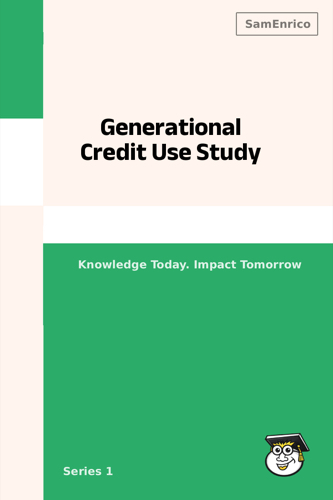
Generational Credit Use Study eBook
Compares Boomer debt aversion and card payoff vers
Compares Boomer debt aversion and card payoff versus Gen Z BNPL and revolving utilization.
Formats
Free sample
Chapter 1: The $17 Question...--–- The first time I understood that debt had generations, not just dollars, I was sitting in a coffee shop watching a father and daughter argue across a cappuccino. He was maybe sixty-two, silver at the temples, wearing a watch that looked paid off. She was twenty-three, phone-faced, mid-scroll, wearing nothing that suggested she had ever balanced a checkbook. The fight was about a concert ticket. Four hundred dollars.
She had bought it using something called Afterpay. He had just discovered the payment schedule on her phone. Four installments of one hundred dollars. The first had already hit her account. The next three were pending.
He was not angry about the concert. He was angry about the structure. "You don't understand," he kept saying, his voice climbing. "This is how it starts. This is exactly how it starts." She looked up from her phone, genuinely confused.
"Starts what?" she said. "It's four payments. I know exactly when they're due. What's the problem?"That question—what's the problem—is the subject of this book.The father saw debt as a trap. The daughter saw debt as a schedule.
Neither was wrong. Neither was entirely right. But they were speaking different languages, shaped by different economies, different technologies, and different definitions of what money is for. The father grew up in an era when credit card interest hit twenty-one percent and minimum payments could stretch a couch purchase into a decade of servitude. The daughter grew up with a smartphone in her hand, watching her friends check out with Klarna and Affirm and Pay Pal Pay in 4, watching them spread the cost of a flight or a dress or a dinner over six weeks with no interest and no apparent consequence.
The father had been taught that carrying a balance was a moral failure. The daughter had never been taught anything about balances at all. She had been taught user experience.This book is called The Credit Divide, and it is about the collision of two fundamentally different ways of understanding debt. It is about the Baby Boomer generation, raised in the shadow of high inflation and higher interest rates, who learned to fear revolving credit the way some people learn to fear fire. And it is about Generation Z, raised in the glow of the smartphone, who have largely rejected the plastic card in favor of Buy Now, Pay Later products that feel less like debt and more like a budgeting feature.
The divide between them is not just about money. It is about psychology, technology, status, and trust. It is about whether debt is something you carry or something you schedule. And it is about what happens when those two worldviews collide in the same household, the same economy, and the same regulatory vacuum.This chapter introduces the central question that will drive the next eleven chapters. It is a simple question, disguised as a small one.
You could call it the Seventeen Dollar Question, because that is what it often looks like on a statement: four payments of seventeen dollars for a latte and a pastry. But the seventeen dollars is a mask. Behind it is a four-trillion-dollar transformation in how a generation thinks about credit, cash flow, and the future. Understanding that transformation requires understanding where the two sides came from, why they trust different institutions, and what each is willing to risk.The Two Standards Let us name the two poles clearly, because throughout this book we will return to them again and again. On one side is the Boomer Standard.
On the other is the Gen Z Standard. Neither is a monolith—there are Boomers who love BNPL and Gen Z who carry credit card balances—but as statistical and cultural averages, they point in opposite directions.The Boomer Standard treats credit as a tool for planned, large purchases with a heavy emphasis on rewards. The typical Boomer credit card user carries a card not because they need the float but because they want the points. They pay the balance in full every month—this is the crucial detail that popular accounts often miss—and they view the card as a payment intermediary, not a source of financing. When a Boomer uses a credit card, they are thinking about the rewards first and the interest rate not at all, because they never pay interest.
The fear is not the card. The fear is the balance. Carrying a balance from one month to the next is, for most Boomers, a violation of a deep psychological rule. It feels like failure. It feels like the first step toward the revolving trap that trapped their parents or their neighbors in the 1980s.The Gen Z Standard treats credit as a utility for managing short-term cash flow with an emphasis on transparency.
The typical Gen Z credit user—and note that I say credit user, not credit card user—prefers Buy Now, Pay Later products because they offer fixed installments, no variable APR, and a clear endpoint. Where the Boomer sees a credit card statement with a minimum payment, a due date, and a terrifyingly low number that promises decades of interest, the Gen Z user sees a BNPL dashboard: "You owe $25 on May 15, $25 on June 1, $25 on June 15, $25 on July 1." Four payments. Visible. Finite. Over.
The psychological difference is enormous. A revolving balance is an open loop. An installment plan is a closed loop. One creates anxiety about the future. The other creates certainty about the present.The data supports this split.
In a major survey of consumer credit behavior, seventy-six percent of Boomers reported using credit cards for summer travel, compared to just fifty-three percent of Gen Z. That gap is not small. It represents a fundamental shift in which tool consumers reach for when they need to spend money they do not have in their checking account at that exact moment. The Boomer reaches for plastic. The Gen Z reaches for a button on a checkout screen that says "Pay in 4."But here is the nuance that the headlines miss.
Most Boomers do use credit cards. They use them frequently. They are not debt-avoidant in the sense that they shun plastic. They are debt-avoidant in the specific sense that they shun revolving debt. The credit card is a convenience tool, a rewards engine, a fraud shield.
It is not a loan. The moment it becomes a loan—the moment they carry a balance—they have crossed a line. For Gen Z, that line does not exist in the same place. Or rather, it exists in a different place. The line for Gen Z is not between paying in full and carrying a balance.
The line is between predictable installments and unpredictable interest. BNPL offers predictable installments. Credit cards, with their variable APRs and complex statement cycles, offer unpredictability. The Gen Z user is not afraid of debt. They are afraid of surprise.The Generational Rewiring This is not a phase.
It is not something Gen Z will grow out of when they get older and acquire mortgages and children and the other signifiers of adult financial responsibility. The evidence suggests that credit preferences are…
This is the end of the free sample. Get the eBook to keep going. Buy now
About this book
Details
- Author
- Brumfield Chanda
- Publisher
- SamEnrico
- Language
- English
- Genre
- Non-Fiction, Consumer Mind Report, Credit Economics
- Released
- 2026-06-08
- Pages (approx.)
- 136
- Available as
- eBook, Audiobook

Read better in the ZLOADR app
Your eBooks on your phone or tablet. Sign in with your SamEnrico account and start reading.
More by Brumfield Chanda
 Vitamin K2 Calcium GuideBrumfield Chanda$11.99
 Nagorno Karabakh EscapeBrumfield Chanda$11.99
 Word Finding Difficulty GuideBrumfield Chanda$11.99
 Gacy Burial Removal ProcessBrumfield Chanda$11.99
 Behavioral Therapy Quit PlanBrumfield Chanda$11.99
 IBS And Mast Cell ActivationBrumfield Chanda$11.99
 Night Stalker Elderly VictimsBrumfield Chanda$11.99
 The Man Who Forgot His Name: The Bizarre Case of Henry MolaisonBrumfield Chanda$11.99
 The Deep Blue Philanthropists: Black Visionaries Who Built Empires Beneath the WavesBrumfield Chanda$11.99
 How to Start a Air-transport Equipment Renting With Operator, for Scheduled Passenger TransportationBrumfield Chanda$11.99
 Understanding Post-polio SyndromeBrumfield Chanda$11.99
 Ransomware Vulnerability AssessmentBrumfield Chanda$12.99
You may also like
 Hong Kong Handover 1997Dunn Johnnie$11.99
 Zumba For Postnatal Recovery CourseNeal Christian$11.99
 Zumba for BeginnersLadner Nikia$11.99
 YouTube Comment Mining GuideHumes Pandora$12.99
 Worry Box MeditationCarlin Rudy$11.99
 Workplace Stress MeditationNguyen Lynn$11.99
 Workplace Stress and Sleep RepairHawley Ivory$11.99
 Workplace Perfectionism CureDelaney Jeffry$11.99
 Workplace Injustice Anger GuideWallen Isabelle$11.99
 Work Addiction and Burnout LinkGreenwood Ester$11.99
 Women in Yoga and WellnessBeattie Galina$11.99
 Women in Stand Up ComedyChun Evangeline$11.99