
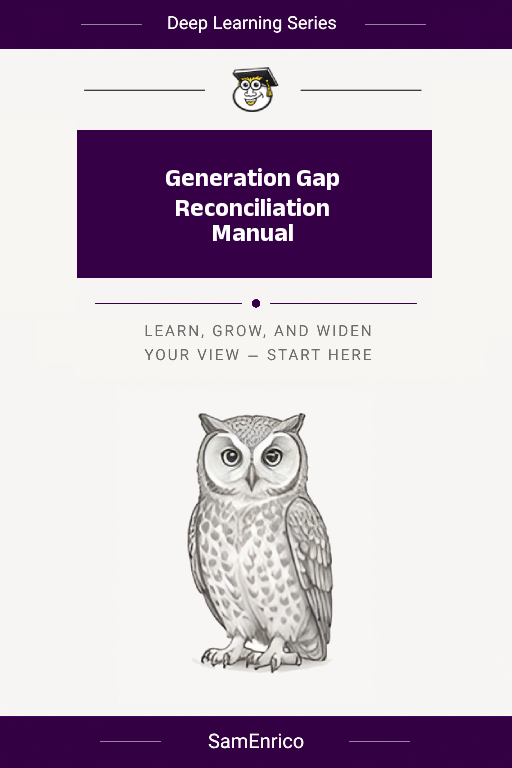
Non-FictionMental WealthCultural CompetenceGeneration Guide
Generation Gap Reconciliation Manual eBook
Seek therapy without alienating parents or elders
Seek therapy without alienating parents or elders who dismiss mental health as Western or shameful. Covers code-switching, gradual normalization, and involving trusted third parties.
Formats
Free sample
Chapter 1: The Loyalty Bind...--–- Mariam is thirty-eight years old. She is a corporate litigator who has won cases against billion-dollar firms. She owns a two-bedroom apartment in a city she never thought she would afford. She has a therapist she sees every Tuesday at 4:00 PM via a secure video link. And she has not told her mother about any of it.Not the apartment.
Not the promotion. And certainly not the therapist.Every Tuesday at 4:30 PM, immediately after her session ends, Mariam calls her mother. The conversation follows the same script it has followed for fifteen years. Her mother asks if she has eaten. Mariam says yes.
Her mother asks if she is working too hard. Mariam says no. Her mother asks if she is seeing anyone. Mariam says she is too busy. Her mother sighs.
Mariam changes the subject to the weather. They hang up. Mariam stares at her phone and feels something she cannot name—a tightness in her chest that her therapist calls grief and that her mother would call ingratitude.Mariam is not a failure. She is not weak. She is not confused about her culture or her identity.
She is trapped in something that this book will name in the first chapter, dissect in the second, and spend the remaining ten chapters teaching you how to loosen, if not escape.She is trapped in the Loyalty Bind.What the Loyalty Bind Actually Is The Loyalty Bind is not a fancy clinical term for "my parents don't understand me." It is a specific, deeply embedded psychological contract that operates in collectivist cultures—particularly immigrant, diaspora, and traditional conservative households. Here is the contract in its simplest form:The family is a closed, self-healing system. Bringing in an outsider to fix a family problem implies that the family is broken. If the family is broken, then the parents failed. If the parents failed, then the sacrifices they made—migration, long hours, separation from their own parents—were for nothing.
Therefore, you will not bring in an outsider. You will suffer in silence. And you will call it love.This is not a choice. It is a inheritance.In individualist cultures (most Western societies), the self is the primary unit. If an individual struggles, they seek help.
That help does not reflect on the family's worth. In collectivist cultures (spanning South Asia, the Middle East, East Asia, Africa, Latin America, and much of Southern and Eastern Europe), the family is the primary unit. An individual's struggle is the family's struggle. An individual's healing, if done outside the family, is the family's shame.This is why Mariam cannot tell her mother about her therapist. Not because her mother is cruel or ignorant.
Because her mother would hear the word "therapist" and translate it unconsciously into a sentence that sounds like this: "My daughter needed help. She did not come to me. She went to a stranger. Therefore, I am not enough. Therefore, my life's work—leaving my country, learning a new language, working double shifts—was insufficient to keep my child whole."Mariam is not accusing her mother of anything.
But the structure of the Loyalty Bind does not require an accusation. It requires only the presence of an outsider. The presence itself is the indictment.Ishq vs. Trust: Two Different Languages of Love To understand the Loyalty Bind, you must understand a distinction that most therapy literature ignores entirely. The distinction between Ishq and Trust.Ishq is an Urdu, Persian, and Arabic word that translates roughly to "passionate, unconditional, self-annihilating love." It is the love of a mother who starves herself so her children can eat.
It is the love of a father who works a job that destroys his body so his daughter can become a lawyer. It is the love that expects nothing in return—except, paradoxically, everything. Because Ishq is unconditional, it cannot be negotiated. It cannot be adjusted. It cannot be made "healthier" without becoming something else entirely.Trust, in the Western therapeutic sense, is different.
Trust is conditional, earned, and transactional. You trust a therapist because they have training, credentials, and confidentiality agreements. You trust them for fifty minutes a week. You do not ask them to co-sign your mortgage or raise your children. Trust has boundaries.
Trust has contracts. Trust has an expiration date if violated.In collectivist cultures, Ishq is the default language of family love. Trust is reserved for strangers, business partners, and professionals you pay.Here is the problem that this entire book exists to solve: You cannot translate mental health needs into the language of Trust and expect someone who speaks only Ishq to understand you.When you say to your parent, "I need to see a therapist to work on my anxiety," you are speaking Trust. You are saying: I have a problem. I will pay a qualified stranger to help me.
This does not affect my love for you.When your parent hears that, they translate it into Ishq. They hear: You are not enough. Your love did not fix me. I am going to a stranger because you failed.Neither of you is wrong. You are speaking different languages.
And the first step to reconciliation is not changing your parent. It is recognizing that the conflict is not about therapy. It is about the grammatical structure of love itself.The Closed-System Family vs. The Open-System Family The Loyalty Bind only operates in what family therapists call a closed system. In a closed system, information, emotions, and problems circulate only among family members.
Outsiders are threats. Secrets are protection. Appearances are survival.In an open system, information flows in and out. Outsiders—therapists, doctors, teachers, mentors—are welcome as long as they respect the family's values. Secrets are minimized.
Appearances matter less than actual functioning.Most traditional and immigrant families are closed systems not because they are "backward" but because they were necessary. When you are a minority in a hostile country, a closed family system keeps you safe. When you have no social safety net, a closed family system ensures survival. When your community is small and reputation is everything, a closed family system prevents disaster.The problem is that what kept your grandparents alive is suffocating you.This book does not ask you to abandon the closed system. That would be cruel and, for many readers, impossible without losing your family entirely.
Instead, this book teaches you how to crack the door. How to let in one outsider—a therapist, a coach, a trusted elder—without the whole system collapsing. How to translate your needs into the language of Ishq so that your parent hears loyalty, not betrayal.The Self-Assessment Quiz: Is Your Family a Closed or Open System?Before you read further, take this quiz. Answer honestly. There is no shame in any score.For each statement, rate yourself 1 (strongly disagree) to 5 (strongly agree).When I have a personal problem, the first person I tell is a family member.My parents would be upset if they knew I discussed family matters with a friend.In my family, what happens at home stays at home.My parents have never apologized to me for anything significant.I have hidden a major…
This is the end of the free sample. Get the eBook to keep going. Buy now
About this book
Details
- Author
- Overby Domonique
- Publisher
- SamEnrico
- Language
- English
- Genre
- Non-Fiction, Mental Wealth, Cultural Competence, Generation Guide
- Released
- 2026-06-01
- Pages (approx.)
- 119
- Available as
- eBook, Audiobook

Read better in the ZLOADR app
Your eBooks on your phone or tablet. Sign in with your SamEnrico account and start reading.
More by Overby Domonique
 Governor's Veto WarsOverby Domonique$11.99
 Influencer Disclosure And TaxesOverby Domonique$11.99
 Testamentary Trust Planning GuideOverby Domonique$11.99
 Daily Affirmations Rewire BrainOverby Domonique$11.99
 The Cohousing For Seniors ManualOverby Domonique$11.99
 The Last Letter of the Lost Colony: Roanoke's Silent CipherOverby Domonique$11.99
 Front of House ReceptionistOverby Domonique$11.99
 Cross Border B2B Customs GuideOverby Domonique$12.99
 Understanding Isaacs SyndromeOverby Domonique$17.99
 How to Become a Tube SplicerOverby Domonique$11.99
You may also like
 Hong Kong Handover 1997Dunn Johnnie$11.99
 Zumba For Postnatal Recovery CourseNeal Christian$11.99
 Zumba for BeginnersLadner Nikia$11.99
 YouTube Comment Mining GuideHumes Pandora$12.99
 Worry Box MeditationCarlin Rudy$11.99
 Workplace Stress MeditationNguyen Lynn$11.99
 Workplace Stress and Sleep RepairHawley Ivory$11.99
 Workplace Perfectionism CureDelaney Jeffry$11.99
 Workplace Injustice Anger GuideWallen Isabelle$11.99
 Work Addiction and Burnout LinkGreenwood Ester$11.99
 Women in Yoga and WellnessBeattie Galina$11.99
 Women in Stand Up ComedyChun Evangeline$11.99