
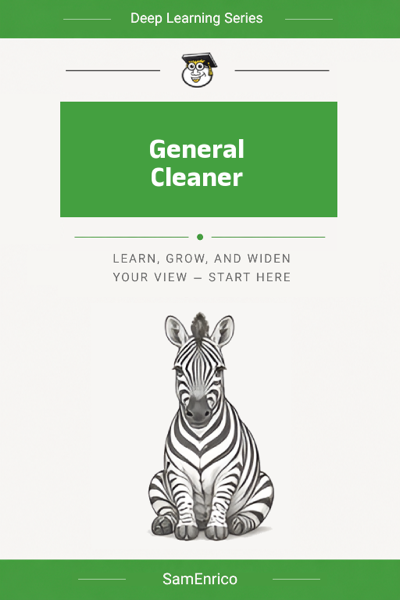
General Cleaner eBook
A Coursebook on General Cleaner
A Coursebook on General Cleaner
Formats
Free sample
Chapter 1: The Two Faces of Clean--–- On a Tuesday morning, a spotless kitchen fails an ATP test while a cluttered desk in the next room registers as biologically pristine. This paradox is not a laboratory anomaly but the daily reality of cleaning science. The assumption that "clean" is a universal, self-evident truth has led to countless wasted hours, unnecessary chemical exposure, and the peculiar anxiety of feeling dirty in a room that looks immaculate. This chapter dismantles that assumption and rebuilds it as a practical framework: the two distinct standards of cleanliness that every general cleaner must master.The first standard is subjective cleanliness. It is the emotional feeling of a tidy space—beds made, pillows fluffed, magazines stacked at right angles.
Subjective clean pleases the eye and calms the nervous system. It is what most people mean when they say a room "looks clean." The second standard is scientific cleanliness. It is measured by microbial load, dust particulate concentration, and the complete absence of visible and invisible soil. Scientific clean cares nothing about whether the pillows are fluffed. It cares whether the kitchen counter carries coliform bacteria or the carpet holds twice the EPA’s recommended allergen level.A general cleaner who does not understand both standards will inevitably fail.
The professional who cleans only for appearances leaves clients vulnerable to illness and allergic reactions. The professional who cleans only for microbial elimination ignores the psychological reality that a messy space feels dirty even when disinfected, leading to unhappy clients who cannot articulate why they feel unsatisfied. The synthesis of both standards is the heart of this book.The Psychology of Subjective Clean For most of human history, cleanliness was primarily a visual and olfactory judgment. A floor without visible dirt was considered clean. A plate without food residue was ready for use.
The microscope changed everything by revealing a universe of microorganisms invisible to the unaided eye, but the human brain did not evolve to process this information. The emotional response to a tidy room remains more powerful than any lab report.Research in environmental psychology has demonstrated that clutter imposes a cognitive load. Each visible object out of place competes for attention, reducing working memory and increasing irritability. A study published in the Journal of Neuroscience found that women who described their homes as cluttered had elevated cortisol levels throughout the day, regardless of the actual microbial cleanliness of their surfaces. The subjective experience of disorder triggers a low-grade stress response that no amount of disinfecting can resolve.Conversely, a space that is visually orderly but biologically contaminated produces a different kind of distress.
Consider the hospital room that appears spotless but harbors Clostridium difficile spores on the bedrail. The patient feels safe because the room looks clean. The infection feels nothing at all. The general cleaner working in a residential setting must recognize that clients cannot see bacteria, so they will judge the quality of your work primarily by what they can see. This is not a flaw in the client.
It is the fundamental architecture of human perception.The practical implication is that every cleaning job has two parallel objectives. The first objective is to reduce bioburden and particulate matter to safe levels. The second objective is to create the visual and tactile experience of cleanliness. Neither can be sacrificed for the other. A perfectly disinfected room left in disarray will produce an unhappy client.
A perfectly tidy room with a biofilm-covered sink will produce an unsafe one.The Physiology of Clean: What the Nose and Skin Detect Humans possess remarkable but limited biological sensors for cleanliness. The nose detects volatile organic compounds produced by bacterial metabolism. That "musty towel smell" is not the towel itself but the waste products of microbes that have colonized the fibers. The skin senses residue. A counter that has been wiped with a dirty cloth feels slightly tacky or gritty because a thin film of soil has been spread rather than removed.These sensory inputs are processed below the level of conscious thought.
A client may not be able to explain why a room feels "not quite clean," but their nose and fingertips have already delivered a verdict. The general cleaner must understand the physiology of these sensations to troubleshoot problems effectively.Take the example of a glass shower door that looks transparent but feels slightly rough when touched with wet fingers. That roughness is the beginning of hard water scale—calcium and magnesium deposits left behind as water evaporates. The scale provides a textured surface that traps soap residue and body oils, creating a biofilm that becomes visibly cloudy over time. The client cannot see the scale when the glass is dry, but their fingers detect it in the shower.
Their perception of cleanliness erodes long before any visible film appears.Similarly, the smell of a kitchen after cleaning can betray the cleaner. A bleach-like odor suggests adequate disinfection but may also indicate that bleach was used on a surface that should have received a different treatment. A sour or musty odor suggests that a cloth or mop head was not sufficiently clean or dry between uses, transferring bacteria rather than removing them. A neutral or faintly pleasant odor is the sensory signature of a properly cleaned space.The professional general cleaner develops what might be called sensory literacy—the ability to anticipate what a client will feel and smell before the client enters the room. This literacy is not mystical.
It is the product of deliberate attention to the feedback that surfaces provide. A finger dragged across a baseboard reveals dust invisible to the eye. A nose lowered to a drain detects biofilm before it produces a room-filling odor. A palm pressed against a recently wiped counter confirms that no residue remains.The 20/10 Method and the Psychology of Procrastination Among the most common obstacles to effective cleaning is not ignorance of technique but the paralysis that precedes action. For individuals with ADHD, depression, chronic fatigue, or simply the overwhelm of modern life, the prospect of cleaning an entire room can trigger a freeze response.
The task seems too large, too undefined, too punishing. The result is avoidance, which compounds the original problem and deepens feelings of shame and inadequacy.The 20/10 method, adapted from the bestselling work Unf*ck Your Habitat, provides a structured intervention for this paralysis. The method is simple: work for twenty minutes, then rest for ten minutes. Repeat as needed. The power of this approach lies not in its ambition but in its modesty.
Twenty minutes is a manageable chunk of time. Anyone can tolerate twenty minutes of effort. And the ten-minute rest interval is not a reward for completion but an integral part of the work cycle, preventing burnout and maintaining decision-making quality.For the professional cleaner, the 20/10 method has a different application. It serves as a pacing tool for large jobs and as a teaching tool for clients who struggle with maintenance cleaning. A cleaner who spends eight hours in a client's home can use 20/10 cycles to maintain consistent energy and attention.
A client who is ashamed of their clutter can be coached to attempt one 20-minute session per day, transforming an…
This is the end of the free sample. Get the eBook to keep going. Buy now
About this book
Details
- Author
- Boudreaux Shelby
- Publisher
- SamEnrico
- Language
- English
- Genre
- Non-Fiction, Informative, Educational
- Released
- 2026-06-02
- Pages (approx.)
- 120
- Available as
- eBook, Audiobook

Read better in the ZLOADR app
Your eBooks on your phone or tablet. Sign in with your SamEnrico account and start reading.
More by Boudreaux Shelby
 The Check the Facts DBT GuideBoudreaux Shelby$11.99
 Parenting With NVC GuideBoudreaux Shelby$11.99
 Canva Brand Identity for Travel AgentsBoudreaux Shelby$11.99
 Kamikaze Attack WitnessBoudreaux Shelby$11.99
 The Cosmic Pioneers: How Women First Walked on the MoonBoudreaux Shelby$11.99
 AI for Log Analysis & DebuggingBoudreaux Shelby$12.99
 Learn to Play the Wagner TubaBoudreaux Shelby$11.99
 10 Ways to Use Fennel (Recipe Book)Boudreaux Shelby$11.99