

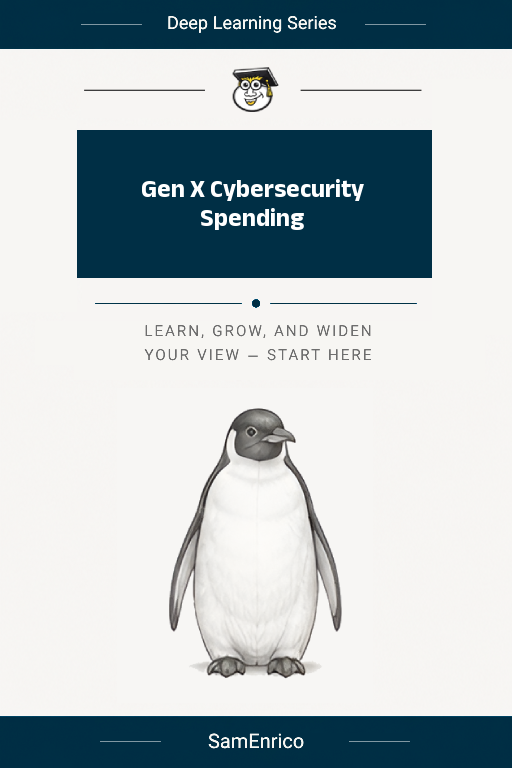
Non-FictionConsumer Mind ReportCybersecurity Economics
Gen X Cybersecurity Spending eBook
Map antivirus, VPN, identity theft protection, and
Map antivirus, VPN, identity theft protection, and password manager purchases for Gen X protecting digital assets and family data.
Formats
Free sample
Chapter 1: The Digital Sandwich--It was a Tuesday like any other until it wasn't.At 9:14 AM, Mark, a 49-year-old regional sales manager in Columbus, Ohio, glanced at his phone while waiting for a conference call to start. A text message from "UPS" informed him that a package delivery had failed and he needed to click a link to reschedule. Mark had ordered a birthday gift for his wife the night before. Without thinking, he tapped the link and entered his address to confirm the "redelivery."By 9:30 AM, the damage had begun.The link installed a remote access trojan on Mark's phone. Because his phone was synced to the family PC—the same computer his 14-year-old daughter used for homework and his 70-year-old mother used to video chat with cousins—the trojan spread laterally across the home network.
By noon, his daughter's Roblox account had been stripped of 400invirtualcurrencyandwassendingracistmessagestoherentirefriendlistfromhercompromisedcredentials.By3:00PM,hismotherreceivedaphonecallfromavoicethatsoundedexactlylike Mark′sdaughter,sobbingthatshehadbeeninacaraccidentandneeded400 in virtual currency and was sending racist messages to her entire friend list from her compromised credentials. By 3:00 PM, his mother received a phone call from a voice that sounded exactly like Mark's daughter, sobbing that she had been in a car accident and needed 400invirtualcurrencyandwassendingracistmessagestoherentirefriendlistfromhercompromisedcredentials.By3:00PM,hismotherreceivedaphonecallfromavoicethatsoundedexactlylike Mark′sdaughter,sobbingthatshehadbeeninacaraccidentandneeded8,000 in gift cards immediately. The voice had been scraped from a Tik Tok video his daughter posted publicly last week.By 7:00 PM, Mark discovered that someone had opened a 15,000Best Buycreditcardinhisnameanddrained15,000 Best Buy credit card in his name and drained 15,000Best Buycreditcardinhisnameanddrained4,000 from his checking account via a cloned debit card. His employer's IT department called at 8:00 PM to inform him that his work laptop—connected to the same home network—had been compromised and he would need to return it for forensic imaging. He was placed on paid leave pending investigation.Total damage: 27,400indirectfinancialloss,120hoursofhislifeoverthefollowingthreemonthsspentwithbanks,creditbureaus,lawyers,andhisemployer′s HRdepartment.Hisdaughterrefusedtouseherschool−issuedlaptopfortwoweeks.Hismothernowcallshimbeforeopeninganyemail.And Markdiscoveredsomethingthatmadehimangrierthanthemoney:hehadbeenpaying27,400 in direct financial loss, 120 hours of his life over the following three months spent with banks, credit bureaus, lawyers, and his employer's HR department.
His daughter refused to use her school-issued laptop for two weeks. His mother now calls him before opening any email. And Mark discovered something that made him angrier than the money: he had been paying 27,400indirectfinancialloss,120hoursofhislifeoverthefollowingthreemonthsspentwithbanks,creditbureaus,lawyers,andhisemployer′s HRdepartment.Hisdaughterrefusedtouseherschool−issuedlaptopfortwoweeks.Hismothernowcallshimbeforeopeninganyemail.And Markdiscoveredsomethingthatmadehimangrierthanthemoney:hehadbeenpaying89 per month for six different cybersecurity subscriptions—Norton, Life Lock, a VPN he never used, credit monitoring from his bank, a separate identity protection plan, and a password manager he installed but never configured.Not a single one of them stopped the attack.Mark is not a cautionary tale from a cybersecurity conference. Mark is every Gen X parent, child, and professional who has been sold a collection of security products instead of a security strategy. And this book is the remedy.The Generational Blind Spot If you are reading this book, you likely fall into one of three categories.
First, you are a member of Generation X, born roughly between 1965 and 1980. Second, you have parents who are aging—perhaps into their seventies, eighties, or beyond—and you have begun to notice that they click things they should not click and believe things they should not believe. Third, you have children or teenagers who have never known a world without the internet and who treat their digital lives with a combination of reckless bravery and profound ignorance about how the internet actually works.If you fall into all three categories, welcome. You are the digital sandwich generation.The term "sandwich generation" was coined in the 1980s to describe adults caring for both their own children and their aging parents simultaneously. The financial and emotional toll of that role is well documented.
But in the 2020s, a new layer has been added to the sandwich: digital security. You are not just responsible for the physical and financial well-being of the people above and below you in the family tree. You are responsible for their digital well-being as well. And unlike physical safety, which has clear rules (look both ways, don't touch a hot stove), digital safety is a moving target that changes every time a new app launches, a new scam emerges, or a new device joins your home network.The cybersecurity industry has not ignored Gen X. Quite the opposite.
It has targeted you relentlessly with advertisements featuring shadowy figures in hoodies, ominous warning messages, and promises of "total protection" for a low monthly fee. But here is the dirty secret that no antivirus commercial will tell you: the industry has sold you a collection of products designed to be purchased and forgotten, not a strategy designed to be maintained.This book exists because the industry's approach has failed. You do not need more products. You need fewer products that actually work together. You need to stop spending money on tools that duplicate each other's functions while leaving critical gaps uncovered.
And you need to recognize that the single most important factor in your family's cybersecurity is not the brand of antivirus you install but the habits you teach, the boundaries you set, and the conversations you are willing to have around the dinner table.The Three-Domain Problem To understand why Gen X cybersecurity cannot be a one-size-fits-all solution, you must first understand the three-domain problem. Unlike Boomers, who typically manage only their own retirement accounts and perhaps a shared email with a spouse, and unlike Millennials, who often grew up with cloud storage and have fewer physical assets, Gen X straddles three distinct digital domains that all coexist on the same home network.The first domain is work. You are likely at the peak of your career. You have access to sensitive company data, client information, intellectual property, or financial systems. Your employer may have provided you with a laptop, but that laptop connects to your home Wi-Fi.
It shares the network with your teenager's gaming PC and your parent's i Pad. Corporate IT policies are designed to protect the device when it is in the office or connected to a corporate VPN. They are not designed to protect it when your mother clicks a "your computer is infected" pop-up and gives remote access to a scammer in a call center who then pivots to your work laptop because both devices are on the same unsegmented home network.The second domain is personal finance. You have accumulated assets. Maybe it is a 401(k) from two decades of contributions.
Maybe it is a brokerage account, a home equity line of credit, or a side business. You have mortgages, car loans, and credit cards. Your credit score is high enough that you qualify for significant lines of credit. This makes you a prime target for identity thieves. They do not want your checking account balance.
They want your clean credit history, which they can use to open new accounts in your name that you will not discover until collection agencies start calling.The third domain is family data. You have children whose Social Security numbers are pristine—no credit history at all, which makes them perfect blank slates for synthetic identity theft. You have parents whose Social Security numbers have been floating around for decades, appearing on countless medical…
This is the end of the free sample. Get the eBook to keep going. Buy now
About this book
Details
- Author
- Michael Eusebio
- Publisher
- SamEnrico
- Language
- English
- Genre
- Non-Fiction, Consumer Mind Report, Cybersecurity Economics
- Released
- 2026-05-29
- Pages (approx.)
- 156
- Available as
- eBook, Audiobook

Read better in the ZLOADR app
Your eBooks on your phone or tablet. Sign in with your SamEnrico account and start reading.
More by Michael Eusebio
 Microbiome Immune FunctionMichael Eusebio$11.99
 Traffic Jam Coping StrategiesMichael Eusebio$11.99
 Relapse Prevention HandbookMichael Eusebio$11.99
 Weekly Review for Small Business OwnersMichael Eusebio$11.99
 Catherine the Great Rebellion Suppression TacticsMichael Eusebio$11.99
 The Fire Prophet of the Red Sea: Ibn Majid and the Science of Volcanic WrathMichael Eusebio$11.99
 Galileo's Stargazing Secrets: The Telescope That Changed the WorldMichael Eusebio$11.99
 Avoiding Payment Rejection ReasonsMichael Eusebio$12.99
 Understanding BatrachophobiaMichael Eusebio$17.99
 Insurance InvestigatorMichael Eusebio$11.99
 10 Ways to Use Chocolate Biscuit (Recipe Book)Michael Eusebio$11.99
You may also like
 Hong Kong Handover 1997Dunn Johnnie$11.99
 Zumba For Postnatal Recovery CourseNeal Christian$11.99
 Zumba for BeginnersLadner Nikia$11.99
 YouTube Comment Mining GuideHumes Pandora$12.99
 Worry Box MeditationCarlin Rudy$11.99
 Workplace Stress MeditationNguyen Lynn$11.99
 Workplace Stress and Sleep RepairHawley Ivory$11.99
 Workplace Perfectionism CureDelaney Jeffry$11.99
 Workplace Injustice Anger GuideWallen Isabelle$11.99
 Work Addiction and Burnout LinkGreenwood Ester$11.99
 Women in Yoga and WellnessBeattie Galina$11.99
 Women in Stand Up ComedyChun Evangeline$11.99