
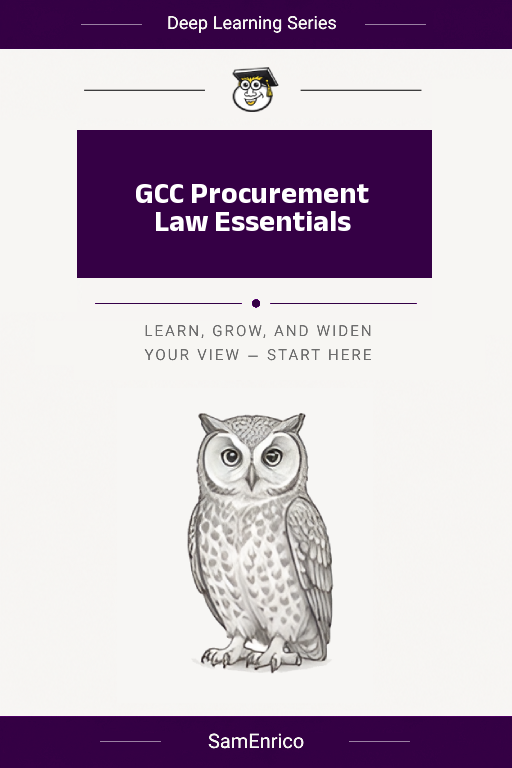
GCC Procurement Law Essentials eBook
Understand government procurement codes and local
Understand government procurement codes and local content requirements across Gulf Cooperation Council states.
Formats
Free sample
Chapter 1: The Gulf Mirage--–- The conference room in Dubai’s DIFC had floor-to-ceiling windows overlooking the Burj Khalifa. Outside, the December sun glinted off glass and steel. Inside, temperatures were dropping fast. Jean-Paul Moreau, regional director for a mid-sized French construction firm, had just received the news. His company had won a $340 million contract to build a new medical city in Riyadh.
His team had celebrated with champagne. That was three hours ago. Now, a single email threatened to unravel everything. The subject line read: “LCGPA Audit Notification – Immediate Action Required.”Jean-Paul had never heard of the LCGPA. Neither had his legal team in Paris.
Within thirty days, his company would be suspended from bidding on any government contract in the Kingdom. Within ninety days, they would be blacklisted across three Gulf countries. The medical city contract would be cancelled. The $6.8 million performance bond would be forfeit. And Jean-Paul would be on a plane back to Lyon, his regional career in ashes.All because no one had read the fine print.This book exists to ensure that does not happen to you.The Gulf Cooperation Council states – Saudi Arabia, the United Arab Emirates, Qatar, Kuwait, Oman, and Bahrain – collectively represent over $2 trillion in active and planned government infrastructure projects.
From NEOM’s mirrored desert skyscraper to Qatar’s North Field gas expansion, from Kuwait’s Silk City to the UAE’s Etihad Rail network, the governments of the Arabian Peninsula are spending at a scale unseen anywhere else on earth.But there is a trap hidden inside every tender document, every local content requirement, every mandatory offset obligation. The trap is this: the rules are written in Arabic, enforced by agencies you have never heard of, and change faster than any foreign legal team can track. And the penalty for ignorance is not a polite rejection letter. It is financial ruin.This chapter introduces the central paradox of GCC procurement: a region that desperately wants foreign expertise, technology, and capital – but has designed a procurement system that systematically excludes foreign contractors who fail to master its local intricacies. Understanding this paradox is the first step toward winning, and keeping, billion-dollar government contracts across the Gulf.The Unwritten Contract Every government tender in the GCC is built on what lawyers call an “administrative contract.” Unlike commercial contracts between private parties, which presume a roughly equal bargaining position, an administrative contract is fundamentally unbalanced.
The government entity writes the rules. The government entity evaluates the bids. The government entity can modify the contract after signing. And if a dispute arises, the government entity’s own administrative courts – not neutral arbitrators – will typically decide the outcome.This is not corruption. It is not uniquely Gulf.
France, Egypt, and many civil law jurisdictions have similar administrative contract doctrines. But for contractors accustomed to common law systems (the United States, the United Kingdom, Australia, Canada), the shift is disorienting. You do not negotiate terms with a GCC ministry the way you negotiate with a private client. You accept their terms. Or you do not bid.Consider the standard GCC government contract clause that permits the procuring entity to “unilaterally modify the scope of works” for “reasons of public interest.” In a common law jurisdiction, such a clause would be interpreted narrowly.
In GCC administrative law, it is interpreted broadly. A hospital project can become a military barracks. A road can become a rail line. The contractor’s obligation is to comply and then claim additional compensation – not to refuse performance.This asymmetry is the first lesson of GCC procurement: you are not a partner. You are a service provider.
The government is the sovereign. Act accordingly.The Mirage of Harmonization In 2004, the GCC Supreme Council issued a landmark directive: the Common Market. Among its provisions was a commitment to “equal treatment of GCC nationals and entities in all economic activities,” including public procurement. On paper, a Qatari contractor bidding in the UAE should face the same rules as a UAE national contractor. A Bahraini supplier selling to Saudi Arabia’s Ministry of Health should receive no less favorable treatment than a Saudi supplier.On paper.In practice, every GCC state maintains its own procurement regulations, its own local content formulas, its own registration requirements, and its own enforcement mechanisms.
The theoretical “GCC-wide” preferences exist only at the level of non-binding model laws. The actual rules are national. Sometimes, they are emirate-level (in the UAE) or even agency-level (Aramco’s IKTVA program operates independently of the LCGPA).This fragmentation creates a dangerous cognitive bias. Foreign contractors see “Gulf Cooperation Council” and assume a level of regulatory harmonization similar to the European Union. There is none.
Winning a contract in Qatar teaches you almost nothing about winning a contract in Kuwait. A local content certificate issued by the UAE’s Mo IAT has no value in Oman. A classification from Saudi Arabia’s Municipal and Rural Affairs department is worthless in Bahrain.The successful GCC contractor does not learn “Gulf procurement.” They learn six distinct procurement systems and apply the relevant one to each tender. This book teaches both the common patterns (Chapter 2 on procurement methods, Chapter 4 on the Four Pillars of local content) and the critical divergences (Chapter 5 on Saudi Arabia, Chapter 6 on UAE and Qatar).The $2 Trillion Stakes To understand why mastering GCC procurement matters, one must grasp the scale of what is at stake. The following table, drawn from publicly announced government commitments and sovereign wealth fund mandates, represents projects either tendered or planned for tender between 2025 and 2030:Country Mega-Project Estimated Value (USD)Procurement Status Saudi Arabia NEOM (phase 2)$500 billion Phased tenders 2025-2028Saudi Arabia Qiddiya Entertainment City$20 billion Active Saudi Arabia Red Sea Project$15 billion Active UAEEtihad Rail completion$11 billion Final phases UAEBarakah nuclear (ancillary)$4 billion2025-2026Qatar North Field expansion$40 billion Active Qatar Lusail 2.0$5 billion Planning Kuwait Silk City / Mubarak Al-Kabeer$130 billion Phased Kuwait Al-Zour North (power & water)$2.5 billion2025Oman Duqm Special Economic Zone$20 billion Phased Oman Hydrogen projects$30 billion2025-2030Bahrain Bahrain Metaverse$0.5 billion2025Multi-country GCC railway network$200 billion Stalled, restart 2026These figures represent tenders that will be published, bids that will be evaluated, and contracts that will be awarded.
For contractors who understand the rules, these represent the largest infrastructure market on earth. For contractors who do not, they represent a minefield.The Compliance Pyramid Understanding GCC procurement requires more than reading regulations. It requires understanding a compliance pyramid with four distinct levels. Each level introduces new risks and new opportunities.Level 1: Registration. Before you can bid on any government contract in any GCC state, you must register as a supplier.
This is not a formality. Registration requires audited financial statements, technical qualifications, local agent or partner documentation, and – in Saudi Arabia and Qatar – a local content pre-certification. Registration processing times range from two weeks (Bahrain, Oman) to six months (Saudi classification). You cannot expedite this process. You cannot bid while registration is pending.
The only solution is to register months before your first tender.Level 2: Tender Submission. This is where most foreign contractors lose. GCC tenders are evaluated on a “strict compliance” basis, meaning any deviation from the required format, any missing signature, any expired certificate, any bid…
This is the end of the free sample. Get the eBook to keep going. Buy now
About this book
Details
- Author
- Jimenez Katherine
- Publisher
- SamEnrico
- Language
- English
- Genre
- Non-Fiction, Business Brief
- Released
- 2026-05-30
- Pages (approx.)
- 154
- Available as
- eBook, Audiobook

Read better in the ZLOADR app
Your eBooks on your phone or tablet. Sign in with your SamEnrico account and start reading.
More by Jimenez Katherine
 Undercover Narcotics AgentJimenez Katherine$11.99
 Technology Failure RageJimenez Katherine$11.99
 Self Esteem Through Posture And Movement GuideJimenez Katherine$11.99
 Annuity Purchase GuideJimenez Katherine$11.99
 Congo River Basin TrekJimenez Katherine$11.99
 Dance Moms AbbyJimenez Katherine$11.99
 Creative Journal WorkbookJimenez Katherine$11.99
 Tech Industry Crunch CultureJimenez Katherine$11.99
 The Shadow Throne: How the Dowager Empress Wu Zetian Pulled the Strings of an EmpireJimenez Katherine$11.99
 The Forger's Gamble: The Han Dynasty's Greatest Art ScandalJimenez Katherine$11.99
 Growing CunilaJimenez Katherine$11.99
 Chinese Academic Integrity GuidelinesJimenez Katherine$12.99
You may also like
 Hong Kong Handover 1997Dunn Johnnie$11.99
 Zumba For Postnatal Recovery CourseNeal Christian$11.99
 Zumba for BeginnersLadner Nikia$11.99
 YouTube Comment Mining GuideHumes Pandora$12.99
 Worry Box MeditationCarlin Rudy$11.99
 Workplace Stress MeditationNguyen Lynn$11.99
 Workplace Stress and Sleep RepairHawley Ivory$11.99
 Workplace Perfectionism CureDelaney Jeffry$11.99
 Workplace Injustice Anger GuideWallen Isabelle$11.99
 Work Addiction and Burnout LinkGreenwood Ester$11.99
 Women in Yoga and WellnessBeattie Galina$11.99
 Women in Stand Up ComedyChun Evangeline$11.99