
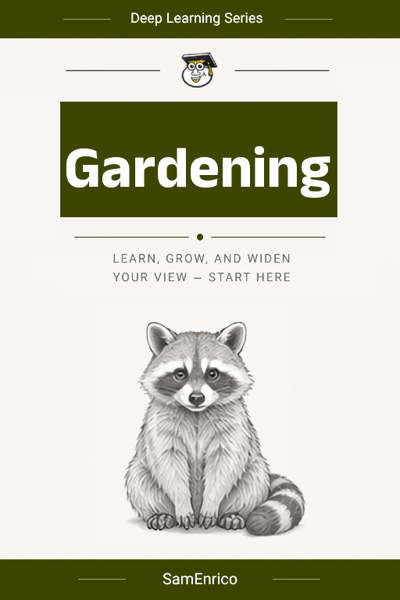
Non-FictionInformativeEducational
Gardening eBook
A Coursebook on Gardening
by Handy Bibi
A Coursebook on Gardening
Formats
Free sample
Chapter 1: Beyond the Lawn...--–- Most gardening books begin with soil. They thrust you into p H balances, nitrogen cycles, and the correct depth for planting tulip bulbs before you have even asked yourself the only question that matters: Why do you want a garden in the first place?This is not an idle question. It is not a fluffy self-help exercise designed to fill space before the "real" gardening begins. It is, in fact, the most practical question you will ever ask as a gardener, because the answer determines every single decision that follows—from how much money you should spend on compost to whether you should bother building a rain barrel to which plants will thrive or die under your care.Let me prove this to you with a story.A few years ago, a friend of mine—let us call her Sarah—decided she wanted a garden. She had just bought her first house, a modest split-level with a decent-sized backyard, and she was determined to do things right.
She bought three gardening books. She watched forty-seven hours of You Tube tutorials. She spent eight hundred dollars at the garden center on soil amendments, raised bed kits, a compost bin, a tool set, and thirty-seven individual plants that looked beautiful in their nursery pots.She planted everything over a single, exhausting Memorial Day weekend. She watered religiously. She weeded every Saturday.
She fertilized on the schedule prescribed by one of her books. And by August, she had a garden that looked like a battlefield. Half the plants were dead. The other half were limping along, yellowing at the edges, clearly miserable. The tomatoes she had so looked forward to produced exactly three fruit, each the size of a marble and possessed of a flavor she described as "sad."Sarah came to me, frustrated nearly to tears, and asked: "What did I do wrong?"I walked through her garden with her.
And here is what I discovered: she had not done anything wrong technically. Her soil was fine. Her watering schedule was fine. Her plant choices were, by the standards of most gardening books, perfectly reasonable.The problem was that Sarah had never asked herself what she actually wanted from her garden.She had bought a Japanese maple because the nursery employee said it was "a good specimen tree." But Sarah did not care about specimen trees. She had built raised beds for vegetables because every gardening book has a chapter on vegetable gardening.
But Sarah worked sixty hours a week and did not have time to tend a vegetable patch. She had planted pollinator-friendly flowers because she had heard bees were in trouble. But she was secretly terrified of bees.Sarah had built someone else's dream garden. And then she had been shocked when it did not make her happy.This is not Sarah's fault. This is the fault of the gardening industry, which has spent decades telling us that there is a single, correct way to garden—that a "real" garden has certain features (lawn, flower borders, perhaps a vegetable patch) and that your job as a gardener is to execute that template as faithfully as your budget and climate allow.That template is a lie.The Great Lie of Conventional Gardening Let me name the lie directly: There is no such thing as a correct garden.There are only gardens that work for the people who tend them and gardens that do not.
A garden that makes you miserable is not a good garden, no matter how many compliments it receives from neighbors. A garden that brings you joy is a good garden, even if it consists entirely of weeds growing out of cracked concrete.This sounds obvious. But watch how quickly the gardening industry tries to convince you otherwise.Walk into any garden center and you will see the same display: rows of flowers arranged by color, alphabetized by Latin name, each with a tiny plastic tag telling you how much sun it needs and how tall it will grow. The implicit message is that gardening is a matter of matching the right plant to the right conditions—a purely technical exercise, like assembling furniture from IKEA.The bestselling gardening books reinforce this message. They are organized around categories like "Soil Preparation," "Plant Selection," "Pest Control," and "Seasonal Maintenance." Each chapter assumes you already know what kind of garden you want.
The only remaining question is how to execute that vision competently.But what if you do not know what kind of garden you want? What if what you want is not a vegetable patch or a flower border or a pollinator meadow but something harder to name—a place to feel calm, a project to share with your children, a way to feel connected to the natural world without spending every weekend on your knees in the dirt?Those desires are not less legitimate than the desire for a perfect lawn. They are simply harder for the gardening industry to monetize. You cannot sell a soil test kit to someone whose goal is "a place to drink coffee on Saturday mornings." You cannot sell a Japanese maple to someone whose goal is "something to do with my hands that is not staring at a screen."And so the industry ignores those desires. It pretends they do not exist.
It serves up the same advice to everyone, regardless of what they actually want, because that is more efficient than the messy work of helping each gardener discover their own path.This book is going to do the messy work instead.The Four Garden Archetypes Most gardeners, when they finally stop and ask themselves what they actually want, discover that their desires fall into one of four broad categories. I call these the four garden archetypes. You may recognize yourself in one of them—or perhaps in a blend of several.Archetype One: The Food Grower The Food Grower wants to eat from their garden. They are motivated by taste (homegrown tomatoes really are better), by cost (herbs are absurdly expensive at the grocery store), by security (knowing exactly where their food comes from), or by simple pride (there is genuine satisfaction in serving a meal you grew yourself).Food Growers tend to be practical, results-oriented people. They do not care much about whether a plant is native or exotic, perennial or annual, showy or subtle.
They care about yield, flavor, and ease of cultivation. They want to know how many pounds of produce they can expect from a square foot of soil and how many minutes of weekly maintenance that pound will cost them.The trap for Food Growers is over-ambition. It is easy to look at the lush vegetable gardens on Instagram and decide you need eight raised beds, a greenhouse, and a seed-starting setup that occupies your entire basement. But a vegetable garden requires consistent attention. If you work full-time, travel occasionally, or simply have other hobbies, a large vegetable garden will quickly become a source of guilt rather than joy.The smarter path for most Food Growers is to start absurdly small.
A single four-by-four foot bed. Three or four containers on a balcony. A single tomato plant in a five-gallon bucket.…
This is the end of the free sample. Get the eBook to keep going. Buy now
About this book
Details
- Author
- Handy Bibi
- Publisher
- SamEnrico
- Language
- English
- Genre
- Non-Fiction, Informative, Educational
- Released
- 2026-05-11
- Pages (approx.)
- 142
- Available as
- eBook, Audiobook

Read better in the ZLOADR app
Your eBooks on your phone or tablet. Sign in with your SamEnrico account and start reading.
More by Handy Bibi
 Merv Griffin Game Show KingHandy Bibi$11.99
 Nobel Laureates in Material ScienceHandy Bibi$11.99
 Sexual Harassment Anger Processing CourseHandy Bibi$11.99
 Job Loss Financial CopingHandy Bibi$11.99
 The Task Batching Efficiency GuideHandy Bibi$11.99
 The Iron Discipline: Frederick the Great and the Birth of Prussian ExcellenceHandy Bibi$11.99
 Understanding Pyruvate Dehydrogenase DeficiencyHandy Bibi$17.99
 Payment Gateways African ExportersHandy Bibi$12.99
 Atlassian PLG GuideHandy Bibi$12.99
 How to Start a Ornamental Tree and Shrub Growing Business (Beginners Guide)Handy Bibi$11.99
You may also like
 Hong Kong Handover 1997Dunn Johnnie$11.99
 Zumba For Postnatal Recovery CourseNeal Christian$11.99
 Zumba for BeginnersLadner Nikia$11.99
 YouTube Comment Mining GuideHumes Pandora$12.99
 Worry Box MeditationCarlin Rudy$11.99
 Workplace Stress MeditationNguyen Lynn$11.99
 Workplace Stress and Sleep RepairHawley Ivory$11.99
 Workplace Perfectionism CureDelaney Jeffry$11.99
 Workplace Injustice Anger GuideWallen Isabelle$11.99
 Work Addiction and Burnout LinkGreenwood Ester$11.99
 Women in Yoga and WellnessBeattie Galina$11.99
 Women in Stand Up ComedyChun Evangeline$11.99