
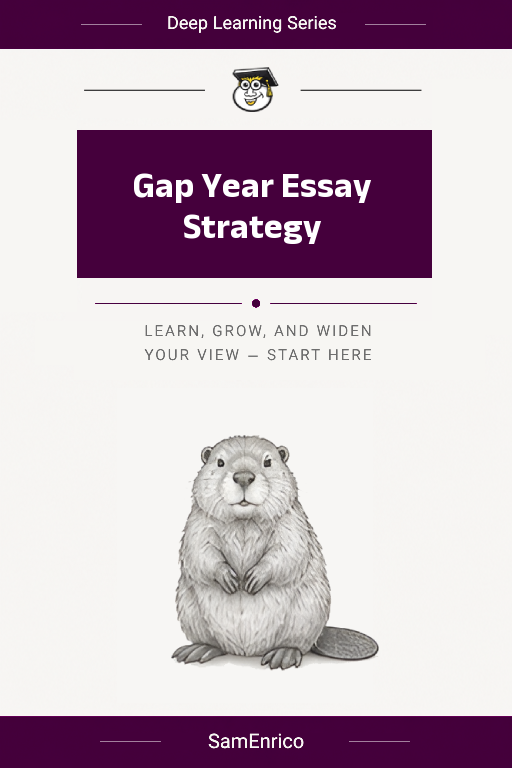
essaysGap Year GuideNarrative Bridge
Gap Year Essay Strategy eBook
Explain gap year experiences productively. Connect
Explain gap year experiences productively. Connect your time off to your academic and personal growth.
Formats
Free sample
Chapter 1: The Burnout Question...--“I was so exhausted that I couldn’t picture another classroom without feeling sick.”That sentence—written by a student who took a gap year after finishing high school—appears in the opening paragraph of one of the most successful admissions essays I have ever read. The student went on to describe working the night shift at a grocery store, sleeping badly, and spending her mornings reading philosophy in a park because she couldn’t afford to travel. She was not wealthy. She had not climbed mountains or taught English in a foreign country. She had simply admitted, on paper, that she had hit a wall—and that she had made a deliberate choice to step back before stepping forward.She was admitted to four Ivy League universities.Her story is not unique.
Every year, thousands of students who take gap years apply to competitive colleges. Some of them write essays that admissions officers remember, fight for, and ultimately admit. Others write essays that get deleted after thirty seconds of reading. The difference between these two groups is rarely the quality of their gap year experiences. It is almost always the quality of their explanation—how they frame their time away from school as strategic, self-aware, and academically relevant.This chapter is about the single most important reframe you will make as you write your gap year essay.
It is not about grammar, structure, or editing. Those come later. This chapter is about your deepest fear: that admitting you needed a break will make you look weak, directionless, or unprepared for college. That fear is understandable. It is also completely wrong.The Fear That Keeps Good Essays Unwritten Before we talk about what works, we need to talk about what stops students from writing well in the first place.
Over the past several years of analyzing gap year essays and interviewing admissions officers, a clear pattern has emerged. Students who take gap years carry a secret fear that they are somehow “behind”—that their peers who went straight to college are already earning credits, joining clubs, and building resumes while they are folding laundry, washing dishes, or wandering through hostels.This fear manifests in their writing in predictable ways. Some students become defensive. Their essays sound like legal depositions: “I did not waste my year. I volunteered for three months.
I worked for six months. I saved money. I am not lazy.” Other students become apologetic: “I know my gap year wasn’t as impressive as some people’s. I couldn’t afford to travel abroad. I mostly just worked at a restaurant and figured out what I wanted.” Still others try to hide the gap year entirely, mentioning it in a single sentence buried in the middle of their application, as if hoping no one will notice.All of these approaches fail for the same reason.
They assume that the gap year is a liability that needs to be excused, minimized, or defended. Admissions officers can smell this assumption from the first sentence. It reads as insecurity, not self-awareness. It reads as shame, not strategy.The students who succeed—the ones whose essays get circled, shared, and admitted—take the opposite approach. They treat their gap year as evidence of something positive.
They do not apologize for being tired. They do not defend their choices. They simply explain, with specificity and confidence, why stepping back was actually the smartest thing they could have done.What Admissions Officers Actually Think About Gap Years Let us clear up a common misconception. Admissions officers do not view gap years as inherently positive or negative. They view them as data.
A gap year is a piece of information about a student’s decision-making, self-awareness, and resilience. Whether that data helps or hurts the application depends entirely on how the student frames it.Here is what the internal research shows. Universities that track gap year students—including Harvard, Princeton, Tufts, and the University of North Carolina—have found that students who take intentional gap years often arrive on campus with higher first-semester GPAs, lower rates of academic probation, and greater persistence to graduation compared to statistically similar students who went straight through. The reason is intuitive: gap year students have had time to rest, reflect, and confirm their motivation. They are not burned out.
They are not questioning whether college is right for them. They have already answered those questions.Admissions officers know this research. They are not hostile to gap years. They are, if anything, slightly favorable toward them—but only when the gap year is framed as a strategic choice rather than an escape.This distinction is crucial. An escape gap year sounds like this: “I needed a break from school.
I was tired of grades and tests. I wanted to travel and have fun before starting college.” That is a red flag. It suggests avoidance, not preparation. It suggests that the student will struggle to re-enter academic life because they never actually solved the problem that made them want to leave.A strategic gap year sounds like this: “I recognized that I was experiencing academic burnout after four years of intense coursework. Rather than enter college exhausted and risk performing below my potential, I chose to spend a year in structured activities that would help me recover, gain perspective, and build skills I knew I lacked.” That is a green flag.
It suggests self-diagnosis, strategic planning, and a mature understanding of how to manage one’s own energy and motivation.The difference between these two framings is not about the activities themselves. A student who traveled through Southeast Asia could write either version. A student who worked at a grocery store could write either version. The difference is entirely about how they understand and explain their own choices.Why “Burnout” Is Not a Dirty Word Many students resist using the word “burnout” in their essays because they worry it sounds like an excuse or a sign of weakness. This is a mistake.
Burnout is a real, documented psychological phenomenon that affects high-achieving students at alarming rates. Acknowledging it is not weakness. It is self-awareness.Consider how the same information lands differently depending on framing. Version A: “I was really tired after high school, so I took a year off.” Version B: “After four years of AP classes, varsity sports, and volunteering every weekend, I noticed that I was no longer excited by learning. That scared me.
I didn’t want to start college feeling resentful of the classroom, so I decided to step back and rebuild my relationship with education.”Version A sounds like a teenager who wanted a vacation. Version B sounds like a young adult who diagnosed a problem and prescribed a solution. The underlying fact—exhaustion—is identical. The framing transforms it.The most effective gap year essays name the burnout directly. They do not hide behind euphemisms like “I needed a break” or “I wanted to see the world.” They say, specifically, what was wrong.
“I couldn’t look at another textbook without feeling dread.” “I had stopped asking questions in class because I no longer cared about the answers.” “I realized that…
This is the end of the free sample. Get the eBook to keep going. Buy now
About this book
Details
- Author
- Reinhart Etsuko
- Publisher
- SamEnrico
- Language
- English
- Genre
- essays, Gap Year Guide, Narrative Bridge
- Released
- 2026-05-29
- Pages (approx.)
- 116
- Available as
- eBook, Audiobook

Read better in the ZLOADR app
Your eBooks on your phone or tablet. Sign in with your SamEnrico account and start reading.
More by Reinhart Etsuko
 My Thousand VoicesReinhart Etsuko$11.99
 Firefly Night GuideReinhart Etsuko$11.99
 Sober Social Life HandbookReinhart Etsuko$11.99
 Post Project Review PracticeReinhart Etsuko$11.99
 Bath Time Efficiency and Speed GuideReinhart Etsuko$11.99
 The Phantom of the Opera: A Time-Traveling MysteryReinhart Etsuko$11.99
 Professional HandymanReinhart Etsuko$11.99
 Understanding Nijmegen Breakage SyndromeReinhart Etsuko$17.99
 Volkswagen ManufacturingReinhart Etsuko$12.99
 How to Start a Periodicals Lending and Storage Business (Beginners Guide)Reinhart Etsuko$11.99
You may also like
 YouTube Video Essay DepthLeon Lala$11.99
 TOEFL Independent Essay GuideMintz Alex$11.99
 Music Theory Essay GuideWilkinson Maisha$11.99
 Expository Essay AI PromptsApplegate Dalia$11.99
 Exam Essay MemorizationMcgovern Johna$11.99
 Compare Contrast Essay PromptsOntiveros Marx$11.99
 College Application Essay GuideSisson Aimee$11.99College Application Essay GuideSisson Aimee$11.99
 The 100 Word Essay ChallengeAli Luciana$11.99
 Journalism Essay PromptsThatcher Williemae$11.99
 Finance Essay PromptsShrader Lamont$11.99
 Cause Effect Essay GPT GuideBland Jacelyn$11.99