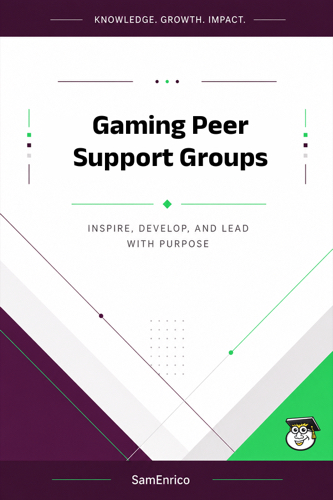
Gaming Peer Support Groups eBook
How to find and use community for gaming addiction
by Higdon Val
How to find and use community for gaming addiction recovery.
Formats
Free sample
Chapter 1: The Lonely Epidemic...--–- The screen glowed blue at 3:47 AM. Another notification. Another level. Another meaningless achievement in a game that would be forgotten in six months. But in that moment, it felt like the only thing keeping you alive.You have probably been there.
Maybe you are there right now, reading this in a dark room while a game launcher idles in the background. Maybe you told yourself you would read for ten minutes before "just checking in." Maybe you have already checked three times since opening this book.This chapter is not here to shame you. It is here to tell you something no one else has been willing to say: You are not broken. You are not lazy. You are not morally weak.
You are caught in a trap that was designed by some of the smartest engineers in the world, and you have been trying to escape using a strategy that is guaranteed to fail—trying to do it alone.The myth of the solitary quitter is the most destructive lie in addiction recovery. We love stories of the lone hero who stares down their demon through sheer willpower. But those stories are almost always fiction. The real story of recovery is messier, more communal, and far more effective than any Hollywood montage.This book is built on a single, evidence-based claim: Peer support groups are the single most effective intervention for gaming addiction—more effective than willpower, more effective than self-help books, and in many cases, more effective than individual therapy alone. That claim is not opinion.
It is drawn from decades of addiction research, synthesized from the best-selling books on recovery, and grounded in the lived experience of thousands of gamers who have walked this path before you.But before we can talk about the solution, we have to understand the enemy. And the enemy is not the game.The Cyber Trap: Why Games Are Not the Problem Let us start with a radical reframe: Gaming addiction is rarely about the games themselves. This claim sounds counterintuitive. If someone is drinking themselves to death, the alcohol is obviously part of the problem. If someone cannot stop gambling, the slot machine is obviously part of the problem.
But gaming is different in one crucial way: for the vast majority of players, gaming is a harmless hobby. According to the ICD-11 diagnosis of Gaming Disorder, less than 3% of gamers meet the clinical threshold for addiction. The problem is not the artifact; the problem is the relationship between the player and the artifact.So what separates a healthy gamer from an addicted one? The answer, drawn from Kevin Roberts' foundational work in Cyber Junkie, lies in what he calls the "cyber trap."The cyber trap works like this: Modern games are not designed to be fun. They are designed to be habit-forming.
There is a difference. Fun is unpredictable and self-limiting. You play a game of Mario Kart, you laugh with friends, and then you stop. Habit-forming is predictable and escalatory. You log into an MMORPG to complete "one daily quest," and three hours later, you are still grinding reputation points for a mount you do not even want.The engineers who build these games understand the neuroscience of reward better than most psychologists.
They employ "retention scientists" whose entire job is to maximize the time you spend in the game. They study your behavior, run A/B tests on reward schedules, and optimize every variable to keep you clicking. You are not fighting your own weakness. You are fighting a multi-billion dollar industry that has weaponized your brain's biology against you.The Neuroscience of the Hijacked Brain To understand why gaming addiction feels so different from other addictions—and why peer support is so effective—we need to take a brief detour into neuroscience. Do not worry.
This will not be a textbook lecture. You just need three concepts.Concept One: The Dopamine Loop Dopamine is not the "pleasure chemical." This is the most common misunderstanding about addiction. Dopamine is the anticipation chemical. It is released when you expect a reward, not when you receive it. Think about the feeling of opening a loot box, or waiting for a boss to drop rare gear, or watching your ranked matchmaking queue count down.
That flutter in your chest? That is dopamine.Games exploit this by using what psychologists call a "variable ratio reward schedule." This is the same mechanism that makes slot machines addictive. When a reward is predictable (every tenth kill gives a drop), dopamine release is moderate. When a reward is unpredictable (sometimes the first kill, sometimes the hundredth), dopamine release spikes dramatically. Your brain becomes obsessed with the search.Concept Two: The Prefrontal Cortex Blackout The prefrontal cortex is the CEO of your brain.
It handles impulse control, long-term planning, and rational decision-making. When you are well-rested and calm, your prefrontal cortex is in charge. But when you are stressed, sleep-deprived, or lonely, the prefrontal cortex begins to shut down. Its connection to the amygdala (your threat-detection center) weakens, and your more primitive "habit brain" takes over.Here is the kicker: Gaming addiction actively damages the prefrontal cortex. Neuroimaging studies of compulsive gamers show reduced gray matter density in the very regions responsible for impulse control.
The more you game compulsively, the harder it becomes to stop gaming compulsively. This is not a moral failure. This is a brain injury.Concept Three: The Social Reward Paradox Humans are social animals. Our brains evolved to release oxytocin (the bonding chemical) and serotonin (the status chemical) when we connect with others. Eye contact, shared laughter, even a warm voice on the phone trigger these responses.
These are the brain's "social rewards."But social rewards are unpredictable. Other people let you down. They cancel plans. They misunderstand you. They argue.
Games offer something real life cannot: predictable social rewards. The guild always shows up for raid night. The matchmaking system always finds you a game. The experience bar always fills eventually. Your brain learns that the game is a more reliable source of belonging than actual human beings.This is the cruelest irony of gaming addiction.
You started playing to feel less lonely. But the more you played, the more your brain unlearned how to find connection in the real world. You became trapped in a cycle where the only thing that made you feel less alone was also the thing that was isolating you further.The Opposite of Addiction Is Not Sobriety This brings us to the central insight of this entire book, drawn from the work of Johann Hari, Bruce Alexander, and the best-selling Addiction and Recovery Rewired: The opposite of addiction is not sobriety. The opposite of addiction is connection.This claim sounds radical. But look at the evidence.
In the famous "Rat Park" experiments, rats isolated in bare cages almost always chose morphine-laced water over plain water. But rats placed in a "rat park"—a spacious, social environment with toys, tunnels, and other rats—almost never chose the morphine water, even when it was sweetened. They did not need the drug because their social needs were met.Human addiction follows the same pattern. The…
This is the end of the free sample. Get the eBook to keep going. Buy now
About this book
Details
- Author
- Higdon Val
- Publisher
- SamEnrico
- Language
- English
- Genre
- Non-Fiction, Health & Wellness, Support Groups
- Released
- 2026-06-10
- Pages (approx.)
- 150
- Available as
- eBook, Audiobook

Read better in the ZLOADR app
Your eBooks on your phone or tablet. Sign in with your SamEnrico account and start reading.
More by Higdon Val
 Self Esteem Restoration GuideHigdon Val$11.99
 Test Taking Nausea SolutionsHigdon Val$11.99
 Morning Anxiety SurrenderHigdon Val$11.99
 Asylum Family Reunification JourneyHigdon Val$11.99
 Corporate Lawyer Stress ReductionHigdon Val$11.99
 The Prison Visit Gone WrongHigdon Val$11.99
 Bankruptcy And Your BondHigdon Val$11.99
 Sir Alexander Mackenzie: The Pathfinder of the NorthwestHigdon Val$11.99
 The Twitter Bitcoin ScamHigdon Val$11.99
 The Pedal Pioneers: How Victorian Cyclists Conquered the Tour de France's Forgotten BeginningsHigdon Val$11.99
 The Mineral Guide to Allingite (Synonym of Amber)Higdon Val$11.99
 Business Process ManagementHigdon Val$11.99