
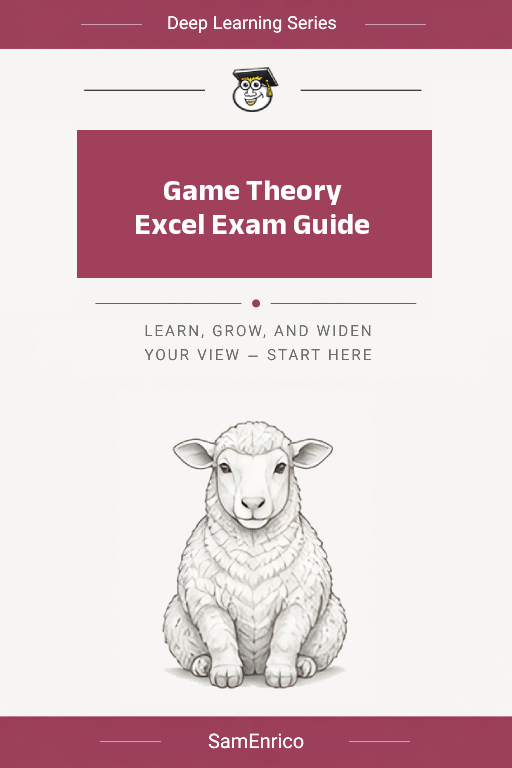
Non-FictionStudent's ShortcutGame Theory
Game Theory Excel Exam Guide
Models payoff matrices, Nash equilibrium, and sequ
by Guess Maira
Models payoff matrices, Nash equilibrium, and sequential games using Excel for industrial organization and game theory exams.
Formats
About this book
Free sample
Chapter 1: The 90-Second Advantage--–- It is 11:47 PM before your industrial organization final exam. You have been staring at a 3×3 payoff matrix for twenty-three minutes. Your scratch paper is covered with crossed-out numbers. You have tried circling best responses twice, but you keep losing track of which payoff belongs to which player. Your roommate texts you a meme about “game theory nightmares.” You are considering guessing randomly.
Stop. Close your notebook. Open Excel. What you are about to learn will change how you take exams forever.The dirty secret that top students know—and that no professor tells you—is that game theory exams are not really testing your ability to solve matrices. They are testing your ability to avoid algebraic mistakes under time pressure.
And algebra is precisely what computers were built to handle. Excel is not a crutch. It is a weapon. This chapter will prove that a tool sitting on nearly every exam computer can turn a twenty-minute manual slog into a ninety-second automated solution. By the time you finish reading these pages, you will have built a reusable template that finds Nash equilibria faster than most students can write down the players’ names.Why Your Calculator Is Lying to You Most students walk into a game theory exam with two weapons: a pencil and a calculator.
Both will fail you. The pencil runs out of eraser. The calculator does not understand strategic interdependence. When you solve a 3×3 Nash equilibrium by hand, you are not demonstrating game theory insight. You are demonstrating clerical endurance.
You must compute up to nine payoff comparisons, track which rows and columns contain best responses, identify mutual matches, and then do it all over again when you realize you misaligned Player 1’s payoffs with Player 2’s strategies.Consider a standard 3×3 coordination game. Manual solution requires: (1) circling Player 1’s highest payoff in each column, (2) circling Player 2’s highest payoff in each row, (3) identifying cells with two circles, (4) labeling those as Nash equilibria, (5) double-checking because you probably circled the wrong column in step one. Even a fast student takes…
This is the end of the free sample. Get the eBook to keep going. Buy now
Contents
- Chapter 1
- Chapter 2
- Chapter 3
- Chapter 4
- Chapter 5
- Chapter 6
- Chapter 7
- Chapter 8
- Chapter 9
- Chapter 10
- Chapter 11
- Chapter 12
Details
- Author
- Guess Maira
- Publisher
- SamEnrico
- Language
- English
- Genre
- Non-Fiction, Student's Shortcut, Game Theory
- Released
- 2026-06-01
- Pages (approx.)
- 125
- Available as
- eBook, Audiobook

Read better in the ZLOADR app
Your eBooks on your phone or tablet. Sign in with your SamEnrico account and start reading.
More by Guess Maira
 Creator Gear Upgrade PathGuess Maira$11.99
 Nightmare Processing For Dissociative Disorders GuideGuess Maira$11.99
 Kigali Startup CompetitionsGuess Maira$11.99
 Exercise Anger TriggersGuess Maira$11.99
 The Food Scale Accuracy GuideGuess Maira$11.99
 The Poisoned Chalice: Japan's Silent Serial KillerGuess Maira$11.99
 Immigration Compliance First HireGuess Maira$12.99
 Understanding Protein S DeficiencyGuess Maira$17.99
 How to Become a Optician ApprenticeGuess Maira$11.99
 Diadochite MiningGuess Maira$11.99
You may also like
 Hong Kong Handover 1997Dunn Johnnie$11.99
 Zumba For Postnatal Recovery CourseNeal Christian$11.99
 Zumba for BeginnersLadner Nikia$11.99
 YouTube Comment Mining GuideHumes Pandora$12.99
 Worry Box MeditationCarlin Rudy$11.99
 Workplace Stress MeditationNguyen Lynn$11.99
 Workplace Stress and Sleep RepairHawley Ivory$11.99
 Workplace Perfectionism CureDelaney Jeffry$11.99
 Workplace Injustice Anger GuideWallen Isabelle$11.99
 Work Addiction and Burnout LinkGreenwood Ester$11.99
 Women in Yoga and WellnessBeattie Galina$11.99
 Women in Stand Up ComedyChun Evangeline$11.99