
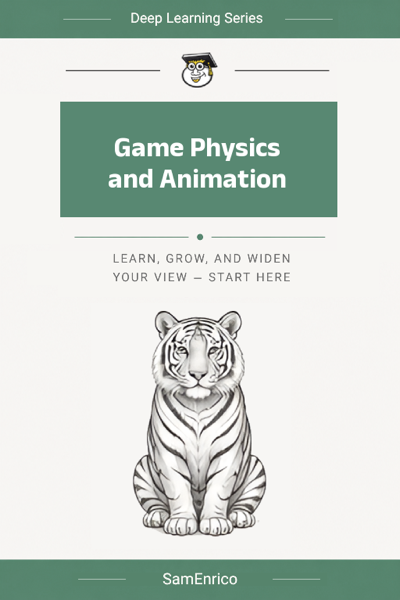
Game Physics and Animation
A Coursebook on Game Physics and Animation
A Coursebook on Game Physics and Animation
Formats
About this book
Free sample
Chapter 1: The Broken Puppet...–- In 1998, a single frame of animation broke the gaming industry’s collective heart. The game was Half-Life. The moment: a headcrab zombie, mid-lunge, its limbs twisting in ways no human body should ever move. Players didn’t notice the precise mathematical failure—they only felt it. Something was wrong.
The puppet strings were showing. That moment, buried in a thousand forum posts and forgotten review blurbs, revealed a truth that game developers have been chasing for twenty-five years: motion in a virtual world is not about reality. It is about the illusion of reality, and that illusion shatters the instant the audience sees the machinery underneath.This book is about how to keep those strings hidden. It is about the strange, beautiful, and deeply counterintuitive marriage between two disciplines that seem like natural partners but behave like jealous rivals: game animation (the art of creating deliberate, expressive motion) and game physics (the mathematical simulation of forces, collisions, and consequences). Animators want control.
Physicists want emergence. Animators hand-craft every eyebrow raise. Physicists throw a box down stairs and watch it bounce. The greatest games in history—The Legend of Zelda: Breath of the Wild, Dark Souls, Inside, Super Mario Odyssey—achieve their magic by forcing these two warring philosophies into an uneasy, productive marriage. This chapter explains why that marriage is so difficult, why it matters more than any single line of code or keyframe, and why you—whether you come to this book as an artist, a programmer, or a terrified hybrid of both—must learn to speak both languages fluently.The Unbearable Lightness of Being a Virtual Object Let us begin with a seemingly simple question: What is motion in a video game?
The obvious answer—"moving pixels on a screen"—is technically true but existentially useless. A deeper answer requires distinguishing between two fundamentally different ways of making things move.Hand-crafted animation is the older approach. An artist (or a team of artists) sits at a workstation and deliberately poses a character frame by frame. Every gesture, every stumble, every triumphant fist-pump is invented. The animator…
This is the end of the free sample. Get the eBook to keep going. Buy now
Contents
- Chapter 1
- Chapter 2
- Chapter 3
- Chapter 4
- Chapter 5
- Chapter 6
- Chapter 7
- Chapter 8
- Chapter 9
- Chapter 10
- Chapter 11
- Chapter 12
Details
- Author
- Morgan Richard
- Publisher
- SamEnrico
- Language
- English
- Genre
- Non-Fiction, Informative, Educational
- Released
- 2026-06-02
- Pages (approx.)
- 142
- Available as
- eBook, Audiobook

Read better in the ZLOADR app
Your eBooks on your phone or tablet. Sign in with your SamEnrico account and start reading.
More by Morgan Richard
 Meditation for Decision AnxietyMorgan Richard$11.99
 Parenting Stress Partnership GuideMorgan Richard$11.99
 Body Scan for BiofeedbackMorgan Richard$11.99
 Memory Palace Blueprint CourseMorgan Richard$11.99
 Parent Caregiver Support GroupsMorgan Richard$11.99
 Semester Planning Stress GuideMorgan Richard$11.99
 Talent Migration and HousingMorgan Richard$11.99
 Loving Kindness For PerfectionistsMorgan Richard$11.99
 Kenai Fjords Cold WaterMorgan Richard$11.99
 The Last Stand of the Swiss: Blood and Honor at Novara (1513)Morgan Richard$11.99
 Woody Herman: Four Brothers, One Family of SoundMorgan Richard$11.99
 Gilgamesh’s Descent: The King Who Walked with GodsMorgan Richard$11.99