
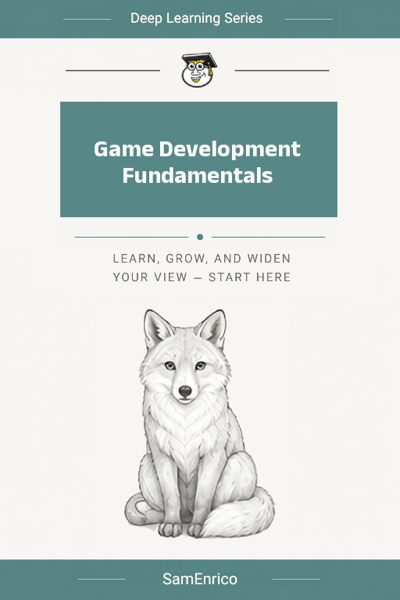
Non-FictionInformativeEducational
Game Development Fundamentals eBook
A Coursebook on Game Development Fundamentals
by Alonzo Rea
A Coursebook on Game Development Fundamentals
Formats
Free sample
Chapter 1: The Forgotten Vocabulary--– You already understand games. You have spent hundreds – maybe thousands – of hours playing them. You can feel when a game is fun, when it is unfair, when it respects your time, and when it insults your intelligence. But if someone asked you to explain why a game works, could you do it? Could you name the invisible machinery that makes Tetris addictive despite having no story?
Could you articulate why The Sims feels so different from Call of Duty, even though both run on computers? Could you point to the exact moment a game stops being a toy and becomes a puzzle, or the instant a puzzle transforms into a sport?Most people cannot. Not because they lack intelligence, but because they lack vocabulary. Games are ancient – older than written language – yet we have only recently begun to build a shared, precise language for talking about them. Without that language, you are like a musician who cannot read sheet music or name the notes.
You can play, but you cannot compose. You cannot critique. You cannot improve systematically.This chapter builds your foundational vocabulary. By the end, you will be able to look at any game – digital or analog, new or ancient – and name its moving parts. You will distinguish a game from a toy, a puzzle, and a sport.
You will learn the MDA framework, the most widely used analytical tool in professional game design. You will understand the magic circle, emergence, and the difference between linear and nonlinear play. And you will never again say, “I don’t know why, but this game is boring.” Instead, you will say, “The negative feedback loop is too weak, the aesthetics of fellowship are absent, and the mechanics create degenerate dynamics.”That is power. That is the first step toward becoming not just a player, but a maker.What This Chapter Will Teach You By the time you close this chapter, you will be able to:Define a game with precision, separating it from toys, puzzles, and sports.Apply the MDA (Mechanics, Dynamics, Aesthetics) framework to any game.Explain the magic circle and why players voluntarily accept artificial rules.Distinguish linear from emergent gameplay and identify each in real examples.Deconstruct a board game or video game using formal vocabulary.Recognize why Tetris works as a pure system without narrative or advanced graphics.These are not abstract academic exercises. Every skill here will be used in later chapters.
When you prototype in Chapter 4, you will use MDA to diagnose what is broken. When you design levels in Chapter 8, you will rely on the language of pacing and emergence. When you playtest in Chapter 10, you will describe problems precisely instead of saying, “It feels off.”Vocabulary is not decoration. Vocabulary is surgical precision.The First Cut: Game vs. Toy vs.
Puzzle vs. Sport Before we can design games, we must know what a game is – and what it is not. Most people use the word “game” to cover everything from a bouncing ball to a chess match to a narrative-driven RPG. But these experiences are structurally different. Confusing them leads to bad design.What Is a Toy?A toy is an interactive object with no built-in goal, no enforced rules, and no failure state.
You play with a toy. You do not win or lose at a toy.Consider a rubber ball. You can bounce it, throw it, spin it, or put it on a shelf. The ball does not tell you what to do. It does not track score.
It has no victory condition. The ball is a toy. The same is true for building blocks, a doll, a yo-yo, or a fidget spinner. Toys invite free play – undirected, self-motivated exploration.Toys become boring when the player runs out of interesting interactions. A ball remains fun because physics creates infinite variety.
A single plastic block becomes boring quickly because it only sits there. Good toys have hidden complexity.Key test for a toy: Can you “win” at it? If no, it is a toy or an object, not a game.What Is a Puzzle?A puzzle has a fixed solution and no emergent behavior. You solve a puzzle. Once you know the solution, the puzzle loses its challenge.A crossword puzzle has exactly one correct set of answers.
A Rubik’s cube has a solved state. A jigsaw puzzle has a single completed image. Puzzles are about discovery, memory, or logic. They do not change based on your previous moves – not really. The solution is baked in.Some people call puzzles “static games,” but that is misleading.
Puzzles do not generate novel situations. Every player who solves a given crossword ends up with the same letters in the same boxes. There is no meaningful choice, only correct and incorrect paths.Key test for a puzzle: If you solve it once, does it become trivial? If yes, it is a puzzle, not a game (or it is a game with puzzle elements).What Is a Game?A game, in the formal sense used by designers, has four required components:Rules – A formal system that defines what players can and cannot do.Goal – A clear victory condition or success state.Conflict – Obstacles that prevent immediate goal achievement, created by the system, opponents, or chance.Voluntary participation – Players choose to accept the rules and pursue the goal.If any of these is missing, you do not have a game. You have something else.Take chess.
Rules define how pieces move. Goal is checkmate. Conflict comes from an opponent who actively blocks you. Participation is voluntary – no one forces you to sit at the board. Chess is a game.Take a slot machine.
Rules exist (pull lever, match symbols). Goal is to match winning combinations. Conflict? The machine is designed to pay out less than it takes in, but there is no intelligent opposition – just probability. Some designers call this a “game of chance” but others argue it is a gambling device, not a true game, because the conflict is purely mathematical.
This ambiguity matters. When you design, you must decide what kind of experience you are building.What Is a Sport?A sport is a game with physical skill as the primary conflict mechanism and often (but not always) a competitive physical context. Basketball, soccer, tennis – these are sports. They are also games. “Sport” is a subset of games.The distinction matters only when you are designing for physical interfaces (VR, motion controls, fitness games).
For most digital game design, “sport” is just a flavor of game.The Spectrum, Not a Box Reality is messy. Many experiences sit between categories:The Sims: Has goals (get a promotion, build a house) but strong toy-like free play. Many players never “win” – they just play with systems. Is it a game or a toy? It is a toy-game hybrid.Minecraft in Creative Mode: No goals, no conflict, no failure.
Pure toy. Minecraft in Survival Mode: Full game.Portal: Puzzles embedded inside a game. You solve spatial puzzles, but the game also has progression, narrative, and a victory condition. It is a game with puzzle mechanics.The goal is not to force everything into a box.…
This is the end of the free sample. Get the eBook to keep going. Buy now
About this book
Details
- Author
- Alonzo Rea
- Publisher
- SamEnrico
- Language
- English
- Genre
- Non-Fiction, Informative, Educational
- Released
- 2026-05-06
- Pages (approx.)
- 154
- Available as
- eBook, Audiobook

Read better in the ZLOADR app
Your eBooks on your phone or tablet. Sign in with your SamEnrico account and start reading.
More by Alonzo Rea
 Caretaking From ChildhoodAlonzo Rea$11.99
 Professor Communication GuideAlonzo Rea$11.99
 Mindfulness Meditation Body Scan TutorialAlonzo Rea$11.99
 Meditation for Perfectionism AnxietyAlonzo Rea$11.99
 Number Shape Peg WorkbookAlonzo Rea$11.99
 Body Scan for Somatic ExperiencingAlonzo Rea$11.99
 Parent Caregiver AnxietyAlonzo Rea$11.99
 Metta For People PleasersAlonzo Rea$11.99
 Dual Career Couple MigrationAlonzo Rea$11.99
 The Silk Road Escape: How a Convict Outsmarted the SystemAlonzo Rea$11.99
 The Quantum Whisperer: How a Teen Genius Cracked the Code of the CosmosAlonzo Rea$11.99
 Growing DracaenaAlonzo Rea$11.99
You may also like
 Hong Kong Handover 1997Dunn Johnnie$11.99
 Zumba For Postnatal Recovery CourseNeal Christian$11.99
 Zumba for BeginnersLadner Nikia$11.99
 YouTube Comment Mining GuideHumes Pandora$12.99
 Worry Box MeditationCarlin Rudy$11.99
 Workplace Stress MeditationNguyen Lynn$11.99
 Workplace Stress and Sleep RepairHawley Ivory$11.99
 Workplace Perfectionism CureDelaney Jeffry$11.99
 Workplace Injustice Anger GuideWallen Isabelle$11.99
 Work Addiction and Burnout LinkGreenwood Ester$11.99
 Women in Yoga and WellnessBeattie Galina$11.99
 Women in Stand Up ComedyChun Evangeline$11.99