
Non-FictionInformativeEducational
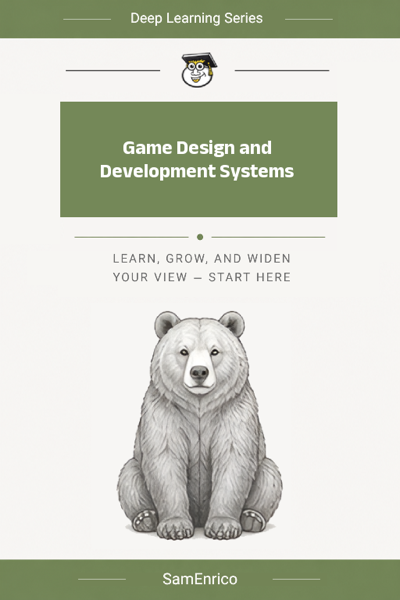
Game Design and Development Systems eBook
A Coursebook on Game Design and Development System
by Clem Emerita
A Coursebook on Game Design and Development Systems
Formats
Free sample
Chapter 1: The Sword Fallacy--–- Every novice game designer begins the same way. They sit down with a notebook or a blank screen, overflowing with ideas. “There will be swords,” they write. “And dragons. And a skill tree.
And a dark forest. And a crafting system. And—” The list grows. Features pile upon features. The document becomes a catalog of nouns, a shopping list of cool things that should exist in the world.
This is not design. This is wishful thinking.The difference between a feature list and a functional game system is the difference between owning bricks and building a cathedral. The bricks are necessary. You cannot build without them. But bricks alone provide no shelter, no beauty, no structure.
The cathedral emerges from the relationships between the bricks—how they support each other, how weight transfers down to the foundation, how light passes through the spaces between them. A game system is the same. It is not what you put into the game. It is how those things behave, interact, and change over time.This entire book is about that distinction. If you master nothing else, master this: Content is a noun.
A system is a verb.The Deceptive Simplicity of a Single Sword Consider a sword. Just one sword. In a novice designer’s document, it appears as a line item: “Sword – deals 10 damage.” That is content. It exists. The player can hold it, swing it, and see numbers float off enemies.
This is a feature.Now ask yourself: Where did the sword come from? Does it drop from enemies? If so, at what rate? Does every goblin carry a sword, or only one in twenty? Does the sword degrade with use?
If so, how many swings before it breaks? Can it be repaired? If yes, with what materials? Where do those materials come from? Can the sword be upgraded?
Does it have levels? Does it have elemental variants? Can the player craft a sword from raw ore? If so, what is the recipe? Does the sword have a level requirement?
Does it scale with the player’s Strength stat? If yes, what is the scaling formula? Is it linear? Exponential? Logarithmic?
Does the sword have a unique ability that triggers on critical hits? How often can that ability fire? Does it have a cooldown? Does the cooldown reset on death? On saving?
On logging out?Each question reveals another system hiding beneath the surface of that single sword. The durability system. The drop rate system. The crafting system. The repair economy.
The stat scaling system. The cooldown system. The save state system. By the time you have answered all the questions, you are no longer describing a sword. You are describing the rules that govern every sword in your game.
That is a system.This chapter is about recognizing that shift in perspective. It is the most difficult transition a new designer makes—moving from thinking about what exists to thinking about how things behave. The rest of this book will teach you the tools, the math, and the documentation practices to build those behaviors. But first, you must learn to see the systems hiding inside every feature.The Anatomy of a Game System Before we proceed, we need a working definition. A game system is a set of interconnected components that produce emergent behavior through their interactions, governed by rules that can be simulated and balanced.Let us break that down.Set of interconnected components means the system has parts.
Those parts could be variables (health, gold, experience), entities (players, enemies, items), or relationships (if-then rules, formulas, triggers). A system with one part is not a system—it is a static value. The sword in isolation is not a system. The sword plus the durability rules plus the repair materials plus the drop rate is a system.Emergent behavior means the system produces outcomes that are not explicitly programmed. No designer at Nintendo wrote a script that says, “If the player places a metal weapon on the ground and lightning strikes nearby, electrocute all enemies in a ten-meter radius.” Instead, they wrote three smaller rules: metal conducts electricity, lightning strikes the highest metal object in an area, and electricity damages enemies.
When a player drops a metal sword during a thunderstorm, the combination of these rules produces an emergent event: the sword becomes a lightning rod. The designer did not predict that specific use. The system generated it.Governed by rules that can be simulated means the system is deterministic enough to model. If you cannot build a spreadsheet that approximates the system’s behavior, you do not understand the system well enough to design it. This does not mean every system must be perfectly predictable.
Randomness is allowed. But the distribution of randomness must be knowable. A system that says “the player sometimes gets lucky” is not a system. A system that says “the player has a 20% chance to crit, using a shuffle bag algorithm to prevent streaks” is a system.Can be balanced means the system has tunable parameters. If every variable in your system is binary (on/off, present/absent), you cannot balance it.
You can only add or remove features. Balanced systems have knobs—diminishing returns, cooldowns, costs, drop rates, scaling exponents. You turn these knobs until the system feels fair, engaging, and sustainable.The Novice Mistake: Top-Down Vision Without Bottom-Up Logic There is a particular conversation that happens in every game studio, often between a creative director and a systems designer. It goes like this:Creative Director: “I want the combat to feel visceral and empowering. The player should feel like a demigod.”Systems Designer: “Okay.
What does that mean mechanically?”Creative Director: “You know. Visceral. Like, when they hit an enemy, it really hurts.”Systems Designer: “What is the time to kill on a basic enemy? Two hits? Five?
Ten?”Creative Director: “I don’t know. Whatever feels right.”Systems Designer: “What is the miss rate? Can attacks miss? If so, how often?”Creative Director: “I don’t want them to miss. That doesn’t feel empowering.”Systems Designer: “If they never miss, then every fight is deterministic.
The only question is how many hits. That can feel mathematical, not visceral.”Creative Director: “Then add a critical hit system. Crits feel great.”Systems Designer: “What is the crit chance? What is the crit multiplier? Does crit chance scale with player stats?
Does it have a pity timer?”Creative Director: “...Just make it feel good.”This conversation fails because the creative director is thinking top-down. They have a vision—a feeling, a mood, an aesthetic goal. That vision is valuable. Games without vision are soulless spreadsheets. But vision without bottom-up logic is a castle built on fog.
You cannot implement “visceral.” You can implement “critical hits deal double damage and trigger a screen shake and a sound effect and a hitstop of 0.1 seconds.” Those are rules. Those are systems.The top-down approach asks, “What experience do I want the player to have?” The bottom-up approach asks, “What rules, when combined, produce that experience?” You need both. The top-down provides the destination. The bottom-up provides the path.This book is bottom-up. It…
This is the end of the free sample. Get the eBook to keep going. Buy now
About this book
Details
- Author
- Clem Emerita
- Publisher
- SamEnrico
- Language
- English
- Genre
- Non-Fiction, Informative, Educational
- Released
- 2026-06-03
- Pages (approx.)
- 144
- Available as
- eBook, Audiobook

Read better in the ZLOADR app
Your eBooks on your phone or tablet. Sign in with your SamEnrico account and start reading.
More by Clem Emerita
 Habit Maintenance GuideClem Emerita$11.99
 Spouse Loss Travel GuideClem Emerita$11.99
 Loving Kindness for a Dying PetClem Emerita$11.99
 Anki For Fantasy FootballClem Emerita$11.99
 The 1857 Uniforms ExplainedClem Emerita$11.99
 The Stress Fitness RecoveryClem Emerita$11.99
 Qigong For Pain ReliefClem Emerita$11.99
 London Student Pop Up SeasonClem Emerita$11.99
 Yakuza Construction IndustryClem Emerita$11.99
 The Billion-Dollar Bet: How Donald Trump Built, Bankrupted, and Rebuilt His EmpireClem Emerita$11.99
 The Day the Internet Broke: A Timeline of ChaosClem Emerita$11.99
 Love and Cannon Fire: The Queen and the Tsar in the Great Northern WarClem Emerita$11.99
You may also like
 Hong Kong Handover 1997Dunn Johnnie$11.99
 Zumba For Postnatal Recovery CourseNeal Christian$11.99
 Zumba for BeginnersLadner Nikia$11.99
 YouTube Comment Mining GuideHumes Pandora$12.99
 Worry Box MeditationCarlin Rudy$11.99
 Workplace Stress MeditationNguyen Lynn$11.99
 Workplace Stress and Sleep RepairHawley Ivory$11.99
 Workplace Perfectionism CureDelaney Jeffry$11.99
 Workplace Injustice Anger GuideWallen Isabelle$11.99
 Work Addiction and Burnout LinkGreenwood Ester$11.99
 Women in Yoga and WellnessBeattie Galina$11.99
 Women in Stand Up ComedyChun Evangeline$11.99