
Non-FictionSelf-Help / Gambling Recovery
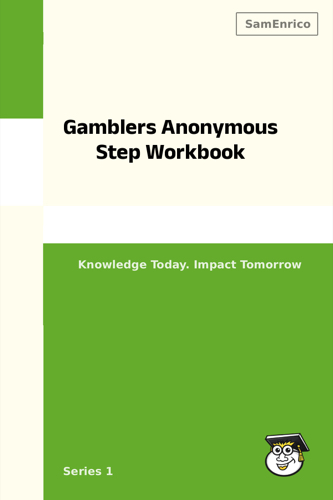
Gamblers Anonymous Step Workbook eBook
Adapts twelve steps for compulsive gambling with f
Adapts twelve steps for compulsive gambling with financial amends and bettor-specific examples.
Formats
Free sample
Chapter 1: The First Bet...--–- The machine beeped. Not a loud alarm. Not a winner’s fanfare. Just a small, polite beep, the kind that says insufficient funds. You swiped again.
Same beep. You checked your balance on your phone—a thing you once promised yourself you would never do in public—and saw a number that looked like a typo. Three hours ago, that number had four digits. Now it had two. And somewhere in the back of your skull, a voice that sounded exactly like your own whispered: You can get it back.
You always do.That voice is the subject of this book. That voice is not your friend. That voice has a name, and we will call it the Chaser.Before you write a single word in this workbook, before you attend your first meeting or call a sponsor, you must understand one thing with absolute clarity: recovery from compulsive gambling is not about winning. It is not about control. It is not about learning to bet responsibly.
Recovery is about never placing the first bet again.Not the second bet. Not the chase bet. Not the “just this once” bet. The first bet.Everything you are about to read—every inventory sheet, every amends script, every financial worksheet—exists to protect you from that single decision. Because here is what every recovered gambler knows and every active gambler denies: You do not lose control on the tenth bet.
You lost it on the first.The Lock-In: What Actually Happens Inside Your Skull Let us name the thing that has been happening to you.Gambling researchers call it the “Lock-In.” Gamblers Anonymous members call it “the trance.” You may have called it “Tuesday.” Whatever name you use, the experience is the same: you sit down at a machine, a table, or in front of an app, and at some point, you cannot leave. Not because you do not want to. Not because you lack willpower. Because your brain has been hijacked.Here is the neurology, stripped of jargon. Your brain runs on a chemical called dopamine.
Dopamine is not the pleasure chemical, as pop psychology often claims. Dopamine is the anticipation chemical. It floods your system when you expect a reward. And nothing—absolutely nothing in human experience—produces dopamine like variable ratio reinforcement. That is the technical term for “sometimes you win, sometimes you lose, and you never know when.”A slot machine is a dopamine pump.
A sports parlay is a dopamine pump. A hand of blackjack, a spin of roulette, a “cash out” button on a betting app—all of them are engineered to exploit the same neural circuit that kept your ancestors scanning the horizon for unpredictable food sources. The difference is that your ancestors, when they found food, ate it and stopped. You, when you win, place another bet.The Lock-In occurs when your dopamine system overrides your prefrontal cortex—the part of your brain responsible for judgment, foresight, and self-control. This is not a metaphor.
Brain scans of active gamblers show that during a betting session, blood flow to the prefrontal cortex decreases by as much as 30 percent. You are literally less intelligent when you are locked in. You are not making bad decisions because you are weak. You are making bad decisions because the part of your brain that makes good decisions has been temporarily silenced.This is what Step One means when it says “powerless.” Not weak. Not lazy.
Not morally defective. Powerless as a diabetic is powerless over sugar. Your body reacts to gambling differently than a social gambler’s body does. A social gambler can place a twenty-dollar bet, lose it, shrug, and go home. You cannot.
Not because you are a bad person. Because your dopamine system is wired for the chase.The first bet opens the door. The Lock-In kicks the door down. And by the time you realize you are trapped, you have already lost more than you can afford.The Diagnostic Checklist: Twenty Questions for the Compulsive Bettor Gamblers Anonymous published a set of twenty questions decades ago. They have not changed much, because compulsive gambling has not changed much—only the delivery systems have.
These questions are not a test you can fail. They are a mirror. Answer them honestly.Place a checkmark next to any question that applies to you.___ Did you ever lose time from work or family due to gambling?___ Has gambling ever made your home life unhappy?___ Did gambling affect your reputation?___ Have you ever felt remorse after gambling?___ Did you ever gamble to get money to pay debts or solve financial difficulties?___ Did gambling cause a decrease in your ambition or efficiency?___ After losing, did you feel you must return as soon as possible and win back your losses?___ After a win, did you have a strong urge to return and win more?___ Did you often gamble until your last dollar was gone?___ Did you ever borrow money to gamble?___ Have you ever sold anything to finance gambling?___ Were you reluctant to use “gambling money” for normal expenditures?___ Did gambling make you careless of the welfare of yourself or your family?___ Did you ever gamble longer than you planned?___ Have you ever gambled to escape worry, trouble, boredom, or loneliness?___ Have you ever committed, or considered committing, an illegal act to finance gambling?___ Did gambling cause you to have difficulty in sleeping?___ Do arguments, disappointments, or frustrations create within you an urge to gamble?___ Did you ever have an urge to celebrate any good fortune by a few hours of gambling?___ Have you ever considered self-destruction or suicide as a result of your gambling?If you checked seven or more of these boxes, you are a compulsive gambler. Not a “problem gambler.” Not a “heavy bettor.” A compulsive gambler. The same diagnosis, the same neurological condition, the same disease as every person in every GA meeting around the world.Here is the good news: you are not alone.
Here is the better news: the condition is treatable. Here is the uncomfortable news: treatment requires that you never place the first bet again.The First Bet Principle: Why One Is Too Many In GA meetings, you will hear a phrase repeated so often it becomes a chant: One bet is too many, and a thousand is never enough.This is not poetry. It is a clinical observation. The compulsive gambler does not have a “safe dose.” There is no amount of gambling that will satisfy the urge because the urge is not for winning. The urge is for the chase.
And the chase, by definition, cannot end.Consider the following thought experiment, which you should actually perform on a piece of paper.Imagine that tonight, against all probability, you win big. Not a few hundred dollars. A life-changing amount. Enough to pay off every debt, buy a new car, take a vacation, and still have money left over. Write that number down.
Now ask yourself: would you stop? Would you walk away forever?If you are a compulsive gambler, the honest answer is no. You would not stop. You would be thrilled. You would pay off some…
This is the end of the free sample. Get the eBook to keep going. Buy now
About this book
Details
- Author
- Carrier Ollie
- Publisher
- SamEnrico
- Language
- English
- Genre
- Non-Fiction, Self-Help / Gambling Recovery
- Released
- 2026-06-06
- Pages (approx.)
- 137
- Available as
- eBook, Audiobook

Read better in the ZLOADR app
Your eBooks on your phone or tablet. Sign in with your SamEnrico account and start reading.
More by Carrier Ollie
 Validation For ADHD BrainsCarrier Ollie$11.99
 The Mother Anger GuideCarrier Ollie$11.99
 HIIT Sleep Quality GuideCarrier Ollie$11.99
 The French Feudalism GuideCarrier Ollie$11.99
 The Black Magic Siege: Australia's Cult Hostage Horror (2004)Carrier Ollie$11.99
 The Breeder's Guide to Leicester Longwool SheepCarrier Ollie$11.99
 Retention Team Structure GuideCarrier Ollie$12.99
 Harness HARO for PRCarrier Ollie$12.99
 Irish Setter BreedingCarrier Ollie$11.99
 How to Start a Baths Made of Fibre Glass Business (Beginners Guide)Carrier Ollie$11.99
You may also like
 Hong Kong Handover 1997Dunn Johnnie$11.99
 Zumba For Postnatal Recovery CourseNeal Christian$11.99
 Zumba for BeginnersLadner Nikia$11.99
 YouTube Comment Mining GuideHumes Pandora$12.99
 Worry Box MeditationCarlin Rudy$11.99
 Workplace Stress MeditationNguyen Lynn$11.99
 Workplace Stress and Sleep RepairHawley Ivory$11.99
 Workplace Perfectionism CureDelaney Jeffry$11.99
 Workplace Injustice Anger GuideWallen Isabelle$11.99
 Work Addiction and Burnout LinkGreenwood Ester$11.99
 Women in Yoga and WellnessBeattie Galina$11.99
 Women in Stand Up ComedyChun Evangeline$11.99