
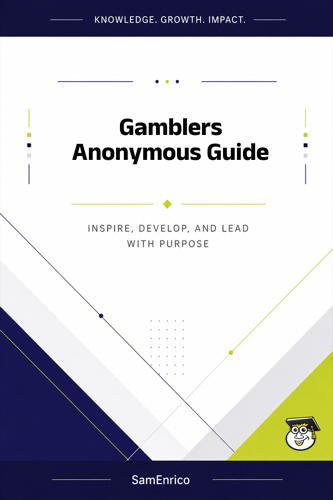
Gamblers Anonymous Guide eBook
Work the twelve steps for compulsive betting using
Work the twelve steps for compulsive betting using this practical recovery workbook.
Formats
Free sample
Chapter 1: The Mirror Doesn't Lie--–- Before you read a single word of this chapter, I need you to understand something that will determine whether this book helps you or sits on a shelf collecting dust: the person who most needs to read this chapter is the person who is already telling themselves, "I don't need this chapter. I already know I have a problem."That voice in your head—the one that says you're different, that you're not as bad as "those people," that you can stop anytime you really want to—that voice is the same voice that has been placing bets for years while promising to stop tomorrow. That voice is not your friend. That voice is the addiction speaking in your own language, using your own vocabulary, hiding inside your own skull like a parasite that has learned to mimic its host's thoughts so perfectly that you can no longer tell where you end and the compulsion begins.This chapter is called Step One for a reason. It is the first step not because it is easy, but because without it, the other eleven steps are useless.
You cannot build a house on sand, and you cannot build recovery on denial. Every person who has ever recovered from compulsive gambling—every single one—began by admitting two things that their pride, their fear, and their addiction had fought to hide. Those two things are the entire content of Step One: "We admitted we were powerless over gambling—that our lives had become unmanageable."If you are reading these words, you have likely already lost more money than you care to admit. You have likely lied to people you love. You have likely promised yourself "never again" and then broken that promise within hours or days.
You have likely felt the unique, sickening collapse of winning a large bet and feeling nothing—or worse, feeling the immediate urge to bet again because the win wasn't enough. You have likely sat in a parked car, stared at a phone screen, and calculated how much of your rent money you had just lost in fifteen minutes of clicking.You are not alone. And you are not a bad person. But you are a person who has been living inside a lie, and the only way out is to stop running from the truth and start walking directly into it.Let us begin.The Two Words That Change Everything The first word is "powerless." For most people, that word sounds like weakness. Our culture worships willpower, self-discipline, and the bootstrap myth that anyone can overcome anything if they just try hard enough.
If you have internalized that belief—and almost all of us have—then admitting powerlessness feels like admitting moral failure. It feels like saying "I am weak" or "I am defective" or "I don't have what it takes."That is not what powerlessness means in Step One.Powerlessness in the Gamblers Anonymous framework is a clinical, practical, and honest recognition of reality. It means that once you start gambling, you cannot reliably stop. It means that your intentions—no matter how sincere—do not translate into control. It means that you have tried to quit, moderate, set limits, or walk away, and every single one of those attempts has failed not because you didn't try hard enough, but because you were fighting a brain condition that does not respond to good intentions.Let me be specific.
A person who is not powerless over gambling can do any of the following:Walk into a casino with a twenty-dollar bill, lose it, and walk out without withdrawing more money Place a sports bet on a single game and not immediately place another Go a month without gambling without feeling obsessed, irritable, or restless Receive an unexpected financial windfall without thinking about betting it See a gambling advertisement and feel nothing more than mild disinterest If you cannot reliably do these things—if you have tried and failed, if you have succeeded occasionally but then catastrophically failed later, if you have told yourself "this time will be different" and then watched yourself do the same thing again—then you are powerless over gambling. That is not a judgment. That is a diagnosis. It is as factual as saying that a person with a peanut allergy cannot safely eat peanuts. The allergy is not a character flaw.
It is a condition. And the first step toward managing that condition is admitting that it exists.The second word is "unmanageable." This is where many gamblers get stuck because they focus only on the financial damage. Yes, you have lost money. Perhaps a lot of money. Perhaps an amount that makes you nauseous to calculate.
But unmanageability goes far beyond your bank account. It reaches into every corner of your life, often in ways you have been too ashamed to examine.Has gambling caused you to lie? To hide your phone screen when someone walks by? To invent excuses for where money went? To call in sick to work when you were actually chasing losses?
To neglect your health, skip meals, lose sleep, or avoid medical care because you were too focused on the next bet? To feel so consumed by shame that you have considered hurting yourself? To withdraw from people who love you because you couldn't face their questions? To feel a constant, low-level hum of anxiety that never fully turns off?If you answered yes to any of these, your life is unmanageable. Not might be.
Not could become. Is. Right now. And the relief you are seeking—the relief that gambling once promised but never delivered—will not come from one more win. It will not come from paying off your debts.
It will come only from stopping the cycle entirely and rebuilding your life from the ground up.The Seven Lies That Keep You Trapped Denial is not just saying "I don't have a problem." Denial is a sophisticated, adaptive system of self-deception that has kept you gambling long past the point when any reasonable person would have stopped. The following seven lies are the most common. Read each one slowly. Notice if your stomach tightens or your mind offers a defense. That tightening is the addiction recognizing that its cover is being blown.Lie #1: "I can win it back."This is the most seductive lie because it contains a grain of mathematical truth.
Yes, if you place another bet and win, you will have more money than you have right now. But the lie hides three facts. First, the vast majority of bets lose—that is how casinos, sportsbooks, and poker rooms make their money. Second, even if you win, you will not stop. Winning does not satisfy the compulsion; it fuels it.
Every winner in the history of gambling addiction has discovered that the win only led to larger bets, more frequent bets, and ultimately larger losses. Third, the money you lost is already gone. Chasing losses is not a financial strategy; it is a symptom of the disease.Lie #2: "It's my only pleasure."When you have been gambling compulsively, your brain's reward system has been hijacked. Normal…
This is the end of the free sample. Get the eBook to keep going. Buy now
About this book
Details
- Author
- Gallardo Alica
- Publisher
- SamEnrico
- Language
- English
- Genre
- Non-Fiction, Health & Wellness, 12 Step Gambling
- Released
- 2026-06-06
- Pages (approx.)
- 143
- Available as
- eBook, Audiobook

Read better in the ZLOADR app
Your eBooks on your phone or tablet. Sign in with your SamEnrico account and start reading.
More by Gallardo Alica
 Laureates Who RefusedGallardo Alica$11.99
 Humor In Conversation GuideGallardo Alica$11.99
 The Healthcare Professional AngerGallardo Alica$11.99
 Stephen Colbert Persona TruthGallardo Alica$11.99
 Tides of Empire: The Unstoppable Rise of the Dutch Merchant AdventurersGallardo Alica$11.99
 Understanding Purpura, Schönlein–henochGallardo Alica$17.99
 Zapier GuideGallardo Alica$12.99
 Payoneer African Exporters GuideGallardo Alica$12.99
 Football PasserGallardo Alica$11.99
 How to Start a Cherry Brandy Business (Beginners Guide)Gallardo Alica$11.99