
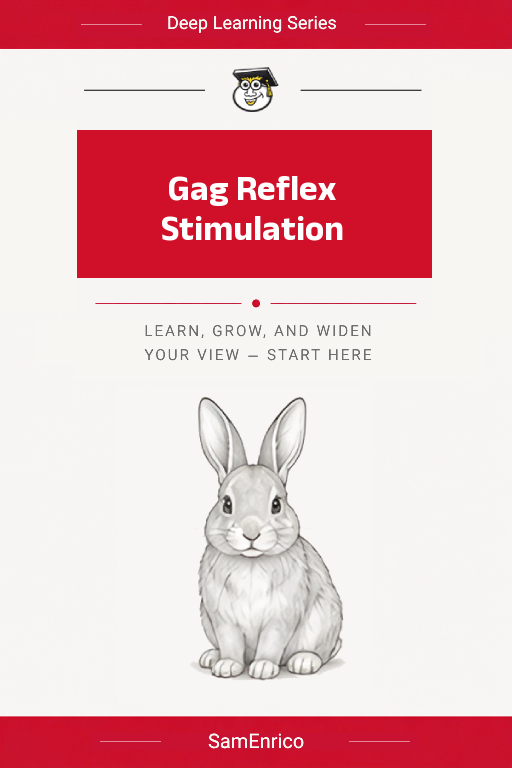
Gag Reflex Stimulation eBook
Gently stimulate soft palate with tongue to activa
Gently stimulate soft palate with tongue to activate vagus nerve and reduce anxiety.
Formats
Free sample
Chapter 1: The Mouth’s Secret...–- You are about to learn something that your nervous system already knows but has never told you. Right now, without moving your hands, without closing your eyes, without changing your breathing, gently touch the tip of your tongue to the bumpy ridge just behind your upper front teeth. Now, very slowly, slide it backward across the roof of your mouth. Keep sliding until the hard bone gives way to something softer. Stop there.
Do not go further. Just feel that soft spot. Hold for five seconds. Now relax.What did you notice? Perhaps nothing.
Perhaps a subtle shift in your pulse. Perhaps a quieting of the internal chatter that has been running in the background all day. Perhaps nothing at all on the first try—and that is perfectly fine. The fact that you are reading this sentence means you have already begun something unusual. You have voluntarily placed your tongue on a part of your body that most people spend their entire lives avoiding.
You have touched your soft palate without gagging. That alone is a small victory.This book is about that soft spot. It is about the neural superhighway that runs from the roof of your mouth to the base of your brain, and from there to every major organ in your body. It is about a reflex that has been protecting you since birth—the gag reflex—and how to transform it from a source of fear into a tool for profound calm. This is not a book about suppressing your body’s signals.
It is about learning to listen to them with such precision that you can turn down the volume on anxiety, panic, and rumination without medication, without equipment, and without anyone ever knowing what you are doing.The Problem That No One Talks About Let us name the elephant in the room. The title of this book contains the words “gag reflex,” and for many readers, those two words produce an immediate, visceral reaction. You might feel a tightening in your throat. You might swallow involuntarily. You might even feel a small wave of nausea just reading the phrase.
That reaction is not weakness. It is not a sign that this book is wrong for you. On the contrary, that reaction is exactly why you need to read this book.The gag reflex is one of the most powerful protective mechanisms in the human body. It is a violent, involuntary contraction of the pharyngeal muscles designed to prevent choking, aspiration, and death. It is fast, it is aggressive, and it is completely outside your conscious control.
When something touches the back of your throat—or even comes close to touching it—your brainstem makes a decision in milliseconds: danger or not danger? If the answer is danger, the pharynx contracts, the diaphragm spasms, and the contents of your stomach attempt to evacuate at high speed. This is not a malfunction. This is a masterpiece of evolutionary engineering.But here is the problem. The gag reflex does not have a nuanced vocabulary.
It speaks only in extremes: safe or not safe, continue or evacuate, stay or run. And because it is wired directly into the vagus nerve—the same nerve that controls heart rate, digestion, and emotional regulation—the gag reflex can hijack your entire nervous system in a fraction of a second. Have you ever gagged while brushing your teeth? While taking a pill? While visiting the dentist?
In those moments, did you also feel your heart race? Your palms sweat? A wave of panic that had nothing to do with actual danger? That is the gag reflex talking to your vagus nerve, and your vagus nerve talking to your entire body.The standard advice for dealing with a sensitive gag reflex is simple: avoid triggers. Do not brush too far back.
Take smaller pills. Ask the dentist to be gentle. But avoidance is not a solution. Avoidance shrinks your world. It turns your own mouth into a minefield.
And for the millions of people who suffer from anxiety disorders, panic attacks, or chronic stress, the gag reflex becomes one more thing to fear—one more bodily signal that something is wrong.This book offers a different path. Not avoidance, but precision. Not suppression, but negotiation. You will learn that the gag reflex is not an on-off switch but a dimmer. You will learn that the difference between gagging and calming is measured in millimeters, milliseconds, and milligrams of pressure.
And most importantly, you will learn that the same nerve that produces the most unpleasant sensation in your mouth can also produce the most profound sensation of safety you have ever felt.The Oral-Vagal Axis: A Neural Superhighway To understand why the roof of your mouth holds the key to anxiety relief, you need to understand a piece of anatomy that most medical textbooks ignore and most self-help books oversimplify. I call it the Oral-Vagal Axis, and it is one of the most direct neural pathways in the human body.Let us start with the vagus nerve. The word “vagus” comes from Latin, meaning “wandering,” and it is an apt description. The vagus nerve is the tenth cranial nerve, and it is the longest and most complex of the twelve. It begins in the brainstem, just behind the ears, and wanders down through the neck, through the chest, and into the abdomen, branching out like a tree to innervate the heart, the lungs, the digestive tract, the liver, the spleen, and dozens of other organs along the way.
If the spinal cord is the information superhighway for movement and sensation, the vagus nerve is the information superhighway for safety and danger. It is the nerve that tells your heart to slow down after a scare. It is the nerve that tells your stomach to digest when you are relaxed. It is the nerve that tells your face to smile when you see a friend.But the vagus nerve does not just send signals from the brain to the body. It also sends signals from the body to the brain.
In fact, approximately eighty percent of vagal fibers are afferent, meaning they carry information from the body upward to the brain. Your gut, your heart, your lungs, and—critically—your mouth are constantly sending updates to your brainstem about whether you are safe or in danger. This is the mechanism behind the phrase “gut feeling.” It is not metaphorical. Your gut is literally talking to your brain through the vagus nerve.Now let us zoom in on the mouth. The soft palate—that fleshy, muscular arch at the back of the roof of your mouth—is innervated by a specific branch of the vagus nerve called the pharyngeal branch.
This branch also innervates the levator veli palatini muscle, which lifts the soft palate when you swallow or speak. What this means in practical terms is that the soft palate is one of the few places in the body where you can voluntarily stimulate a major branch of the vagus nerve without surgery, without electrodes, and without any special equipment. You simply touch it with your tongue.But here is…
This is the end of the free sample. Get the eBook to keep going. Buy now
About this book
Details
- Author
- Mcmillan Lashay
- Publisher
- SamEnrico
- Language
- English
- Genre
- Non-Fiction, Mental Wealth
- Released
- 2026-05-29
- Pages (approx.)
- 120
- Available as
- eBook, Audiobook

Read better in the ZLOADR app
Your eBooks on your phone or tablet. Sign in with your SamEnrico account and start reading.
More by Mcmillan Lashay
 The Empty Nester Auto ShiftMcmillan Lashay$11.99
 S.W.A.T. Team Operator StressMcmillan Lashay$11.99
 The Retirement Housing Liquidity GuideMcmillan Lashay$11.99
 Remote Work Dress Code FocusMcmillan Lashay$11.99
 Hiking Trail Small TalkMcmillan Lashay$11.99
 Active Listening for Community OrganizersMcmillan Lashay$11.99
 Writing Social Anxiety GuideMcmillan Lashay$11.99
 Personal Branding for DevelopersMcmillan Lashay$11.99
 The Marble Whisperers: Michelangelo’s Unfinished MasterpieceMcmillan Lashay$11.99
 The Archimedes Codex: Mathematics as Divine ArtMcmillan Lashay$11.99
 How to Start a Coke Oven Products Business (Beginners Guide)Mcmillan Lashay$11.99
 How to Produce Waste ManagementMcmillan Lashay$11.99
You may also like
 Hong Kong Handover 1997Dunn Johnnie$11.99
 Zumba For Postnatal Recovery CourseNeal Christian$11.99
 Zumba for BeginnersLadner Nikia$11.99
 YouTube Comment Mining GuideHumes Pandora$12.99
 Worry Box MeditationCarlin Rudy$11.99
 Workplace Stress MeditationNguyen Lynn$11.99
 Workplace Stress and Sleep RepairHawley Ivory$11.99
 Workplace Perfectionism CureDelaney Jeffry$11.99
 Workplace Injustice Anger GuideWallen Isabelle$11.99
 Work Addiction and Burnout LinkGreenwood Ester$11.99
 Women in Yoga and WellnessBeattie Galina$11.99
 Women in Stand Up ComedyChun Evangeline$11.99