
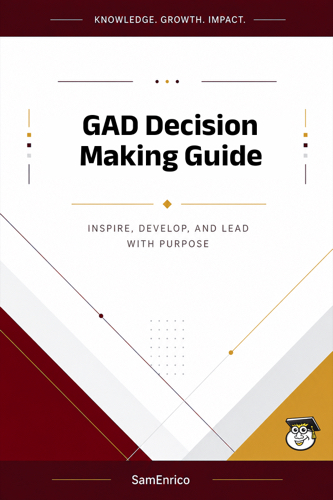
Non-FictionHealth & WellnessDecision MakingIndecision
GAD Decision Making Guide eBook
Stop analysis paralysis and make confident choices
Stop analysis paralysis and make confident choices despite uncertainty.
Formats
Free sample
Chapter 1: The Loop Trap--–- You are standing in the cereal aisle of a grocery store. It is a Tuesday evening. You are tired, hungry, and you have been staring at the same thirty-seven boxes for eleven minutes. Behind you, a mother with a crying toddler has maneuvered around your stationary cart twice. Ahead of you, the fluorescent lights hum a monotone apology for the slow death of your afternoon.
You are not looking for organic granola or high-fiber bran. You are looking for a way out of a prison that exists entirely inside your own skull.The problem is not the cereal. The problem has never been the cereal. The problem is that your brain, the magnificent three-pound universe of electrochemical genius inside your head, has mistaken this box of toasted oats for a saber-toothed tiger. And because it has made that mistake, it will not let you move.This is the Loop Trap.
And if you are reading this book, you have been trapped inside it hundreds of times before.Let us name what is happening to you right now, in this moment, before we fix it. You are experiencing what neuroscientists call destructive rumination and what the rest of us call that feeling of spinning in place while the world moves on without you. It is not laziness. It is not stupidity. It is not a character flaw that your father warned you about.
It is a neurological loop, a stuck circuit in the most powerful pattern-matching machine ever evolved, and it is doing exactly what evolution designed it to do. The only problem is that the world has changed, and your brain has not received the memo.This chapter will show you why caring deeply feels like going crazy. You will learn the difference between productive reflection and destructive rumination. You will discover the Default Mode Network, the brain's idle circuit that becomes a torture chamber for overthinkers. And you will be introduced to the single most important operational concept in this entire book: the Stop-Loss Order, a mental tool borrowed from professional stock traders that will become your emergency brake against the spiral.By the end of this chapter, you will no longer believe that your overthinking is your fault.
You will understand it as a biological process, like digestion or sweating. And you will have your first practical tool to interrupt the loop before it steals another Tuesday evening.The Paradox of Caring Here is a truth that will either liberate you or infuriate you: you only overthink the decisions you actually care about.No one has ever experienced analysis paralysis over which brand of dish soap to buy if they genuinely do not care about clean dishes. No one has ever spent forty-five minutes agonizing over whether to attend a coworker's retirement party when they secretly despise that coworker. The loop activates precisely because the stakes—real or imagined—matter to you. Your brain is not malfunctioning.
It is over-functioning. It is throwing every resource it has at a problem because somewhere deep in your neural architecture, a very old circuit has decided that this decision might determine whether you eat or starve.This is the paradox of caring. The more something matters to you, the more your brain will spiral around it. And the more your brain spirals, the less capable you become of actually making the decision. You end up in a state that psychologists call rumination-induced paralysis, where the act of thinking replaces the act of choosing, and where the fear of making a mistake becomes indistinguishable from the fear of death.Let us be precise about what is happening inside your skull.Your brain operates on a predictive coding model.
That is a fancy way of saying that your brain is constantly generating predictions about what will happen next, comparing those predictions to actual sensory input, and then updating its models based on any errors. When you are walking down a familiar street, your brain predicts the next lamppost, the next mailbox, the next corner. When those predictions match reality, you feel nothing. You are on autopilot.But when your brain encounters uncertainty—when it cannot predict what will happen next—it sounds an alarm. That alarm is anxiety.
And anxiety is not a bug; it is a feature. It is the feeling of your brain saying, "I do not have enough data to keep you safe, so I am going to make you very uncomfortable until you gather more data or until the threat passes."Here is the cruel twist: in the ancestral environment where your brain evolved, uncertainty was usually resolved quickly. Is that rustling in the grass a lion or the wind? You either ran or you did not. Either way, the decision was over in seconds.
But in the modern world, uncertainty can linger for weeks, months, or years. Should you take the job in Austin or stay in Chicago? Should you marry them or leave? Should you buy the house now or wait for rates to drop? Your brain cannot resolve these uncertainties quickly because there is no immediate feedback loop.
And so it keeps the alarm ringing. And ringing. And ringing.That ringing is the sound of your own mind torturing you with love.Productive Reflection vs. Destructive Rumination Not all thinking is created equal. This is perhaps the most important distinction you will learn in this entire book, because once you understand it, you will be able to recognize the exact moment when useful thinking becomes useless suffering.Productive reflection is thinking that does at least one of three things:It generates new information you did not have before.It narrows your set of options by eliminating one or more possibilities.It leads directly to a concrete next action step.When you are productively reflecting, you feel a sense of forward motion.
You might not have solved the problem yet, but you are solving it. You are like a detective adding clues to a bulletin board. Each thought connects to the next, and the picture slowly comes into focus. Productive reflection has a natural stopping point. When you have gathered enough information, when you have eliminated the impossible options, when you have identified your next step—you stop.
Not because you are lazy, but because the work is done.Destructive rumination is thinking that does the opposite. It rehashes the same information you already have. It cycles through the same three options without eliminating any of them. It generates no new data, no narrowed field, no actionable step. Destructive rumination feels like movement because your brain is busy, but it is the busyness of a hamster on a wheel—energetic, frantic, and utterly stationary.You can identify destructive rumination by a simple test: ask yourself whether you have had the exact same thought about this decision before.
If the answer is yes, and if that thought did not lead to a new insight the first three times you had it, you are no longer thinking. You are looping.Here is an example. Sarah is trying to decide whether to leave her job. She has been thinking about it for six weeks. Productive reflection…
This is the end of the free sample. Get the eBook to keep going. Buy now
About this book
Details
- Author
- Mahaffey Zula
- Publisher
- SamEnrico
- Language
- English
- Genre
- Non-Fiction, Health & Wellness, Decision Making, Indecision
- Released
- 2026-06-09
- Pages (approx.)
- 148
- Available as
- eBook, Audiobook

Read better in the ZLOADR app
Your eBooks on your phone or tablet. Sign in with your SamEnrico account and start reading.
More by Mahaffey Zula
 The Nobel And The Electron MicroscopeMahaffey Zula$11.99
 Remote Time Audit WorkbookMahaffey Zula$11.99
 Market Share Bubble ChartMahaffey Zula$11.99
 Daily Priority Setting RoutineMahaffey Zula$11.99
 The Silk Road's Shadow: The Con Artist Who Sold the MoonMahaffey Zula$11.99
 The Deep Time Detectives: Unlocking Europe’s Ice Age SecretsMahaffey Zula$11.99
 Supply Chain Planning AnalystMahaffey Zula$11.99
 Understanding Growth Retardation Hydrocephaly Lung HypoplasiaMahaffey Zula$17.99
 BPO First Response Time GuideMahaffey Zula$12.99
 Foreign Qualification Requirement TrapMahaffey Zula$12.99
 How to Become a Classifier OperatorMahaffey Zula$11.99
You may also like
 Hong Kong Handover 1997Dunn Johnnie$11.99
 Zumba For Postnatal Recovery CourseNeal Christian$11.99
 Zumba for BeginnersLadner Nikia$11.99
 YouTube Comment Mining GuideHumes Pandora$12.99
 Worry Box MeditationCarlin Rudy$11.99
 Workplace Stress MeditationNguyen Lynn$11.99
 Workplace Stress and Sleep RepairHawley Ivory$11.99
 Workplace Perfectionism CureDelaney Jeffry$11.99
 Workplace Injustice Anger GuideWallen Isabelle$11.99
 Work Addiction and Burnout LinkGreenwood Ester$11.99
 Women in Yoga and WellnessBeattie Galina$11.99
 Women in Stand Up ComedyChun Evangeline$11.99