
Non-FictionHealth & WellnessCBDCannabinoid
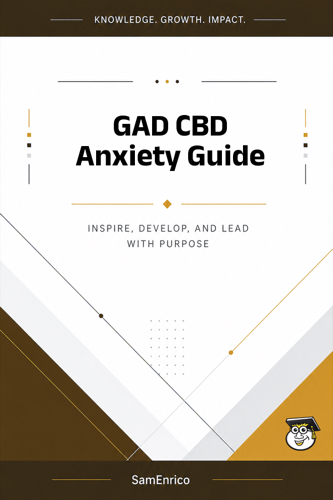
GAD CBD Anxiety Guide eBook
Understand CBD oil dosing, evidence, and risks for
Understand CBD oil dosing, evidence, and risks for generalized anxiety management.
Formats
Free sample
Chapter 1: The Knot That Never Unties...--I want you to imagine something for a moment.Picture waking up at 3:47 AM. The room is dark. Your partner is sleeping peacefully beside you. The house is silent except for the hum of the refrigerator somewhere downstairs. And yet, your heart is pounding like you just ran a sprint.
Your jaw is clenched so tight that your teeth ache. There is no threat. There is no sound. There is no reason. And still, your body is screaming that something is terribly, dangerously wrong.This is not a nightmare.
You are fully awake. The worst part is that you have been here before. Hundreds of times. The thoughts start to arrive like uninvited guests who refuse to leave. Did I send that email wrong?
Why hasn't she texted back? What if I lose my job? What if my mother gets sick? What if what if what if. The same loop.
The same track. The same knot in your chest that you have been trying to untie for years.This is Generalized Anxiety Disorder. And if you are reading this book, you likely know exactly what I am describing.I wrote this chapter—and this entire book—for the person who has been told to "just relax" one too many times. For the person who has tried breathing exercises and meditation apps and still finds themselves clenched with worry. For the person who has sat in a doctor's office, described their symptoms, and been handed a prescription for a medication that dulled everything—the anxiety, yes, but also the joy, the energy, the spontaneous laughter that used to come so easily.
For the person who has wondered, in a quiet moment of desperation, whether there is something else. Something different. Something that works with your body rather than against it.There is. And it is called cannabidiol—CBD. But before we get to the solution, we must fully understand the problem.
Because GAD is not just "being a worrier." It is not a personality flaw. It is not something you can think your way out of. It is a medical condition with specific diagnostic criteria, recognizable biological mechanisms, and real, measurable consequences for your brain and body.This chapter is going to give you a complete, modern, evidence-based understanding of Generalized Anxiety Disorder. We are going to look at how GAD is diagnosed, what it actually does to your nervous system, how it affects your physical health, and—critically—why the treatments you have been offered may have left you feeling like you had to choose between being anxious or being numb.By the end of this chapter, you will understand GAD better than most general practitioners. And you will see why so many people like you are turning to CBD as a legitimate, evidence-supported option for finding calm without losing yourself.Let us begin.The Difference Between Anxiety and Anxiety Disorder Everyone experiences anxiety.
It is a normal, adaptive, and even necessary human emotion. When you have a job interview, your anxiety sharpens your focus. When you cross a busy street, your anxiety keeps you alert. When you need to meet a deadline, your anxiety provides the motivation to stop procrastinating and work. This kind of anxiety has a clear trigger, a limited duration, and it resolves when the situation passes.GAD is fundamentally different in three ways.First, the worry is excessive and disproportionate.
A person without GAD might worry about a job interview for a day or two. A person with GAD might start worrying about the interview weeks in advance, then worry about whether they dressed correctly, then worry about whether they said the wrong thing, then worry about whether the interviewer secretly hated them, then worry about whether they will get fired from a job they have not even been offered yet. The worry is not proportional to the actual threat.Second, the worry is difficult to control. People with GAD describe their worry as a runaway train. They know, on some level, that their fears are unlikely to come true.
They know that ruminating at 3 AM will not solve anything. But they cannot stop. The thoughts return relentlessly, like a pop song stuck on repeat. This is not a failure of willpower. It is a symptom of a dysregulated brain.Third, the worry is chronic and persistent.
To meet the diagnostic criteria for GAD, the worry must occur more days than not for at least six months. This is not a bad week or a stressful month. This is a pattern of living. This is the background hum of your existence.The DSM-5 Criteria: What Clinicians Actually Look For The Diagnostic and Statistical Manual of Mental Disorders, Fifth Edition (DSM-5) is the standard classification system used by mental health professionals in the United States. It provides specific, measurable criteria for diagnosing GAD.
Understanding these criteria is important because it helps you recognize that your experience is real, documented, and shared by millions of other people.According to the DSM-5, a diagnosis of GAD requires the following:A. Excessive anxiety and worry occurring more days than not for at least six months, about a number of events or activities (such as work, school, health, finances, or relationships).B. The individual finds it difficult to control the worry. This is a key distinction. Many people worry, but they can set it aside when needed.
People with GAD cannot.C. The anxiety and worry are associated with at least three of the following six symptoms (with at least some symptoms having occurred more days than not for the past six months):Restlessness or feeling keyed up or on edge. This is the sensation that you cannot sit still. Your leg bounces. Your hands fidget.
You feel like you are waiting for something terrible to happen, even when nothing is happening.Being easily fatigued. Chronic anxiety is exhausting. Your nervous system is running at full throttle all day, every day. By afternoon, you feel like you have run a marathon. This is not laziness.
This is biological depletion.Difficulty concentrating or mind going blank. Anxiety hijacks your attention. You try to read a paragraph, and your eyes move across the words, but your brain is somewhere else—replaying a conversation, anticipating a disaster, scanning for threats. This is why many people with GAD are misdiagnosed with ADHD.Irritability. When you are constantly on edge, small annoyances become major provocations.
The person who cuts you off in traffic. The child who asks one too many questions. The partner who leaves dishes in the sink. Your fuse is short because your nervous system is already at maximum capacity.Muscle tension. This is the physical manifestation of chronic vigilance.
Your shoulders are up around your ears. Your jaw is clenched. Your back hurts. You might not even notice the tension anymore because it has become your normal state. But it is there, and it is draining your energy.Sleep disturbance (difficulty falling or staying asleep, or restless, unsatisfying sleep).
The 3 AM wake-up described at the beginning of this chapter is classic GAD. You fall asleep exhausted, but then you wake up in the early morning…
This is the end of the free sample. Get the eBook to keep going. Buy now
About this book
Details
- Author
- Morley Adelaide
- Publisher
- SamEnrico
- Language
- English
- Genre
- Non-Fiction, Health & Wellness, CBD, Cannabinoid
- Released
- 2026-06-08
- Pages (approx.)
- 160
- Available as
- eBook, Audiobook

Read better in the ZLOADR app
Your eBooks on your phone or tablet. Sign in with your SamEnrico account and start reading.
More by Morley Adelaide
 Revolutionary Guard FoundationMorley Adelaide$11.99
 The Arm Catalepsy InductionMorley Adelaide$11.99
 Vendor Lock In MapMorley Adelaide$11.99
 ABCDE for Mental Health PrioritiesMorley Adelaide$11.99
 The Trollwife of Dovre: A Nordic Cursed LoveMorley Adelaide$11.99
 The Forgotten Genius of the Steppes: How a Soviet Mathematician Revolutionized Number TheoryMorley Adelaide$11.99
 Walkie RiderMorley Adelaide$11.99
 Understanding Hallermann–streiff SyndromeMorley Adelaide$17.99
 Artificial Intelligence Venture Capital OutlookMorley Adelaide$12.99
 Application Essay Strategy HandbookMorley Adelaide$12.99
 A Beginners Guide to Card Bingo (Volume 1)Morley Adelaide$11.99
You may also like
 Hong Kong Handover 1997Dunn Johnnie$11.99
 Zumba For Postnatal Recovery CourseNeal Christian$11.99
 Zumba for BeginnersLadner Nikia$11.99
 YouTube Comment Mining GuideHumes Pandora$12.99
 Worry Box MeditationCarlin Rudy$11.99
 Workplace Stress MeditationNguyen Lynn$11.99
 Workplace Stress and Sleep RepairHawley Ivory$11.99
 Workplace Perfectionism CureDelaney Jeffry$11.99
 Workplace Injustice Anger GuideWallen Isabelle$11.99
 Work Addiction and Burnout LinkGreenwood Ester$11.99
 Women in Yoga and WellnessBeattie Galina$11.99
 Women in Stand Up ComedyChun Evangeline$11.99