
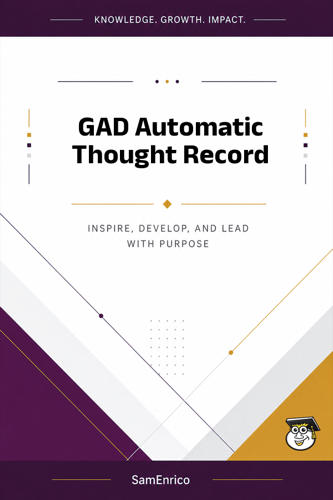
Non-FictionHealth & WellnessAutomatic ThoughtsCBT
GAD Automatic Thought Record eBook
Capture and challenge spontaneous anxious thoughts
Capture and challenge spontaneous anxious thoughts using structured CBT forms.
Formats
Free sample
Chapter 1: The Cage You Built--–- You are not broken. You are not weak. And you are not alone.This is not a reassurance tactic. It is a clinical fact. Over 6 million adults in the United States alone meet the diagnostic criteria for Generalized Anxiety Disorder, and millions more live in the gray zone of chronic worry that never quite reaches a diagnosis but nonetheless steals hours from every day.
You are part of a very large, very exhausted, very capable group of people who have one thing in common: your brain has learned a response pattern that no longer serves you.The premise of this entire book rests on a single, liberating idea: Anxiety is not a character flaw. It is a learned pattern. And what has been learned can be unlearned.But before we teach you the unlearning—before we introduce the GAD Automatic Thought Record, the 7-column tool that will become your most trusted ally—we must first name the cage you have been living in. You cannot unlock a door you do not know exists.The Paradox of the Productive Worrier Let us begin with a distinction that will structure everything that follows: the difference between productivity anxiety and GAD worry.Productivity anxiety is the feeling that helps you meet deadlines. It is the alertness that makes you check your email before a big meeting, the energy that propels you to prepare a presentation, the caution that leads you to pack an umbrella when clouds gather.
Productivity anxiety has a beginning, a middle, and an end. It arises in response to a specific stimulus, motivates a specific action, and dissipates once that action is complete. It is uncomfortable but useful. It is the smoke alarm that alerts you to actual smoke.GAD worry is different. GAD worry has no clear off switch.
It arises without an identifiable trigger—or, more accurately, it attaches itself to any available target, floating from finances to health to relationships to work within a single hour. It does not motivate action; it paralyzes it. It does not dissipate after problem-solving; it mutates into new worries. Productivity anxiety asks, "What do I need to do right now?" GAD worry asks, "What if everything falls apart six months from now?" The first question is useful. The second question is a cage.Consider two people facing the same situation: an upcoming performance review at work.Person A (Productivity Anxiety): "I feel nervous.
I should prepare. I will review my achievements from the past quarter, practice my talking points, and ask a colleague for feedback. After I do these things, I will feel better regardless of the outcome because I will have done my best."Person B (GAD Worry): "What if my boss hates my work? What if I get a bad review? What if I get fired?
What if I can't find another job? What if I lose my house? What if my family starves?" (This entire cascade occurs within 30 seconds. No action is taken. The person feels worse than before.
The worry returns tomorrow, unchanged.)Person A and Person B are experiencing the same external event. But Person A's anxiety is contained, directed, and useful. Person B's anxiety is diffuse, escalating, and paralyzing. The difference is not in the person's character or strength. The difference is in the pattern of response.This book is written for Person B.
And it will teach you to respond like Person A—not by suppressing anxiety, but by channeling it.The Six-Month Rule and the Hallmark Symptom Before we go further, let us be precise about what we are addressing. Generalized Anxiety Disorder has specific diagnostic criteria, and understanding these criteria helps in two ways: first, it validates that your experience is real and recognized; second, it provides clear targets for intervention.The Six-Month Rule To meet the threshold for GAD, a person must experience excessive anxiety and worry more days than not for at least six months. The "more days than not" clause is important: GAD is not about occasional bad days or situational anxiety triggered by a specific stressor (a move, a divorce, a job loss). It is about a persistent background hum of worry that persists even when life is objectively stable.If you find yourself worrying on sunny Sundays with no deadlines approaching, if you wake up anxious on vacation, if you feel a low-grade dread even when nothing is wrong—that persistence over time is a signal that your anxiety has moved from situational to generalized.The Hallmark Symptom: Difficulty Controlling Worry The diagnostic criterion that matters most for this book is not the number of symptoms or the intensity of physical sensations. It is this: difficulty controlling the worry once it starts.This is the feature that distinguishes GAD from normal stress.
A person without GAD can, with effort, "put aside" a worry. They can say to themselves, "I will think about this tomorrow," and actually do it. A person with GAD cannot. Each attempt to stop worrying generates more worry. The command "Stop worrying!" is interpreted by the anxious brain as "There is something dangerous to worry about!"This is not a failure of willpower.
It is a feature of how the anxious brain processes language. When you tell yourself "Don't think about a pink elephant," what do you immediately think about? A pink elephant. The same neurological process operates with worry. "Don't worry about the presentation" immediately activates the representation of the presentation in your neural networks.
Your brain is not being difficult. It is being obedient to the structure of language.The GAD Automatic Thought Record is designed specifically to address this hallmark symptom. It does not ask you to stop worrying. It asks you to write down the worry. And writing down a worry is not the same as stopping it.
Writing externalizes the thought, moves it from the emotional brain to the logic brain, and begins the process of disarming it. You will learn this tool in Chapter 3. But first, we must understand what you are up against.The Diffuse State: Why GAD Is Not a Phobia One of the most frustrating aspects of GAD is the inability to point to a single cause. A person with a phobia of flying can say, "I am afraid of airplanes." A person with social anxiety can say, "I am afraid of being judged in groups." A person with panic disorder can say, "I am afraid of having another panic attack."A person with GAD cannot complete that sentence."I am afraid of... what?
Everything? Nothing? I don't know. I just feel anxious."This diffuseness is not a diagnostic flaw. It is the diagnostic signature.
GAD anxiety is "free-floating"—it attaches to whatever is available. Today it is your health. Tomorrow it is your relationship. Next week it is your finances. The underlying engine is the same; only the target changes.This has two important implications for treatment.Implication One: You Cannot Avoid Your Way Out of GADWith a phobia, avoidance works—temporarily.
If you are afraid of flying, you can drive everywhere. You have a problem, but you have a solution. With GAD, there is no single trigger…
This is the end of the free sample. Get the eBook to keep going. Buy now
About this book
Details
- Author
- Hutchinson Eneida
- Publisher
- SamEnrico
- Language
- English
- Genre
- Non-Fiction, Health & Wellness, Automatic Thoughts, CBT
- Released
- 2026-06-09
- Pages (approx.)
- 145
- Available as
- eBook, Audiobook

Read better in the ZLOADR app
Your eBooks on your phone or tablet. Sign in with your SamEnrico account and start reading.
More by Hutchinson Eneida
 Iranian Revolution Exile RadioHutchinson Eneida$11.99
 PMS Cramp Relief HandbookHutchinson Eneida$11.99
 Mindful Movement MBSR GuideHutchinson Eneida$11.99
 Lucid Dreaming for Trauma ProcessingHutchinson Eneida$11.99
 The Oracle’s Gambit: A Spy in the House of DelphiHutchinson Eneida$11.99
 The Last Telegram: A Love Letter to the Titanic’s Forgotten CoupleHutchinson Eneida$11.99
 Active Shooter Response (Civilian)Hutchinson Eneida$11.99
 Artificial Intelligence Real Estate OutlookHutchinson Eneida$12.99
 International Student China Admissions PrimerHutchinson Eneida$12.99
 Understanding Hand Wringing Rett SyndromeHutchinson Eneida$17.99
 A Beginners Guide to Candy Land (Volume 1)Hutchinson Eneida$11.99
You may also like
 Hong Kong Handover 1997Dunn Johnnie$11.99
 Zumba For Postnatal Recovery CourseNeal Christian$11.99
 Zumba for BeginnersLadner Nikia$11.99
 YouTube Comment Mining GuideHumes Pandora$12.99
 Worry Box MeditationCarlin Rudy$11.99
 Workplace Stress MeditationNguyen Lynn$11.99
 Workplace Stress and Sleep RepairHawley Ivory$11.99
 Workplace Perfectionism CureDelaney Jeffry$11.99
 Workplace Injustice Anger GuideWallen Isabelle$11.99
 Work Addiction and Burnout LinkGreenwood Ester$11.99
 Women in Yoga and WellnessBeattie Galina$11.99
 Women in Stand Up ComedyChun Evangeline$11.99