
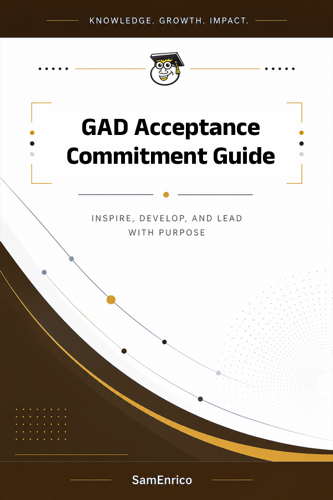
GAD Acceptance Commitment Guide eBook
Apply ACT principles to accept anxious thoughts wi
Apply ACT principles to accept anxious thoughts without fighting or following them.
Formats
Free sample
Chapter 1: The Trap You Didn't Choose--–- You are about to discover something that will change everything you thought you knew about your anxiety. Not because I’m going to teach you a new breathing technique or a positive thinking strategy you haven’t tried yet. But because I’m going to show you that the way you’ve been trying to feel better—the strategies you’ve been using for months or years, the ones that seemed so logical, so necessary, so right—have been keeping you stuck. And that’s not your fault. You were taught to fight.
You were told to calm down. You were advised to think positive, to distract yourself, to reason with your worries, to breathe deeply until the feeling passed. Everyone meant well. But they were wrong.The Moment Everything Changed for Maya Maya hadn't slept more than four hours in six months. Every night, her head hit the pillow, and within minutes, her mind launched into a relentless rehearsal of every possible disaster.
What if she forgot to lock the front door? What if her daughter’s cough was pneumonia? What if the presentation she had prepared for work was missing a critical slide? What if her husband was secretly unhappy? What if, what if, what if—the questions looped like a broken algorithm searching for an answer that didn't exist.She tried everything.
She started checking the locks three times before bed. Then five times. Then she took photos of the locked door on her phone so she could review them in bed. That worked for about a week, until her mind found a new angle: what if the photo was taken yesterday? So she started timestamping them.
Then she spent an hour each night reviewing her daughter’s symptoms on Web MD. She installed a symptom tracker app. She messaged her pediatrician at 11 PM. She rearranged her presentation slides seventeen times. She asked her husband “Are you okay?” so many times that he stopped answering.Maya was exhausted.
Not just physically—though she was—but existentially exhausted. The kind of tired that comes from fighting a war you cannot win, against an enemy that lives inside your own head. She told her therapist, “I just want the anxiety to stop. I’ll do anything. Just tell me how to make it go away.”And her therapist said something that, at first, made Maya angry.
She said, “What if the goal isn’t to make it go away? What if the goal is to stop fighting it?”Maya thought that was the stupidest thing she had ever heard. Stop fighting? Wasn’t that giving up? Wasn’t that letting the anxiety win?
She almost walked out. But she was too tired to walk anywhere. So she stayed. And over the next several weeks, she began to understand something she had never considered: her fight against anxiety was not her salvation. It was her cage.The White Bear Experiment That Explains Your Entire Struggle In 1987, a psychologist named Daniel Wegner conducted a simple experiment that revealed something astonishing about the human mind.
He asked participants to do one thing: for five minutes, do not think about a white bear. That’s it. Just avoid the image of a white bear. Every time the bear appears in your mind, push it away.What do you think happened? If you have ever tried to suppress an anxious thought, you already know the answer.
The participants could think of little else. The white bear appeared again and again, sometimes every few seconds. They rang a bell every time the bear came to mind. The bells rang constantly.But here is the crucial part of the experiment. After the suppression phase, Wegner asked the same participants to do the opposite: now, for five minutes, actively think about a white bear.
The people who had been asked to suppress the bear first thought about it even more than people who had been asked to think about it from the beginning. Suppression didn’t remove the thought. It supercharged it.This is called the ironic rebound effect. And it explains almost everything about why your anxiety feels uncontrollable.Every time you tell yourself, “Stop worrying about that,” your brain has to first check whether you are worrying about it—which means bringing the worry to mind. Every time you push a thought away, it bounces back harder.
Every time you try to calm down, you are sending your brain a message that there is something dangerous happening that requires calming. The very act of fighting creates more of what you are fighting.Let me say that again, because it is the most important sentence in this entire chapter: The very act of fighting your anxiety creates more anxiety.This is not a moral failing. This is not weakness. This is how the human nervous system works. You have been fighting against the laws of your own mind, and then blaming yourself for losing.
That is like trying to hold a beach ball underwater and then feeling ashamed when it keeps popping back up. The beach ball is doing exactly what beach balls do. The problem is not the beach ball. The problem is the instruction to hold it underwater.The Three Things You Do When Anxiety Arrives (And Why None of Them Work)When an anxious thought or sensation appears, you have three automatic responses. You did not choose these responses.
They were learned over years of trial and error, reinforced by your culture, your family, your well-meaning friends, and every self-help article that told you to “just breathe.” These three responses feel like the only options. But they are all forms of the same thing: struggle.Response One: Fight Fighting looks like suppression, argument, and control. It sounds like:“Stop thinking that.”“That’s irrational.”“There’s nothing to be afraid of.”“Just calm down.”“I shouldn’t feel this way.”You might try to reason with the thought, to prove it wrong with evidence. You might repeat affirmations. You might use logic to talk yourself down.
You might tense your muscles in an attempt to physically push the feeling away.Here is what fighting does: it tells your brain that the thought is dangerous. And when your brain believes something is dangerous, it sends more alarm signals. You are essentially training your amygdala to treat ordinary worries as life-threatening emergencies. Fighting is why you can spend twenty minutes arguing with a thought and end up more anxious than when you started.Response Two: Flee Fleeing looks like avoidance, distraction, and escape. It sounds like:“I’ll just check my phone.”“I need a drink.”“I’m not going to that meeting.”“Let me watch something mindless.”“I have to get out of here.”You might scroll social media, turn on the television, eat something, clean something, or physically leave a situation.
Fleeing provides immediate relief, which is why it feels so effective in the moment. But that relief teaches your brain one thing: anxiety is so dangerous that you had to escape from it. The next time anxiety appears, your brain will sound the alarm even…
This is the end of the free sample. Get the eBook to keep going. Buy now
About this book
Details
- Author
- Bean Henriette
- Publisher
- SamEnrico
- Language
- English
- Genre
- Non-Fiction, Health & Wellness, ACT, Acceptance
- Released
- 2026-06-07
- Pages (approx.)
- 139
- Available as
- eBook, Audiobook

Read better in the ZLOADR app
Your eBooks on your phone or tablet. Sign in with your SamEnrico account and start reading.
More by Bean Henriette
 Khomeini Return to IranBean Henriette$11.99
 Mindfulness For Test Anxiety GuideBean Henriette$11.99
 Quadrant Two Deep Work GuideBean Henriette$11.99
 Global Local Positioning MapBean Henriette$11.99
 The Castaway of the Red Sea: The Extraordinary Survival of Mohammed AbdullaBean Henriette$11.99
 The Jade Phoenix's Last Flight: A Tale of Celestial RebellionBean Henriette$11.99
 Series LLC for Non Residents GuideBean Henriette$12.99
 Five Year Artificial Intelligence ForecastBean Henriette$12.99
 Understanding Guérin–stern SyndromeBean Henriette$17.99
 System Safety SpecialistBean Henriette$11.99
 A Beginners Guide to Cego (Volume 1)Bean Henriette$11.99