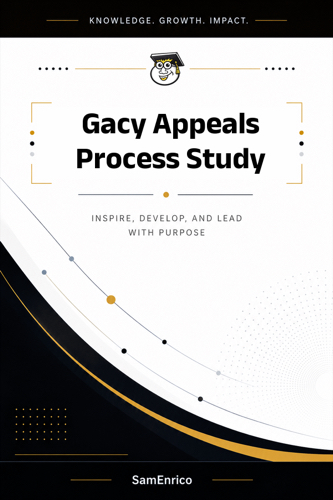
Gacy Appeals Process Study eBook
Reviews Gacy's multiple death row appeals and even
by Spain Andree
Reviews Gacy's multiple death row appeals and eventual execution in 1994.
Formats
Free sample
Chapter 1: The Half-Million Dollar Verdict...--–- The jury took only two hours. Two hours to decide the fate of a man who had murdered thirty-three people. After five weeks of testimony, after one hundred witnesses, after the excavation of twenty-nine bodies from the crawl space beneath a suburban Chicago ranch house, the twelve jurors of Cook County Circuit Court needed less time to deliberate than most commuters spent stuck in rush hour traffic on the Dan Ryan Expressway. On March 12, 1980, they filed back into the courtroom of Judge Louis B. Garippo and delivered their verdict: guilty on all thirty-three counts of murder -6.The following day, the same jury returned to decide whether John Wayne Gacy would live or die.
Under Illinois law, which had reinstated capital punishment after the Furman v. Georgia moratorium, Gacy was eligible for death on twelve of the thirty-three murders—those proven to have been committed after the statute’s effective date -3. The prosecution, led by Assistant State’s Attorney William Kunkle, asked for execution. The defense, battered by the rejection of their insanity claim and hemorrhaging credibility, mounted what would later be described as a feeble response. The jury sentenced Gacy to die.The public exhaled.
The headlines screamed. The case was closed.Except it wasn’t. Not even close.What the two-hour deliberation and the swift sentencing obscured was the true duration of the Gacy case. The trial that captivated America in the winter of 1980 lasted five weeks. But the legal war that followed would stretch across fourteen years, consume more than half a million dollars in taxpayer money, generate over two hundred pages of judicial opinions, climb to the United States Supreme Court three separate times, and outlive two Illinois governors, three presidential administrations, and the first Gulf War.This book is not about the crawl space.
It is not about the clown suit, the Pogo the Clown persona, the political connections, or the gruesome excavation that made Gacy a household name. Those stories have been told, retold, and sensationalized beyond recognition. This book is about what happened after the verdict—the legal labyrinth that transformed an open-and-shut case of serial murder into a fourteen-year procedural odyssey.This is the story of the Gacy appeals process: the machine that ground slowly, expensively, and inexorably toward a conclusion everyone already knew was coming. It is a story about the tension between finality and fairness, between the public’s demand for swift justice and the Constitution’s insistence on exhaustive process. It is a story about the money—the shocking disparity between what the state spent to convict Gacy and what it spent to keep him alive.
And it is a story about the lawyers: the ones who bungled, the ones who inherited the wreckage, and the ones who fought long after any rational observer believed victory was possible.But before we can understand the fourteen years of appeals, we must understand what the trial actually cost—not in moral terms, but in dollars and cents. Because the numbers tell a story that the headlines never captured.The Price of a Conviction The Chicago Tribune, in an analysis published just days before Gacy’s eventual execution in May 1994, attempted to calculate the total public expenditure on the Gacy case from arrest to execution. The trial alone—five weeks of courtroom time, sequestered jurors, expert witnesses, and security—carried a very conservative price tag of $251,725 -1.Let us unpack that number, because it contains multitudes.The trial cost calculation began with the most mundane of expenses: the jurors. Under Illinois law in 1980, jurors were paid $16 per day. The Gacy jury consisted of twelve regular jurors and four alternates.
Their service lasted approximately thirty days, from jury selection in Rockford through the return of the verdict in Chicago. The math is simple: sixteen jurors multiplied by thirty days multiplied by sixteen dollars equals $7,680 in juror compensation -1.But that was the least of it. The jurors were sequestered for the duration of the trial—housed at the Essex Inn on South Michigan Avenue, fed three meals a day, and escorted to and from the Cook County Criminal Courts Building. The sequestration cost an estimated $14,000 -1. Today, adjusted for inflation, that figure would approach $50,000.The courtroom itself operated at a cost that proved difficult to calculate with precision.
A 1993 North Carolina study, cited by the Tribune, estimated the daily operating cost of a courtroom for a murder trial at $1,416 per day. Applying that figure to the five-week Gacy trial—approximately twenty-five court days—yields an additional $35,400 in overhead: the salaries of the judge, bailiffs, court reporters, clerks, and security personnel -1.The judge, Louis B. Garippo, presided over the trial with what observers described as a calm, almost clinical demeanor. He made a critical decision early in the proceedings that saved the county a substantial sum: rather than selecting the jury in Chicago and transporting the evidence to Rockford, he decided to select the jury in Rockford and transport the jurors to Chicago -1. This single decision eliminated the need to move the mountains of physical evidence—including the excavation records, the autopsy reports, the photographs of the crawl space—to a remote venue.The prosecution and defense teams required their own resources.
William Kunkle and his team of assistant state’s attorneys logged hundreds of hours preparing for trial. The defense, led by Sam Amirante and Robert Motta, worked under court appointment, billing the county for their time at rates that would later become a subject of controversy during Gacy’s appeals. (We will return to Amirante and Motta in Chapter 5, when we examine the sensational claim that their pursuit of book and movie deals compromised their representation.)Expert witnesses added another layer of expense. The prosecution retained forensic anthropologists to identify the skeletal remains, odontologists to match dental records, and pathologists to determine causes of death. The defense retained psychiatrists to support their insanity claim—a strategy that ultimately failed when the jury rejected Gacy’s assertion that he suffered from multiple personality disorder and could not control his actions.When the Tribune added all these figures together—juror compensation, sequestration, courtroom operations, expert fees, and the ancillary costs of security and evidence management—they arrived at the conservative estimate of $251,725 -1.
Conservative, they emphasized, because certain costs proved impossible to reconstruct a decade after the fact. The actual figure, had every expense been tracked and accounted, would almost certainly have been higher.The $279,000 Question But $251,725 was merely the opening bid.The true cost of the Gacy case—the number that should give every taxpayer pause—was the amount spent on appeals. Between Gacy’s conviction in March 1980 and his execution in May 1994, the state and federal governments poured an additional $279,000 into the legal machinery that processed his case through the courts -1. The total price tag approached $530,000.To put that number in perspective: half a million dollars was, in 1994, roughly equivalent to the cost of sending ten Illinois students to four years of private university, or purchasing four modest homes in the Chicago suburbs, or operating a police patrol division for an entire year. It was enough money to provoke a…
This is the end of the free sample. Get the eBook to keep going. Buy now
About this book
Details
- Author
- Spain Andree
- Publisher
- SamEnrico
- Language
- English
- Genre
- Non-Fiction, True Crime, Appeals
- Released
- 2026-06-11
- Pages (approx.)
- 141
- Available as
- eBook, Audiobook

Read better in the ZLOADR app
Your eBooks on your phone or tablet. Sign in with your SamEnrico account and start reading.
More by Spain Andree
 Office Supply Purchase StudySpain Andree$11.99
 Working Memory Aging GuideSpain Andree$11.99
 Nicotine Patch Step Down GuideSpain Andree$11.99
 IBS Misdiagnosis GuideSpain Andree$11.99
 Malian Islamist EscapeSpain Andree$11.99
 HRT Master GuideSpain Andree$11.99
 Dubai Student CryptocurrencySpain Andree$11.99
 The Torso in the Thames: London's Forgotten Dismemberment MysterySpain Andree$11.99
 The Bones of the Andes: How a K9 Detective Solved Peru's Coldest CaseSpain Andree$11.99
 How to Produce General Mechanical Components StockSpain Andree$11.99
 A Collector's Handbook to the Citroën Citroen Ds 19Spain Andree$11.99
 Joint Ventures for Government ContractsSpain Andree$12.99