
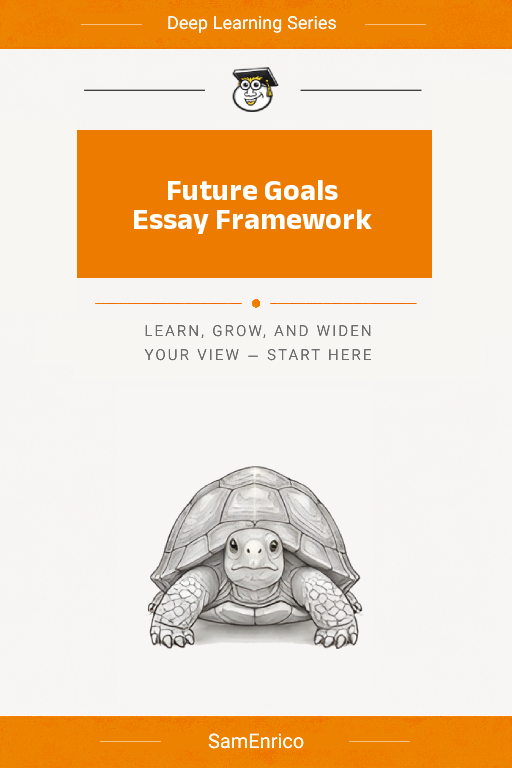
Future Goals Essay Framework eBook
Connect past experiences to specific college oppor
Connect past experiences to specific college opportunities and career aspirations, showing a logical through-line in your application.
Formats
Free sample
Chapter 1: The Passion Trap--Every year, millions of high school seniors sit down to write their college application essays, convinced they need to uncover one thing: their passion.They’ve been told, by well-meaning counselors and glossy guidebooks, that admissions officers want to see fire in the belly. They’ve heard that the best essays reveal a singular obsession—an extracurricular that became an identity, a hobby that blossomed into a calling. And so they search their memories for that one perfect, burning thread. They worry when they don’t find it. They fabricate when it doesn’t exist.
And they submit essays that sound less like themselves and more like a caricature of what they think a prestigious college wants to hear.Here is the truth that no one tells you: Admissions officers are exhausted by passion.Not because passion is bad. But because the word has been hollowed out. Thousands of students claim to be “passionate about helping others.” Thousands claim that their volunteer trip or debate tournament or science fair project “ignited a fire.” After reading the fiftieth essay about a mission trip that changed a student’s life, admissions officers stop believing in epiphanies. They start looking for something else entirely.This book is about that something else.The Problem With Passion Let me tell you about a student I’ll call Priya. Priya had excellent grades—3.9 unweighted.
Strong test scores—1520 SAT. Impressive activities—president of the speech and debate team, editor of the literary magazine, volunteer tutor for immigrant students in her community. On paper, she looked like a shoo-in for her top-choice university, a selective liberal arts college known for its emphasis on social justice and community engagement.Priya wrote her personal statement about her “passion for equity in education.” She described how tutoring immigrant students opened her eyes to systemic barriers. She talked about wanting to “level the playing field.” She connected this passion to the college’s education department and its community-based learning requirements.She was waitlisted.She was devastated. And confused.
She had done everything right. She had identified a passion. She had connected it to her activities. She had even researched the college’s specific programs. What went wrong?I asked to read her essay.
Here, roughly, is what it said:“Ever since I started tutoring English to immigrant students in my community, I have been passionate about educational equity. I saw how hard my students worked and how many obstacles they faced. This experience ignited a fire in me to pursue a career in education policy. At your university, I would love to continue this work through the education department and the community learning initiative. I believe that education is the key to breaking cycles of poverty, and I am passionate about being part of that solution.”Nothing in that paragraph is false.
Nothing is badly written. And yet, nothing is memorable. Why? Because Priya made the same mistake that thousands of applicants make every year: she told the admissions officer what she thought they wanted to hear, using the vocabulary she thought they expected, without ever showing them how she actually thinks.The essay was generic. It could have been written by any of the thousands of students who have tutored, volunteered, or participated in a service activity.
There was no Priya in it—no specific observation, no unexpected connection, no moment where the reader thought, “Ah, I have never heard anyone say it quite that way before.”This is the Passion Trap.The Passion Trap Defined The Passion Trap is the mistaken belief that your essay needs to declare a single, burning, lifelong devotion to a cause, field, or activity. It leads students to write essays that are:Vague (“I want to help people”)Generic (“I have always been passionate about science”)Epiphany-driven (“That day, everything changed”)Future-heavy (“One day, I hope to…”)Emotionally flat (telling us you care without showing us why)The Passion Trap is seductive because it feels safe. You have heard that admissions officers want to see “drive” and “commitment.” You have seen sample essays that declare bold ambitions. You assume that the safer path is to claim a passion, even if you are not entirely sure it is yours.But here is the paradox: the safer path is the more dangerous one.When you claim a passion that is not yet fully your own, or that you cannot support with specific, idiosyncratic details, your essay joins a vast crowd of similar essays. Admissions officers develop a kind of radar for these claims.
They have read too many to be moved by them. In fact, they have started to actively distrust the word “passion” and its cousins: “ignited,” “fueled,” “driven,” “inspired.”A senior admissions officer at a top-twenty university once told me, off the record: “When I see the word ‘passion’ in an essay, I immediately become skeptical. Nine times out of ten, what follows is something the student thinks I want to hear, not something they actually think about when no one is watching.”That is a damning indictment. But it is also a gift. Because it tells you exactly what to avoid—and what to do instead.What Admissions Officers Actually Want If passion is not the answer, what is?
What are admissions officers looking for when they read your “Why this college?” or “Future goals” essay?After analyzing dozens of admissions rubrics, interviewing former admissions officers, and studying the research on how experienced readers evaluate applications, a clear pattern emerges. Admissions officers are not searching for passion. They are searching for coherence.Coherence means that the pieces of your application—your grades, your activities, your essays, your recommendations—fit together into a recognizable picture. Not a perfect picture. Not a picture that reveals your entire life plan.
Just a picture that makes sense.The most memorable applications tell a story that answers three questions in a logical sequence:What have you experienced or observed that shaped how you see the world? (Your Past)What specific opportunities at this college will help you build on that experience? (Your College)Where do you want to go next, and why does that follow logically from the first two? (Your Career)Notice what is missing from that list. There is no requirement to have a single, lifelong passion.
There is no requirement to have your entire future mapped out. There is only a requirement that the three pieces connect.This is the Through-Line Framework. It is the central organizing principle of this book. And it is radically different from the Passion Trap.Where passion asks you to declare, the Through-Line asks you to connect. Where passion asks you to feel, the Through-Line asks you to think.
Where passion asks you to inspire, the Through-Line asks you to make sense.The Through-Line Framework in Practice Let me show you what this looks like with a different student. I will call him Marcus.Marcus did not have a single, clear passion. He liked a lot of things. He enjoyed his computer science classes but did not want to be a pure programmer. He cared about environmental issues but did not want to be a policy advocate.
He liked building things with his hands but did not want to be an engineer.When Marcus first sat down to…
This is the end of the free sample. Get the eBook to keep going. Buy now
About this book
Details
- Author
- Sander Edwardo
- Publisher
- SamEnrico
- Language
- English
- Genre
- essays, Student's Shortcut
- Released
- 2026-06-01
- Pages (approx.)
- 143
- Available as
- eBook, Audiobook

Read better in the ZLOADR app
Your eBooks on your phone or tablet. Sign in with your SamEnrico account and start reading.
More by Sander Edwardo
 Major Depressive Disorder Light Therapy GuideSander Edwardo$11.99
 The Resilience Habit LoopSander Edwardo$11.99
 Glass Cleaner Ammonia RisksSander Edwardo$11.99
 Tree Planting OrganizerSander Edwardo$11.99
 Russian Mafia in Latin AmericaSander Edwardo$11.99
 Túpac Katari BolivianSander Edwardo$11.99
 Nobel Chemistry Breakthroughs ExplainedSander Edwardo$11.99
 Dumbbell Only ProgramSander Edwardo$11.99
 Love Letters from the Moon: The Cosmic Romance of Neil Armstrong and Janet ShearonSander Edwardo$11.99
 The Last Stand of the Iron King: The Trial That Shaped a DynastySander Edwardo$11.99
 How to Produce Watercraft Parts and AccessoriesSander Edwardo$11.99
 How to Produce Lotus RootsSander Edwardo$11.99
You may also like
 Scholarship Essays On Community ImpactHickey Lawerence$12.99
 Gender and Sexuality Identity EssaysCotton Marissa$12.99
 College Essay For Business MajorsSandlin Sheilah$12.99
 Overcoming Adversity Essay FrameworkLynch Cameron$12.99
 Why This College Essay TemplateWestbrook Shakira$12.99
 Volunteer and Service EssaysForsyth Ivory$12.99
 Voice and Tone for College EssaysBrownlee Jacqualine$12.99
 US Common App Essay GuideBelton Cassidy$12.99
 Undecided Major Essay TemplateSolano Lesia$12.99
 Transfer Application Essay GuideDeaton Deb$12.99
 Supplemental Essay Strategy HandbookLaflamme Bradly$12.99
 Scholarship Essay Writing WorkbookHolden Kory$12.99