
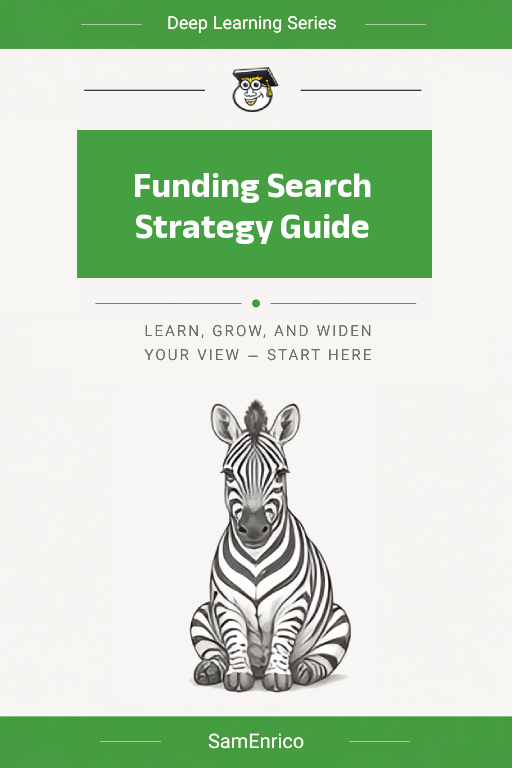
Non-FictionStudent's ShortcutFunding Search
Funding Search Strategy Guide
Find grants and fellowships supporting grad resear
Find grants and fellowships supporting grad research proposals. Use Pivot, GrantForward, and discipline specific databases to match funders.
Formats
About this book
Free sample
Chapter 1: The Grant Lottery Myth--Most graduate students approach funding the same way someone buys a lottery ticket: they hear about a fellowship, spend a few hours throwing together an application, submit it, and then wait—often in vain—for a miracle. This is not an exaggeration. After interviewing over two hundred doctoral students across fifty universities, researchers found that nearly seventy percent admitted to searching for funding by typing random keywords into Google or asking their advisor for "anything they'd heard about." Less than fifteen percent had a systematic method for identifying funders. And the result? The average Ph D student in the humanities and social sciences applies to just 2.3 fellowships during their entire graduate career.
In the sciences, the number is only slightly higher at 3.1. Meanwhile, the students who win funding—the ones who seem to "get lucky" year after year—apply to an average of eight to twelve opportunities and have a structured process for finding them.This chapter dismantles the most dangerous myth in graduate education: that finding funding is a matter of luck, timing, or being in the right place with the right advisor. Drawing directly from Zheng Yan's Introductory Grantology (2025) and the emerging field of grant-seeking as an evidence-based science, this chapter will transform how you think about the search process. You will learn why "just searching" fails, how to adopt a researcher's mindset toward funding, and the critical difference between opportunistic searching and strategic alignment. By the end of this chapter, you will stop asking "Is there a grant for my idea?" and start asking "Which funders' priorities best match my work, based on their grant history?" You will also create your first "grantology worksheet"—a hypothesis-driven tool that turns funding discovery from a desperate scramble into a replicable, documentable research process.The High Cost of the Lottery Mindset Before we build a better system, we must understand why the current one fails so spectacularly.
The lottery mindset manifests in three specific behaviors that actively sabotage graduate students' chances of winning funding.First, the lottery mindset produces what we call "one-off applications." A student hears…
This is the end of the free sample. Get the eBook to keep going. Buy now
Contents
- Chapter 1
- Chapter 2
- Chapter 3
- Chapter 4
- Chapter 5
- Chapter 6
- Chapter 7
- Chapter 8
- Chapter 9
- Chapter 10
- Chapter 11
- Chapter 12
Details
- Author
- Weldon Selene
- Publisher
- SamEnrico
- Language
- English
- Genre
- Non-Fiction, Student's Shortcut, Funding Search
- Released
- 2026-06-01
- Pages (approx.)
- 142
- Available as
- eBook, Audiobook

Read better in the ZLOADR app
Your eBooks on your phone or tablet. Sign in with your SamEnrico account and start reading.
More by Weldon Selene
 Navajo Code Talkers MemoirWeldon Selene$11.99
 Settling the Body Before TMWeldon Selene$11.99
 LSE Online Economics SpecializationsWeldon Selene$11.99
 Ambassador To A War ZoneWeldon Selene$11.99
 The Gridiron Kings: How Rome's Architects Laid the Foundation for Modern CitiesWeldon Selene$11.99
 How to Produce Bicycle Protective PadsWeldon Selene$11.99
 Screen Printing (Manual)Weldon Selene$11.99
 How to Start a Botanical Gardens Business (Beginners Guide)Weldon Selene$11.99
You may also like
 Hong Kong Handover 1997Dunn Johnnie$11.99
 Zumba For Postnatal Recovery CourseNeal Christian$11.99
 Zumba for BeginnersLadner Nikia$11.99
 YouTube Comment Mining GuideHumes Pandora$12.99
 Worry Box MeditationCarlin Rudy$11.99
 Workplace Stress MeditationNguyen Lynn$11.99
 Workplace Stress and Sleep RepairHawley Ivory$11.99
 Workplace Perfectionism CureDelaney Jeffry$11.99
 Workplace Injustice Anger GuideWallen Isabelle$11.99
 Work Addiction and Burnout LinkGreenwood Ester$11.99
 Women in Yoga and WellnessBeattie Galina$11.99
 Women in Stand Up ComedyChun Evangeline$11.99