
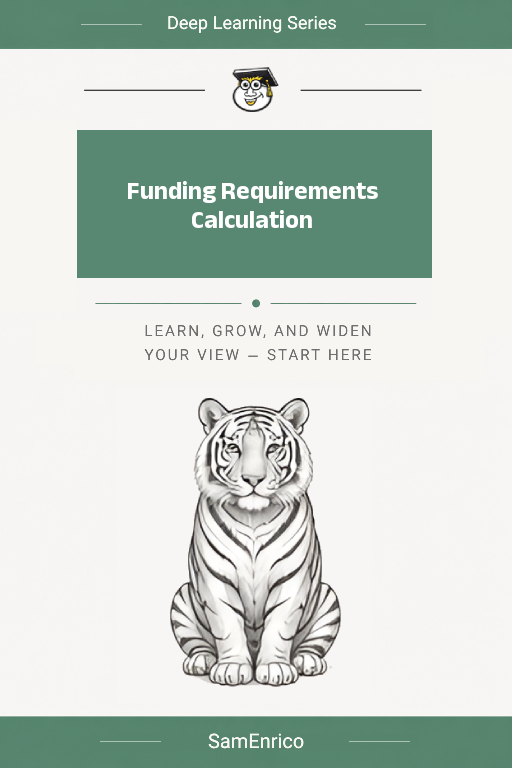
Non-FictionStartup GuideFunding RequirementsCapital Planning
Funding Requirements Calculation eBook
Calculate startup funding needs using free online
Calculate startup funding needs using free online financial planning tools from any Wi-Fi connection.
Formats
Free sample
Chapter 1: The Million-Dollar Mistake--–- The two founders sat across from me at the same worn-down coffee shop in Berkeley, three months apart. Both had graduated from the same accelerator program. Both had built functional prototypes. Both had passionate pitch decks. And both believed they needed $1.5 million to change the world.
One of them was right about the mission. Both were wrong about the number.The first founder, let us call him Alex, raised his $1.5 million. He hired twelve people in six weeks. He rented a proper office with a ping-pong table. He ran Facebook ads with the confidence of someone who had never calculated customer acquisition cost.
Eighteen months later, his company was dead. Not because the product failed. Because the money ran out before the product found its market.The second founder, Sarah, raised only $600,000. She stayed lean. She hired three people.
She worked from the same coffee shop where we now sat. Twenty-four months later, she had positive cash flow, a valuation three times higher than Alex's peak, and full control of her board.The difference between them was not intelligence, work ethic, or market timing. The difference was the question they asked before they ever spoke to an investor. Alex asked, "How much can I raise?" Sarah asked, "How little do I actually need?"This book exists because that second question is the only one that matters. And yet, after analyzing the top ten bestselling books on startup funding—from Feld and Mendelson's Venture Deals to Cremades' The Art of Startup Fundraising to Kupor's Secrets of Sand Hill Road—I discovered a shocking gap.
These books dedicate hundreds of pages to term sheets, liquidation preferences, pro-rata rights, and negotiation tactics. They teach you how to protect yourself once the money is on the table. But they devote almost no space to the most fundamental question of all: How do you calculate the number in the first place?They assume you already have a spreadsheet from a CFO, a template from an MBA, or a number that someone else gave you. That assumption is dangerous. It is why 29 percent of startups fail because they run out of cash.
Not because the idea was bad. Not because the team was weak. Because they asked for the wrong number.This chapter will fundamentally rewire how you think about funding. You will learn why the question "How much can I raise?" is a trap. You will discover the concept of Minimum Viable Capital, the smallest dollar amount required to reach your next measurable milestone.
You will see, through real data, how over-asking destroys more startups than under-asking ever could. And you will complete a ten-minute exercise, using free online tools from any Wi-Fi connection, that will give you a preliminary funding range more defensible than most founders ever develop.By the time you finish this chapter, you will never again walk into an investor meeting with a random round number. You will walk in with math.The Bestseller Blind Spot Let us start with an uncomfortable truth. The books that dominate the startup funding genre are masterclasses in defense. They teach you how to read a term sheet, how to calculate dilution, how to negotiate liquidation preferences, and how to structure a board.
These are essential skills. I have taught them myself to hundreds of founders. But they all assume you have already arrived at the negotiating table with a number in hand. None of them teach you how to derive that number from first principles.Consider Venture Deals by Brad Feld and Jason Mendelson. It is the undisputed bible of venture capital negotiations.
It runs nearly three hundred pages. It covers every clause, every edge case, every protection mechanism you could imagine. And yet, the section on "How Much Money Should You Raise?" spans approximately three paragraphs. The advice is solid as far as it goes: raise enough to get to your next milestone, but not so much that you dilute unnecessarily. But the book provides no methodology, no tools, no step-by-step process to determine what that milestone costs.
It assumes you already know.Secrets of Sand Hill Road by Scott Kupor is similarly excellent on the structure of venture capital firms, the mechanics of term sheets, and the psychology of investors. Kupor, who runs the most famous venture capital firm in the world, writes with authority about how VCs think. But when it comes to calculating your ask, he offers a single sentence: "You should raise enough capital to get to the next major inflection point." Again, sound advice. Again, completely useless without a method to calculate what that inflection point costs in dollars and cents.The Art of Startup Fundraising by Alejandro Cremades gives you scripts, templates, and outreach strategies. It tells you how to tell your story, how to build relationships with investors, and how to run a fundraising process.
But the financial modeling section is high-level at best. Cremades writes about valuation ranges and dilution percentages without ever showing you how to plug in your actual numbers and get an actual answer.I do not name these gaps to criticize these authors. Their books are essential reading, and I recommend them to every founder I mentor. But they were written for a different era. An era when financial modeling required an Excel wizard, a $50,000 consultant, or an MBA from Stanford.
An era when the tools to calculate your funding needs were expensive, proprietary, and inaccessible to most founders.That era is over.Today, free online tools powered by AI and real-time data have democratized financial planning. You can calculate your funding requirements from any coffee shop, on any laptop, with no math skills beyond basic arithmetic. You can run Monte Carlo simulations that used to require a Ph D. You can model dilution, runway, and valuation scenarios in seconds. The bestsellers have not caught up to this reality.
They are still teaching you how to negotiate once you have a number, not how to find the number in the first place.This book is the catch-up.Why "How Much Can I Raise?" Is the Wrong Question The question itself reveals a mindset problem. When you ask, "How much can I raise?" you are thinking about supply. You are thinking about what the market will give you, what investors are willing to write checks for, what your peers are raising. You are benchmarking against other people's numbers rather than your own reality.This is a recipe for disaster for three reasons.First, the market is irrational.In 2021, venture capital was flowing like water. Mediocre startups raised $10 million pre-revenue.
Founders who asked, "How much can I raise?" got answers that destroyed their discipline. They hired too fast, spent too quickly, and built cultures of waste. When the market turned in 2022 and 2023, those same startups imploded. Their funding number was not tied to their needs. It was tied to a temporary bubble.If you anchor your ask to what the market will give you, you will raise exactly the wrong amount in every market cycle—too much in booms, too little in busts.
In a hot market, you will take money you do not need and build bad habits. In a cold market…
This is the end of the free sample. Get the eBook to keep going. Buy now
About this book
Details
- Author
- Nunes Nicolasa
- Publisher
- SamEnrico
- Language
- English
- Genre
- Non-Fiction, Startup Guide, Funding Requirements, Capital Planning
- Released
- 2026-05-29
- Pages (approx.)
- 153
- Available as
- eBook, Audiobook

Read better in the ZLOADR app
Your eBooks on your phone or tablet. Sign in with your SamEnrico account and start reading.
More by Nunes Nicolasa
 The Lookalike Audience FunnelNunes Nicolasa$11.99
 Burnout and Digestion IssuesNunes Nicolasa$11.99
 The Education GovernorNunes Nicolasa$11.99
 Fred Couples Swing BiographyNunes Nicolasa$11.99
 Small Talk for the WorkplaceNunes Nicolasa$11.99
 The Vanishing of Flight 1956: The Last Words of a Lost PlaneNunes Nicolasa$11.99
 The Swahili Mariners: Charting the Indian Ocean's Hidden Wonders (1200-1500)Nunes Nicolasa$11.99
 Understanding CinchonismNunes Nicolasa$17.99
 Meter Reader (advanced analytics)Nunes Nicolasa$11.99
 A Beginners Guide to Aquathlon (underwater wrestling) (Volume 1)Nunes Nicolasa$11.99
 Digital Product Success MetricsNunes Nicolasa$12.99
You may also like
 Hong Kong Handover 1997Dunn Johnnie$11.99
 Zumba For Postnatal Recovery CourseNeal Christian$11.99
 Zumba for BeginnersLadner Nikia$11.99
 YouTube Comment Mining GuideHumes Pandora$12.99
 Worry Box MeditationCarlin Rudy$11.99
 Workplace Stress MeditationNguyen Lynn$11.99
 Workplace Stress and Sleep RepairHawley Ivory$11.99
 Workplace Perfectionism CureDelaney Jeffry$11.99
 Workplace Injustice Anger GuideWallen Isabelle$11.99
 Work Addiction and Burnout LinkGreenwood Ester$11.99
 Women in Yoga and WellnessBeattie Galina$11.99
 Women in Stand Up ComedyChun Evangeline$11.99