
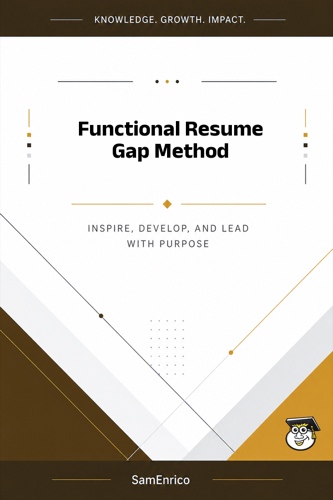
Functional Resume Gap Method eBook
Use skills based CV formatting to deemphasize chro
Use skills based CV formatting to deemphasize chronology and highlight abilities.
Formats
Free sample
Chapter 1: The Six-Second Execution--The resume lands on the recruiter’s screen at 9:47 AM. She has 147 more to review before lunch. Her finger hovers over the keyboard. She clicks. She scans.Four seconds later, she hits “Reject.”She did not read about your achievements.
She did not see that you increased sales by 40% or that you led a team of fifteen. She saw one thing: a date gap. A job that ended seven months ago with nothing after it. In her mind, that gap is a risk signal, and the risk signal is a rejection.You never had a chance.This is not an edge case or an outlier. This is the standard operating procedure of modern recruiting.
According to eye-tracking research conducted by The Ladders and published in their 2018 study “The Science of the 6-Second Resume Scan,” professional recruiters spend an average of just 6.25 seconds on their initial resume review. Within that window, 80% of their visual attention is concentrated on the top third of the first page: your name, your headline, your professional summary, and your first job role. If any of those elements trigger a threat pattern—a gap, a short tenure, a title that doesn’t match the expected progression—the resume is discarded before a single achievement is read.This chapter is about understanding that reality, accepting it without resentment, and then systematically dismantling it. You are about to learn why chronology is a liar’s game, why the traditional resume format is designed to punish anyone who has ever taken a break, and how you can re-engineer the top third of your resume to force recruiters to see your capabilities before they ever see your timeline.The Chronology Trap For decades, the reverse-chronological resume has been treated as the gold standard. List your most recent job first.
Work backwards. Let the timeline tell the story. This approach works beautifully for one type of candidate: the person who has moved steadily upward, without interruption, at recognizable companies, for twenty consecutive years.For everyone else, it is a trap.Consider two candidates applying for the same operations manager role. Candidate A has worked at three companies over twelve years. No gaps.
Steady promotions. Candidate B has similar experience but took two years off to care for an aging parent, then spent eighteen months consulting part-time while searching for the right full-time role. On paper, Candidate A’s resume looks pristine. Candidate B’s resume has what recruiters call “white space”—periods with no employer listed.Here is the truth that the traditional format hides: Candidate B may be the better operator. During those two years of caregiving, she managed complex medical scheduling across five specialists, negotiated with insurance companies, coordinated home care, and handled a six-figure household budget.
Those are project management, negotiation, logistics, and financial oversight skills. But because they lack a corporate job title, the chronological resume treats those years as a void.Chronology is a lazy heuristic. It measures presence, not performance. It rewards showing up and punishes stepping away. It assumes that a person who sat in a cubicle for five years is automatically more valuable than a person who spent two years managing a crisis.
This is not just unfair—it is empirically wrong. And yet, it persists because recruiters are overwhelmed, under-trained, and operating on muscle memory.The solution is not to complain about the system. The system will not change for you. The solution is to change the game entirely by replacing “time-based trust” with “competency-based trust.”Time-Based Trust vs. Competency-Based Trust Time-based trust sounds like this: “She worked at Google for five years, so she must be smart.” It is an assumption based on duration and brand association.
Competency-based trust sounds like this: “She led three product launches that generated $2 million in revenue. I don’t care when she did them or where.” It is an assumption based on demonstrated results.The chronological resume is built entirely on time-based trust. It assumes that the longer you stayed somewhere, the more you must have learned. It assumes that a gap means you were doing nothing of value. Both assumptions are false.The Gap Method flips this entirely.
It builds a resume on competency-based trust. It leads with what you can do, not when you did it. It presents achievements divorced from their timeline, forcing the recruiter to evaluate capability before chronology. And only after you have already proven your worth does it offer a controlled, minimal timeline—just enough to satisfy the ATS and the recruiter’s muscle memory.This is not deception. This is strategic framing.
You are not lying about your gaps. You are simply refusing to let them be the first thing a recruiter sees.The 6.25-Second Reality Let’s get specific about those 6.25 seconds. The Ladders study tracked the eye movements of thirty professional recruiters as they reviewed real resumes. The findings were brutal:Recruiters spent the first 2-3 seconds locating your name and current job title.The next 2-3 seconds were spent scanning the top third for red flags: gaps, short tenures, irrelevant titles, or missing keywords.If no red flags were found, they would spend additional time reading deeper.If a red flag was found, the resume was rejected immediately.This means that a single gap of six months or longer—visible as a break in the timeline—can trigger rejection before you have communicated a single skill, achievement, or result. The recruiter does not think, “I wonder what valuable things she did during that gap.” The recruiter thinks, “Risk” and moves on.Consider the anatomy of a rejected resume.
A candidate named Michael had a fourteen-month gap between his role as a marketing manager and his next contract position. On his chronological resume, it looked like this:Marketing Manager, Acme Corp (2019-2022)[achievements]Freelance Marketing Consultant (2023-2024)[achievements]Between 2022 and 2023, there was nothing. The eye-tracker would show the recruiter’s gaze stopping at that empty space, then jumping to the next candidate. Michael’s achievements during his freelance period—the campaigns he ran, the revenue he generated—were never read because the visual interruption of the gap had already triggered a rejection.Now imagine the same timeline presented differently. What if the gap itself was invisible?
What if the fourteen months were absorbed into a single line that said “2022-2024” with no months listed? What if the achievements from that period appeared not under a job title but under skill headings like “Campaign Management” and “Client Strategy,” with no dates attached at all?That is the Gap Method. And it works because it removes the trigger before the recruiter’s finger hits the reject button.The Top Third Takedown If 80% of the recruiter’s attention is on the top third of page one, then the top third is where you win or lose. The rest of the resume is for confirmation. The Gap Method requires a complete re-engineering of that critical real estate.Here is what the top third of a traditional resume contains: your name, your contact information, an objective statement (which no one reads), and your most recent job with dates.
That is a disaster. The most prominent information on the page is your timeline.Here is what the top third of…
This is the end of the free sample. Get the eBook to keep going. Buy now
About this book
Details
- Author
- Devito Jacquetta
- Publisher
- SamEnrico
- Language
- English
- Genre
- Non-Fiction, Non-Obvious Career, Resume Writing, Skills
- Released
- 2026-06-10
- Pages (approx.)
- 148
- Available as
- eBook, Audiobook

Read better in the ZLOADR app
Your eBooks on your phone or tablet. Sign in with your SamEnrico account and start reading.
More by Devito Jacquetta
 Body Language for ParentsDevito Jacquetta$11.99
 John Wycliffe AccountDevito Jacquetta$11.99
 Breaking the Sports Betting Cycle GuideDevito Jacquetta$11.99
 The Gut Brain Connection GuideDevito Jacquetta$11.99
 The Algorithm’s Dilemma: How Google’s 2018 AI Bias Scandal Reshaped Tech EthicsDevito Jacquetta$11.99
 Understanding Labrador LungDevito Jacquetta$17.99
 Climate Fintech Investment GuideDevito Jacquetta$12.99
 Action Item Extractor WorkbookDevito Jacquetta$12.99
 How to Start a Balaclava Helmet Business (Beginners Guide)Devito Jacquetta$11.99
 Basenji BreedingDevito Jacquetta$11.99