
Non-FictionInformativeEducational
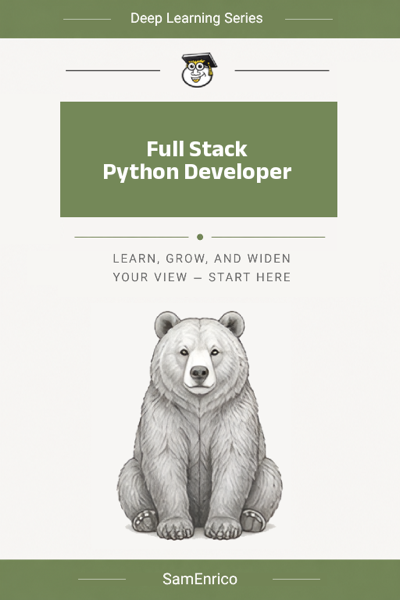
Full Stack Python Developer eBook
A Coursebook on Full Stack Python Developer
by Fisk Gayla
A Coursebook on Full Stack Python Developer
Formats
Free sample
Chapter 1: The Orchestrated Workspace--The most expensive bug I ever fixed cost a company forty-seven thousand dollars. It wasn't a complex algorithmic failure or a security breach. It was a single line of code that worked perfectly on the lead developer's machine but crashed instantly in production because of a mismatched Python version. The developer had used Python 3.11's new feature. The production server ran Python 3.9. The company lost a full day of e-commerce revenue on Black Friday.That developer wasn't incompetent. He was undisciplined about his environment. And that one oversight taught me a lesson that no bootcamp or computer science degree ever emphasizes: the difference between a junior developer who writes working code and a professional who ships reliable software isn't intelligence or talent. It's the ability to control the chaos of tools, dependencies, and environments before writing a single line of business logic.This chapter is not about Python syntax. You can learn that anywhere. This chapter is about building a fortress around your code so that when you write something brilliant, it runs the same way on your laptop, your teammate's computer, and the cloud server serving a thousand users. By the end of the next forty pages, you will have a professional-grade development environment that mirrors what you would find at a Silicon Valley startup or a Fortune 500 enterprise. You will understand why most self-taught developers fail the first technical interview question about environment setup. And you will never be the person who costs their company forty-seven thousand dollars.The Invisible Foundation That Separates Hobbyists from Professionals Open any job description for a full-stack Python developer. You will see requirements for Fast API, React, Postgre SQL, Docker, and cloud deployment. What you will not see is a requirement for "knows how to install Python." That is assumed. What is also assumed, but almost never taught, is the ability to orchestrate these tools so they work together without constant friction.Let me tell you about two developers. Developer A completes a popular online course. She builds a todo list app, a weather dashboard, and a blog platform. Each project lives in a separate folder. She installs packages globally because that is what the tutorial showed. When she tries to run two projects simultaneously, one breaks because it needs an older version of a library. She spends hours on Stack Overflow copying commands she does not understand.Developer B reads this chapter first. He sets up a monorepo before writing any code. He isolates each project's dependencies. He learns five Git commands that save him from ever losing work. When he joins a team of four developers, his environment matches theirs exactly. He never once says, "It works on my machine."Developer B is the one who gets promoted. Developer B is the one who can freelance without embarrassing himself. Developer B is the one who reads the rest of this book and builds Cloud Cart, a real e-commerce platform, without fighting his tools at every step.You are going to be Developer B.Why Virtual Environments Are Not Optional Python is beautiful because of its package ecosystem. Python is infuriating because of its package ecosystem. The same feature that lets you install requests with a single command also lets you unknowingly break every other Python project on your computer.Here is the problem in human terms. Imagine you live in a house with three roommates. Every time you order food delivery, it goes to a shared fridge. One roommate needs the leftover pasta for tomorrow's lunch. Another roommate throws it away because he wants space for his protein shakes. Someone else eats it at midnight. Chaos.That is global package installation. Every Python project you build shares the same collection of libraries. Project A needs fastapi==0.68.0. Project B needs fastapi==0.115.0. They cannot coexist in the same fridge. Something will break.Virtual environments solve this by giving each project its own fridge. Actually, its own kitchen. Actually, its own house.A virtual environment is a self-contained directory that holds a specific Python version and specific package versions for a single project. When you activate that environment, every pip install command installs packages into that isolated space. Project A can have Fast API 0.68.0. Project B can have Fast API 0.115.0. They never interact. They never conflict. They never ruin your weekend.The Three Ways to Create Virtual Environments Python gives you multiple tools for this job. Let me save you months of confusion by explaining the landscape honestly.Option 1: venv (Built-in, Basic)Every Python installation since version 3.3 includes the venv module. It works. It is simple. It is also, for professional full-stack development, insufficient.text Copy Downloadpython -m venv myproject_env
source myproject_env/bin/activate # On Windows: myproject_env\Scripts\activate pip install fastapi uvicorn The problem with venv is that it only manages the environment, not the dependencies. You still need a requirements.txt file. You still need to remember to freeze requirements after every installation. You still have no guarantee that your production environment will match your development environment because requirements.txt often omits sub-dependencies.Option 2: conda (Data Science Heavyweight)If you come from data science or machine learning, you know Conda. It manages both Python versions and non-Python dependencies like CUDA for GPU programming. For web development, it is overkill. It is slow. It includes hundreds of packages you will never use.Option 3: poetry (Professional Choice)This is what you will use in this book. Poetry solves three problems at once. It creates virtual environments. It manages dependencies with deterministic lock files. And it packages your project for distribution.text Copy Downloadcurl -s SL https://install.python-poetry.org | python3 - poetry new cloudcart cd cloudcart poetry add fastapi uvicorn poetry shell The poetry add command installs the package AND records it in pyproject.toml AND updates poetry.lock with exact versions of every single dependency and sub-dependency. When you deploy to production, Poetry installs the exact same versions. No surprises. No Black Friday disasters.For the rest of this book, every time you install a package, you will use poetry add. Not pip install. Not pip3 install. poetry add. Drill this into your muscle memory now.The Monorepo: One Project to Rule Them All Most tutorials teach you to build frontend and backend in separate folders, separate repositories, separate universes. Then they leave you to figure out how to connect them. That is like teaching someone to build a car engine in one garage and the chassis in another garage three miles away, then shrugging when the car does not start.This book uses a monorepo. One folder. One Git repository. Everything in its place.The Structure You Will Build Create a folder called cloudcart on your desktop or in your developer directory. Inside it, create this exact structure:text Copy Downloadcloudcart/ ├── backend/ │ ├── app/ │ │ ├── __init__.py │ │ ├── main.py │ │ ├── models.py │ │ └── routers/ │ ├── tests/ │ ├── pyproject.toml │ └── poetry.lock ├── frontend/ │ ├── src/ │ ├── public/ │ ├── package.json │ └── vite.config.js ├── scripts/ │ ├── seed_database.py │ └── backup.sh ├── docker/ │ ├── Dockerfile.backend │ ├── Dockerfile.frontend │ └── docker-compose.yml ├── docs/ │ ├── api_reference.md │ └── setup_guide.md └── .gitignore Let me explain why each folder exists.backend/ contains all Python…
This is the end of the free sample. Get the eBook to keep going. Buy now
About this book
Details
- Author
- Fisk Gayla
- Publisher
- SamEnrico
- Language
- English
- Genre
- Non-Fiction, Informative, Educational
- Released
- 2026-05-04
- Pages (approx.)
- 134
- Available as
- eBook, Audiobook

Read better in the ZLOADR app
Your eBooks on your phone or tablet. Sign in with your SamEnrico account and start reading.
More by Fisk Gayla
 Senior Center DirectorFisk Gayla$11.99
 Mobile Library VehicleFisk Gayla$11.99
 Canva Brand Identity for Coffee ShopsFisk Gayla$11.99
 Non Nicotine Pharmacotherapy GuideFisk Gayla$11.99
 The Midnight Run: How a Single Pilot Saved 119 Lives in the AndesFisk Gayla$11.99
 Learn to Play the Subcontrabass TubaFisk Gayla$11.99
 10 Ways to Use Figging (Recipe Book)Fisk Gayla$11.99
 AI for Social Media AnalyticsFisk Gayla$12.99
You may also like
 Hong Kong Handover 1997Dunn Johnnie$11.99
 Zumba For Postnatal Recovery CourseNeal Christian$11.99
 Zumba for BeginnersLadner Nikia$11.99
 YouTube Comment Mining GuideHumes Pandora$12.99
 Worry Box MeditationCarlin Rudy$11.99
 Workplace Stress MeditationNguyen Lynn$11.99
 Workplace Stress and Sleep RepairHawley Ivory$11.99
 Workplace Perfectionism CureDelaney Jeffry$11.99
 Workplace Injustice Anger GuideWallen Isabelle$11.99
 Work Addiction and Burnout LinkGreenwood Ester$11.99
 Women in Yoga and WellnessBeattie Galina$11.99
 Women in Stand Up ComedyChun Evangeline$11.99