
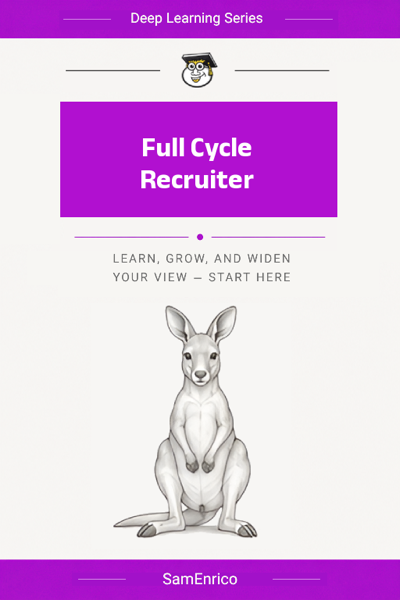
Non-FictionInformativeEducational
Full Cycle Recruiter eBook
A Coursebook on Full Cycle Recruiter
by Gunn Nanci
A Coursebook on Full Cycle Recruiter
Formats
Free sample
Chapter 1: The Resume Trap--–- I once rejected a candidate in eleven seconds. His resume crossed my screen at 9:47 on a Tuesday morning. I glanced at his job titles—five jobs in seven years—scanned for the right keywords, found none, and clicked "Archive." Total time invested: less time than it takes to tie a shoe.That candidate was James. He is now the Chief Technology Officer of a company that competes directly with the one I was recruiting for. The person I hired instead?
He lasted four months.I tell you this story not because I am proud of it. I tell you because you have done the same thing. Maybe not eleven seconds. Maybe you gave it thirty. But you have looked at a resume, made a snap judgment, and moved on.
And in that moment, you were not a strategic talent advisor. You were an order taker. A paper pusher. A human filter standing between your company and the talent it desperately needed.This book exists because that version of you—the one who rejects candidates in eleven seconds—cannot survive the next decade of recruiting. The rules have changed.
The labor market has fractured. Artificial intelligence is eating the administrative parts of your job for breakfast. And the only recruiters who will thrive are those who stop measuring success by "resumes sent" and start measuring it by "business impact delivered."Welcome to Full Cycle Recruiter. This is not a book about how to post jobs faster. It is a book about how to own the talent lifecycle from workforce planning to Day 90 on the job—and how to turn recruiting from a cost center into a competitive weapon.The Great Misunderstanding: What "Full Cycle" Actually Means Let us start with a fundamental problem.
Ask ten recruiters what "full cycle" means, and you will get eleven answers. Some say it is sourcing to closing. Others say it is intake to offer. A few brave souls include onboarding. Almost no one includes retention.Here is the definition that will govern everything in this book: A Full Cycle Recruiter is an end-to-end owner of the talent lifecycle, from workforce planning through Day 90 post-hire, with explicit accountability for business outcomes, not just activity metrics.Notice what that definition includes.
Workforce planning—not just waiting for a requisition to land in your inbox. Day 90 post-hire—not just the start date. Business outcomes—not just time-to-fill. And notice what it excludes. Activity metrics.
Resume volume. "Calls made." "Emails sent." Those are the measurements of an order taker. They are the busywork that justifies a salary. They are not impact.Let me give you a concrete example of the difference. An order taker receives a requisition for a senior software engineer.
She posts it on Linked In, Indeed, and three niche job boards. She sources fifty candidates from Linked In Recruiter. She screens fifteen. She sends five to the hiring manager. Two get interviews.
One gets an offer and accepts. She celebrates. Time-to-fill: forty-two days. She did her job.A Full Cycle Recruiter receives the same requisition. She does not post anything yet.
She asks the hiring manager: "What business problem are we solving by filling this role? What happens if we do not fill it in thirty days? In sixty? In ninety?" She calculates the Cost of Vacancy—the actual revenue or productivity lost per day the role stays open. She discovers that this role supports a product launch worth three million dollars.
Every day it is empty costs the company twelve thousand dollars in delayed revenue.Suddenly, the requisition is not a job order. It is a business problem with a price tag. And she is accountable for solving it.The Cost of Vacancy: Your New Best Friend Let me teach you the single most important formula in this book. It is not complicated. It does not require a spreadsheet.
But it will change how you talk to hiring managers forever.Cost of Vacancy (COV) = (Annual Revenue per Employee ÷ 220) × Days Role is Open Why 220? Because the average employee works about 220 days per year after accounting for weekends, holidays, and vacation. This formula gives you a daily revenue number. Every day that role is empty, that revenue is not being generated.Here is how it works in practice. Let us say your company generates ten million dollars in annual revenue and has one hundred employees.
Average revenue per employee is one hundred thousand dollars. Divide that by 220, and each day of vacancy costs roughly $455 in unrealized revenue. A role that stays open for sixty days costs the company over twenty-seven thousand dollars—not in recruiting spend, but in revenue that never happened.Now you understand why hiring managers who say "we can wait for the perfect candidate" are often making a mathematical error. The perfect candidate might be ten percent better than the good candidate. But if waiting for them adds sixty days of vacancy, you have lost twenty-seven thousand dollars to gain a ten percent improvement.
That math rarely works.The Full Cycle Recruiter brings this calculation to every intake meeting. Not as a weapon. As a shared framework for making trade-offs. You are not telling the hiring manager they are wrong. You are asking: "Given that every day this role is empty costs us X dollars, how much risk are we willing to accept to wait for a marginally better candidate?"That question changes the conversation.
You are no longer an order taker asking "what do you want?" You are a strategic advisor asking "what trade-off should we make?"Quality of Hire: The Metric Everyone Gets Wrong If Cost of Vacancy is your North Star for speed, Quality of Hire is your North Star for accuracy. But here is the problem: almost everyone measures Quality of Hire wrong.Most companies define Quality of Hire as "performance rating at one year." That is useful for organizational benchmarking. It tells you whether your hiring process is working at a macro level. But it is almost useless for individual recruiter accountability. By the time you have a one-year performance rating, the recruiter who made that hire has moved on to fifty other roles.
Feedback loops are broken.This book introduces a two-tiered framework that solves that problem.Tier 1: Early Retention (90 days) – This is the recruiter's accountability window. If a new hire leaves within ninety days, the recruiter owns that failure. Not exclusively—hiring managers and HR share accountability, which we will cover in Chapter 12. But the recruiter cannot blame the manager or the onboarding process. Something in the sourcing, screening, or closing process broke down.
A candidate who leaves at Day 60 was not the right fit on Day 1. The recruiter missed something.Tier 2: Sustainable Retention (1 year) – This is organizational benchmarking. It tells you whether your hiring process, compensation structure, and management practices are working. A one-year retention rate below eighty percent is a systemic problem, not a recruiter problem. It signals issues with culture, management, or total rewards.Here is why this matters.
I once worked with a recruiter named Maria who had a ninety-five percent ninety-day retention rate. By every recruiter metric, she was elite. But her one-year retention rate was sixty…
This is the end of the free sample. Get the eBook to keep going. Buy now
About this book
Details
- Author
- Gunn Nanci
- Publisher
- SamEnrico
- Language
- English
- Genre
- Non-Fiction, Informative, Educational
- Released
- 2026-06-03
- Pages (approx.)
- 135
- Available as
- eBook, Audiobook

Read better in the ZLOADR app
Your eBooks on your phone or tablet. Sign in with your SamEnrico account and start reading.
More by Gunn Nanci
 Meeting Interruption Anger GuideGunn Nanci$11.99
 Nobel Laureates in War TimeGunn Nanci$11.99
 Gambling and Anxiety LinkGunn Nanci$11.99
 Arsenio Hall Dog Pound EnergyGunn Nanci$11.99
 The Calendar Buffer Zone GuideGunn Nanci$11.99
 The Iron Discipline: Frederick the Great and the Birth of Modern WarfareGunn Nanci$11.99
 How to Start a Perchlorate Explosive Business (Beginners Guide)Gunn Nanci$11.99
 Understanding Pyridoxine DeficitGunn Nanci$17.99
 Elastic GuideGunn Nanci$12.99
 USDC for African ExportersGunn Nanci$12.99
You may also like
 Hong Kong Handover 1997Dunn Johnnie$11.99
 Zumba For Postnatal Recovery CourseNeal Christian$11.99
 Zumba for BeginnersLadner Nikia$11.99
 YouTube Comment Mining GuideHumes Pandora$12.99
 Worry Box MeditationCarlin Rudy$11.99
 Workplace Stress MeditationNguyen Lynn$11.99
 Workplace Stress and Sleep RepairHawley Ivory$11.99
 Workplace Perfectionism CureDelaney Jeffry$11.99
 Workplace Injustice Anger GuideWallen Isabelle$11.99
 Work Addiction and Burnout LinkGreenwood Ester$11.99
 Women in Yoga and WellnessBeattie Galina$11.99
 Women in Stand Up ComedyChun Evangeline$11.99