
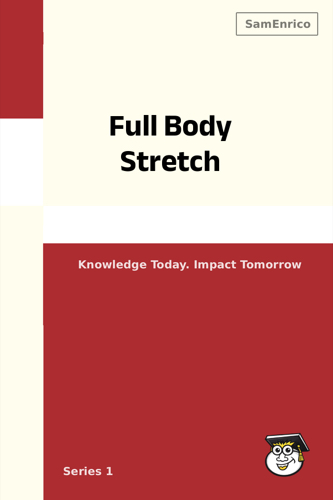
Non-FictionHealth & WellnessFlexibility
Full Body Stretch Audiobook
Teaches daily routine covering all major muscle gr
Teaches daily routine covering all major muscle groups.
Formats
Free sample
Chapter 1: The Stretch Lie--–- Most people believe they know how to stretch. They wake up, point their toes toward the ceiling, grab their foot, and pull. Or they stand up from a desk after six hours of sitting, reach down to touch their toes, bounce a few times, and call it mobility work. Some have even attended a yoga class once, learned a half-dozen poses, and now consider themselves flexible.None of these people understand what stretching actually is.And that is not their fault. The fitness industry has spent decades selling a simplified, and often dangerously wrong, version of flexibility.
Stretching has been reduced to a mechanical act—pull on a tight muscle like a rubber band until it lengthens. If it hurts, the thinking goes, you must be doing something right. No pain, no gain, as the old mantra insists.That mantra has quietly injured millions of people.The problem begins with a fundamental misunderstanding of what limits flexibility in the first place. Most people assume that when a muscle feels tight, the muscle fibers themselves are too short. This assumption leads to a logical but flawed conclusion: stretch harder, hold longer, and push through discomfort until the fibers physically lengthen.But here is the truth that changes everything: muscles are almost never too short.
What you feel as "tightness" is most often a neurological signal—your brain's way of saying, "Stop moving further. I do not feel safe in this range of motion."This single insight is the difference between a stretching practice that works and one that leaves you frustrated, injured, or both.The Rubber Band Myth Let us start with a simple experiment you can perform right now, while reading this chapter. Extend your right arm straight out to the side, palm facing down. Now slowly rotate your palm upward until it faces the ceiling. Keep rotating.
At some point, you will feel resistance—a pulling sensation somewhere in your shoulder or forearm.What just happened? Did your muscles physically shorten in the three seconds it took to rotate your arm? Of course not. Tissue does not change length that quickly. What you felt was your nervous system applying a brake, activating a protective mechanism called the stretch reflex.The stretch reflex is one of your body's most fundamental survival tools.
Inside every muscle are tiny sensory organs called muscle spindles. These spindles detect both how much and how quickly a…
This is the end of the free sample. Get the Audiobook to keep going. Buy now
About this book
Details
- Author
- Andre Nakesha
- Publisher
- SamEnrico
- Language
- English
- Genre
- Non-Fiction, Health & Wellness, Flexibility
- Released
- 2026-06-05
- Pages (approx.)
- 158
- Available as
- eBook, Audiobook

Listen in the VoxFlicks app
Audiobooks and audio dramas wherever you go. Sign in with your SamEnrico account and press play.
More by Andre Nakesha
 Warehouse Outbreak Safety GuideAndre Nakesha$11.99
 Burn Master GuideAndre Nakesha$11.99
 Mindfulness for AngerAndre Nakesha$11.99
 Dividend Calendar Strategy GuideAndre Nakesha$11.99
 My Caseworker AngelAndre Nakesha$11.99
 Cocaine Nasal Septum RepairAndre Nakesha$11.99
 Fiverr Cancellation Rate GuideAndre Nakesha$11.99
 The Unseen Champions: Africa's First Female AthletesAndre Nakesha$11.99
 The Alchemists of Fire: Lavoisier and the Birth of Modern ChemistryAndre Nakesha$11.99
 How to Produce Window HardwareAndre Nakesha$11.99
 A Collector's Handbook to the Morris Twenty-five Series IiAndre Nakesha$11.99
 OKR for 10 Person TeamAndre Nakesha$12.99
You may also like
 Hong Kong Handover 1997Dunn Johnnie$11.99
 Zumba For Postnatal Recovery CourseNeal Christian$11.99
 Zumba for BeginnersLadner Nikia$11.99
 YouTube Comment Mining GuideHumes Pandora$12.99
 Worry Box MeditationCarlin Rudy$11.99
 Workplace Stress MeditationNguyen Lynn$11.99
 Workplace Stress and Sleep RepairHawley Ivory$11.99
 Workplace Perfectionism CureDelaney Jeffry$11.99
 Workplace Injustice Anger GuideWallen Isabelle$11.99
 Work Addiction and Burnout LinkGreenwood Ester$11.99
 Women in Yoga and WellnessBeattie Galina$11.99
 Women in Stand Up ComedyChun Evangeline$11.99