
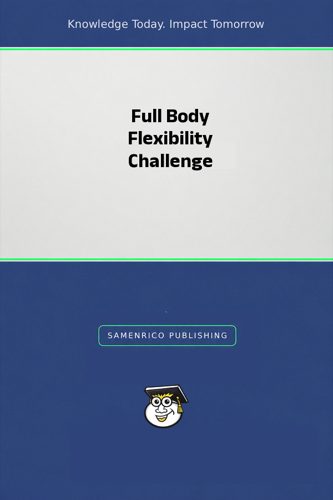
Non-FictionHealth & WellnessChallenge Program
Full Body Flexibility Challenge eBook
Thirty day progressive routine to double your rang
Thirty day progressive routine to double your range of motion.
Formats
Free sample
Chapter 1: Beyond the Toe-Touch--–- Every morning before sunrise, Sarah performed the same ritual she had learned from a popular yoga app: a ten-minute sequence of forward folds, hamstring pulls, and seated twists. She could press her palms flat to the floor while keeping her knees straight—a feat that impressed her friends at the office. By every conventional measure, Sarah was flexible. Yet when she attempted a simple bodyweight squat to play with her three-year-old nephew, her heels lifted off the ground, her lower back rounded like a scared cat, and her knees caved inward. She caught herself from falling backward only by flailing her arms.
Her nephew looked confused. Sarah felt humiliated.–- Sarah's story is not an exception. It is the rule. Millions of people who can touch their toes, perform the splits, or wrap their arms around their thighs in a seated forward fold discover, often painfully, that this flexibility does not translate to real-world movement. They are flexible in a vacuum but fragile in life.
This is what we call the Flexibility Paradox: the more you train flexibility in isolation, the less it serves you in motion.–- This chapter dismantles the most dangerous myths about flexibility that have been repeated so often they have become mistaken for gospel. We will explore why traditional stretching fails to produce lasting change, how the nervous system—not muscle length—is the true gatekeeper of your range of motion, and what real-world flexibility actually looks like when it is tested under load, speed, and unpredictability. By the end of this chapter, you will understand why your current approach may be holding you back and how the Full Body Flexibility Challenge will rebuild your movement from the ground up.The Seductive Lie of Static Stretching–- If you have ever taken a group fitness class, worked with a personal trainer, or simply browsed social media for mobility tips, you have encountered the same core instruction: find a tight muscle, stretch it until you feel a pull, hold for thirty seconds, and repeat. This approach, known as static passive stretching, has become so deeply embedded in fitness culture that questioning it feels almost heretical. But the scientific evidence is unambiguous: static stretching alone is one of the least effective methods for producing lasting, functional flexibility.–- A comprehensive meta-analysis published in the Journal of Strength and Conditioning Research examined over two hundred studies on static stretching and found that while it produces small, acute increases in range of motion, those gains are almost entirely neurological rather than structural.
In plain language: you are not lengthening your muscles. You are temporarily desensitizing your nervous system to the sensation of stretch. This desensitization begins to reverse within thirty minutes of standing up and is typically gone within a few hours. The next day, you are back where you started—or worse, because your muscles have adapted by becoming more resistant to stretch as a protective response.–- The mechanism behind this failure is elegant and frustrating. Inside every muscle are tiny sensory receptors called muscle spindles.
Their job is to detect changes in muscle length and the speed of those changes. When you passively stretch a muscle—meaning you relax completely while an external force (gravity, a strap, or your hands) lengthens it—the muscle spindles interpret that lengthening as a potential threat. They fire an urgent signal to your spinal cord: "Something is pulling this muscle beyond its accustomed length!" In response, your spinal cord activates the stretch reflex, causing the muscle to contract involuntarily to resist the stretch. This is why you feel a "tightness" or "rebound" sensation when you push a stretch too far or too fast. Your body is not being stubborn; it is protecting you from what it perceives as a tear.–- The Golgi tendon organ, another sensory receptor located at the junction where muscle meets tendon, has the opposite function.
When it detects sustained tension for more than a few seconds, it sends an inhibitory signal that overrides the muscle spindles and relaxes the muscle. This is the mechanism behind the common advice to "hold a stretch for thirty seconds"—it gives the Golgi tendon organ time to activate. And it works, temporarily. The muscle relaxes, the stretch deepens, and you feel a sense of progress. But this relaxation is a neurological trick, not a structural adaptation.
You have not lengthened the muscle, remodeled the fascia, or changed the tendon. You have simply fatigued your nervous system's resistance. Within minutes, that resistance returns, often stronger than before because your brain has added this experience to its threat database.The Tissue Myth: Why "Tight Muscles" Are Usually a Red Herring–- When people describe themselves as "tight," they almost always assume the problem resides in their muscles—that the tissue itself is shorter than it should be, like a rubber band that has lost its elasticity. This assumption is so pervasive that it has spawned entire industries of foam rollers, massage guns, and stretching straps. Yet research using ultrasound and magnetic resonance imaging has consistently shown that individuals who report chronic tightness do not have shorter muscles than flexible individuals.
In fact, in many cases, their muscles are identical in length. The difference is in how their nervous system regulates those muscles.–- To understand this, we need to distinguish between three different tissues: muscle, fascia, and tendon. Muscle is highly adaptable and can change its resting length, but this process requires significant time and specific loading—typically months of consistent eccentric training, not weeks of passive stretching. Fascia is the three-dimensional web of connective tissue that surrounds every muscle, bone, nerve, and organ. It can become "stuck" or dehydrated, but releasing fascia requires sustained, slow, often heavy pressure (like foam rolling or massage) combined with active movement, not passive stretching.
Tendons are stiff, spring-like structures that connect muscle to bone. They hate sudden end-range loading and adapt very slowly—over six months to two years. Stretching a tendon aggressively is a recipe for tendinopathy, not flexibility.–- When you perform a static hamstring stretch, you are primarily affecting the nervous system's sensitivity, not the length of any of these three tissues. The muscle does not lengthen. The fascia does not release.
The tendon does not stretch. Your brain simply decides, temporarily, to allow a little more slack. This is why Sarah could touch her toes effortlessly but could not squat. Her nervous system had learned to tolerate passive, slow, predictable hamstring lengthening while lying on her back or sitting on the floor. It had not learned to control that length while her hips, knees, and ankles were simultaneously flexing, while she was bearing her full bodyweight, and while she was moving at a normal speed.
Those are completely different neurological tasks.Real-World Flexibility: The Three Demands Your Body Must Meet–- If touching your toes on a yoga mat does not prepare you for life, what does? Real-world flexibility requires your body to meet three simultaneous demands that traditional stretching never trains.–- Demand One: End-Range Strength. In daily life and athletics, you almost never access end ranges of motion passively. You access them while your muscles are…
This is the end of the free sample. Get the eBook to keep going. Buy now
About this book
Details
- Author
- Arteaga Faviola
- Publisher
- SamEnrico
- Language
- English
- Genre
- Non-Fiction, Health & Wellness, Challenge Program
- Released
- 2026-06-10
- Pages (approx.)
- 140
- Available as
- eBook, Audiobook

Read better in the ZLOADR app
Your eBooks on your phone or tablet. Sign in with your SamEnrico account and start reading.
More by Arteaga Faviola
 Social Comparison Academic Stress GuideArteaga Faviola$11.99
 Weight Loss Journey ComparisonArteaga Faviola$11.99
 Sick Parent Carer Child GuideArteaga Faviola$11.99
 Assertive Communication in Volunteer GroupsArteaga Faviola$11.99
 Waves of Justice: The Trial of the Cape Town Surfing Pioneers (1930s)Arteaga Faviola$11.99
 How to Start a China, Glassware, Wallpaper and Cleaning Materials Importer (wholesale) Business (BegArteaga Faviola$11.99
 Debt CounselingArteaga Faviola$11.99
 Equity Focused Promotion GuideArteaga Faviola$12.99
 Citation Rules for Music StudentsArteaga Faviola$12.99
 Understanding Nail–patella SyndromeArteaga Faviola$17.99
You may also like
 Hong Kong Handover 1997Dunn Johnnie$11.99
 Zumba For Postnatal Recovery CourseNeal Christian$11.99
 Zumba for BeginnersLadner Nikia$11.99
 YouTube Comment Mining GuideHumes Pandora$12.99
 Worry Box MeditationCarlin Rudy$11.99
 Workplace Stress MeditationNguyen Lynn$11.99
 Workplace Stress and Sleep RepairHawley Ivory$11.99
 Workplace Perfectionism CureDelaney Jeffry$11.99
 Workplace Injustice Anger GuideWallen Isabelle$11.99
 Work Addiction and Burnout LinkGreenwood Ester$11.99
 Women in Yoga and WellnessBeattie Galina$11.99
 Women in Stand Up ComedyChun Evangeline$11.99