
Non-FictionInformativeEducational
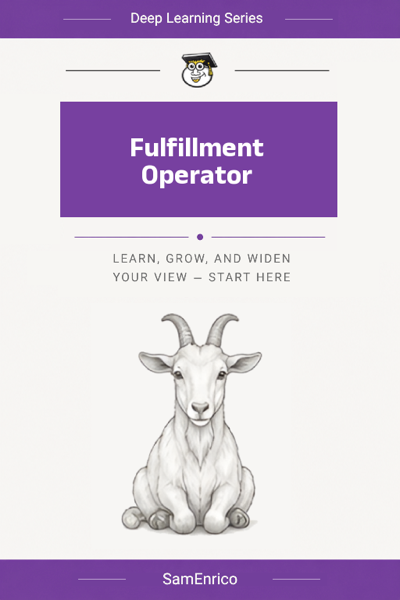
Fulfillment Operator eBook
A Coursebook on Fulfillment Operator
by Yoo Lou
A Coursebook on Fulfillment Operator
Formats
Free sample
Chapter 1: The Invisible Hand...–- Every box that lands on a customer’s doorstep begins as a whisper. Not a loud proclamation, not a roaring engine, but a whisper—a tiny signal buried inside a database, triggered by a click, a tap, or a voice command. That whisper travels through fiber-optic cables, crosses server racks, and eventually arrives at a small handheld screen on a warehouse floor. Someone, somewhere, picks up that screen. They walk into a maze of steel shelves.
They find a single item among ten thousand identical neighbors. And they place it into a box. That act, repeated millions of times per day across the globe, is the invisible hand of modern commerce.The average consumer never thinks about this hand. They see the “Buy Now” button, the shipping confirmation email, the tracking map showing a little dot moving across the country. They do not see the person who walked 12 miles in an eight-hour shift, who learned to read barcodes faster than most people read street signs, who figured out why the system said the item was in Bin A47 when it was actually in Overstock Row C.
That person is the fulfillment operator. And despite every prediction about robots taking over, despite the breathless headlines about drone deliveries and artificial intelligence, that person remains the single most important link in the supply chain.This chapter is about why that is true. It is about the anatomy of the machine you are about to enter, the hidden logic that turns raw inventory into delivered happiness, and the quiet heroism of showing up every day to solve problems that no algorithm can yet solve. By the time you finish this chapter, you will never look at a cardboard box the same way again.The Gap Between Strategy and Floor Every large company has a strategy. Executives in glass offices spend millions of dollars on consultants who draw boxes and arrows on whiteboards, diagrams that show goods flowing smoothly from factory to customer like water through a pipe.
These diagrams are beautiful. They are also almost always wrong.The gap between the whiteboard and the warehouse floor is where reality happens. The whiteboard does not know that the forklift battery died at 2:00 PM. The whiteboard does not know that the shipping label printer ran out of adhesive halfway through the rush. The whiteboard does not know that the item the system says is in Bin B12 was actually set down in Bin C04 by a tired worker at 4:55 AM on a Tuesday.
These small failures, each insignificant on its own, accumulate into what the industry calls “leakage”—lost time, lost money, lost customers.Corporate logistics strategy treats the fulfillment operator as an interchangeable part. The math says: if Operator A processes 100 units per hour and Operator B processes 90, replace B with someone faster. This math misses the point entirely. Operator B might be the one who notices that the batch of canned tomatoes is mislabeled, preventing a recall. Operator B might be the one who realizes that moving the paper towels closer to the box erector would save the whole team thirty seconds per order.
Operator B might be slow because she is careful, and careful prevents returns, and returns are the silent killer of e-commerce profitability.This book exists because the gap between strategy and floor is where careers are made. The operator who understands both the whiteboard and the reality—who can speak the language of metrics while solving the physical puzzles of the warehouse—becomes indispensable. You are not here to be a cog. You are here to learn why the cogs keep failing and how to be the person who fixes them.The Birdhouse Problem Revisited Let me tell you a story. A small company sold birdhouses online.
Beautiful birdhouses, hand-painted, cedar wood, the kind of thing that made suburban mothers cry with joy. The company grew fast. They hired more pickers, more packers, more managers. One day, a customer ordered a birdhouse. The picker picked it.
The packer packed it. The shipper shipped it. The birdhouse arrived shattered.Who was responsible? The picker said: “It was fine when I picked it.” The packer said: “I used the standard bubble wrap.” The shipper said: “I just put the label on the box.” The manager said: “My team followed procedure.” The customer said: “I don’t care who broke it. I want my money back.”This is the Birdhouse Problem.
It is not about birdhouses. It is about ownership. In most warehouses, no single person owns the outcome. The picker owns the pick. The packer owns the pack.
The shipper owns the label. But no one owns the birdhouse arriving intact. The system is designed for tasks, not outcomes. And that design flaw costs the industry billions of dollars per year in returns, replacements, and lost loyalty.The fulfillment operator who solves the Birdhouse Problem is the one who stops thinking in tasks and starts thinking in outcomes. She checks the box after the packer seals it.
She notices that the bubble wrap is too thin and speaks up. She asks the shipper to handle fragile boxes differently. She does not wait for permission because she understands that the system will never give her permission. Permission is not the point. The point is that the birdhouse arrives intact.This chapter is the foundation of that mindset.
Every subsequent chapter will teach you specific skills—picking, packing, system troubleshooting, safety, leadership. But none of those skills matter if you do not first understand that you are not a task-completion machine. You are the last line of defense between a product and a disappointed customer. You are the invisible hand. And the invisible hand does not get to blame the other fingers.Defining the Modern Fulfillment Operator The term “warehouse worker” is outdated.
It conjures images of men in gray jumpsuits pushing brooms, of dead-end jobs with no future, of minds turned off and bodies turned on autopilot. That description has never been accurate, but today it is actively misleading.The modern fulfillment center is a hybrid environment. You will work alongside autonomous robots that bring shelves to your station. You will use voice headsets that speak directly into your ear, telling you exactly where to go and what to pick. You will interact with machine learning algorithms that predict which items will sell together and preposition them for faster picking.
Your handheld scanner is not a simple barcode reader; it is a window into a digital twin of the entire warehouse, updating in real time as every item moves.You are not a warehouse worker. You are a fulfillment operator. The distinction matters because operators exercise judgment. Workers follow instructions. The robot can follow instructions.
The robot cannot decide that the system is wrong when it says Bin A47 contains ten units of SKU 4472 but the bin only has seven. The robot cannot notice that the customer wrote “Please don’t ring bell—new baby” in the delivery notes and translate that into handling instructions. The robot cannot look at a dented can and decide, based on the product type (tomato sauce vs. soda), whether the dent is…
This is the end of the free sample. Get the eBook to keep going. Buy now
About this book
Details
- Author
- Yoo Lou
- Publisher
- SamEnrico
- Language
- English
- Genre
- Non-Fiction, Informative, Educational
- Released
- 2026-06-02
- Pages (approx.)
- 147
- Available as
- eBook, Audiobook

Read better in the ZLOADR app
Your eBooks on your phone or tablet. Sign in with your SamEnrico account and start reading.
More by Yoo Lou
 India Solar Rooftop Subsidy GuideYoo Lou$11.99
 Colombian Green Incentives ManualYoo Lou$11.99
 The Screen Time Sleep GuideYoo Lou$11.99
 Stress Management for Software DevelopersYoo Lou$11.99
 Icebound Echoes: The Lost Franklin Expedition’s Final BroadcastYoo Lou$11.99
 Frozen in Time: The Forgotten Castaways of AntarcticaYoo Lou$11.99
 How to Become a Transmission MechanicYoo Lou$11.99
 State Filing Fee CalculatorYoo Lou$12.99
 Motherhood Test Validation MethodYoo Lou$12.99
 Understanding Chromosome 21, Monosomy 21q22Yoo Lou$17.99
You may also like
 Hong Kong Handover 1997Dunn Johnnie$11.99
 Zumba For Postnatal Recovery CourseNeal Christian$11.99
 Zumba for BeginnersLadner Nikia$11.99
 YouTube Comment Mining GuideHumes Pandora$12.99
 Worry Box MeditationCarlin Rudy$11.99
 Workplace Stress MeditationNguyen Lynn$11.99
 Workplace Stress and Sleep RepairHawley Ivory$11.99
 Workplace Perfectionism CureDelaney Jeffry$11.99
 Workplace Injustice Anger GuideWallen Isabelle$11.99
 Work Addiction and Burnout LinkGreenwood Ester$11.99
 Women in Yoga and WellnessBeattie Galina$11.99
 Women in Stand Up ComedyChun Evangeline$11.99