
Non-FictionInformativeEducational
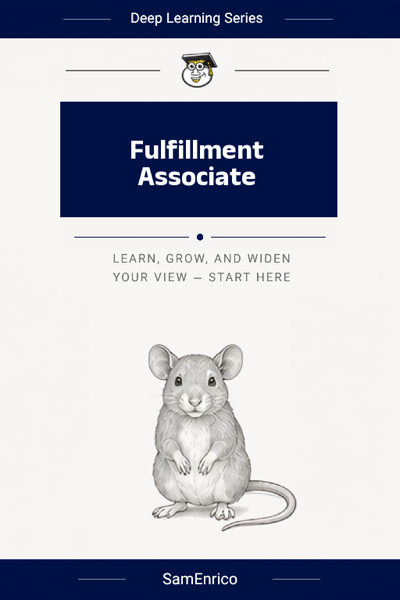
Fulfillment Associate eBook
A Coursebook on Fulfillment Associate
A Coursebook on Fulfillment Associate
Formats
Free sample
Chapter 1: The Machine You Enter--The parking lot is half full at 5:47 AM, which means you are neither early nor late. You are exactly on time—the worst kind of on time, because the people who got here fifteen minutes ago are already through security and the people who will arrive fifteen minutes from now will have to rush. You walk toward the door with a crowd of strangers wearing the same safety vest you are about to put on. No one speaks. The building hums.
Somewhere inside, thirty million dollars' worth of inventory is moving through a system designed by industrial engineers who have never lifted a box in their lives. You are about to meet that system face to face.Welcome to the fulfillment center. Forget everything you think you know about warehouses.The Three Buildings People Call Warehouses If you ask someone on the street to describe a warehouse, they will describe a big building with boxes on shelves. That description is technically correct but practically useless—like saying a hospital is a building with beds. The reality is more specific.
The logistics industry divides storage and distribution into three distinct types of buildings, and each one operates by different rules.The first is the traditional storage warehouse. These buildings are exactly what most people imagine: long rows of pallet racks, items sitting for months or years, a pace that feels almost sleepy compared to what you are about to experience. The goal of a storage warehouse is preservation. Keep the product safe. Keep it dry.
Keep it organized enough that someone can find it when needed. Speed is not the priority. A worker in a traditional warehouse might handle forty pallets in an entire shift. The rhythm is steady. The stakes are low.
If an item sits for an extra week, no one notices.The second is the sortation center. This building does not store anything for more than a few hours. Packages arrive already packed and labeled. The sortation center reads each label, diverts each package to the correct chute, and loads each package onto the correct truck. Sortation centers are the high-speed post offices of the e-commerce world.
The work is repetitive and fast. The goal is throughput—how many packages can you process in an hour? The rhythm is frantic. Mistakes here send packages to the wrong state, which triggers costly rerouting and angry customer calls.The third is the fulfillment center. This is where you are standing.
A fulfillment center does both jobs. It stores inventory like a warehouse, but it processes orders like a sortation center. This hybrid nature creates the chaos that defines the job. One minute you are stowing a case of protein powder onto a shelf for long-term storage. The next minute, across the building, a picker is pulling that exact same protein powder to fulfill an order that came in thirty seconds ago.
The system never sleeps. The inventory never stops moving. The average item in a modern fulfillment center arrives, gets stored, gets picked, gets packed, and leaves the building within seventy-two hours. During peak season—November and December—that number drops to twelve hours or less.Here is what that means for you. You will never be bored.
You will also never feel completely caught up. The work is never done. There is no concept of "finished" in a fulfillment center. There is only the next order, the next scan, the next box, the next truck. This is not a bug.
It is a feature. The system is designed to have exactly enough work to keep everyone moving at full capacity for every minute of every shift. If you ever look around and see nothing to do, you are missing something.The Last Mile Is a Lie, and You Are the Truth In e-commerce boardrooms, executives love to talk about "the last mile." The last mile is the final leg of delivery—from the local distribution center to the customer's front door. It is considered the most expensive and most difficult part of the supply chain. Companies have spent billions of dollars optimizing it with routing algorithms, delivery drones, and gig economy drivers.Here is the secret that no press release will ever tell you.
The real last mile is not the delivery driver. The real last mile is you.The delivery driver handles one package at a time, moving from house to house. You handle hundreds of packages in a single shift. If you mis-stow an item, the picker cannot find it. If the picker cannot find it, the packer has nothing to pack.
If the packer has nothing to pack, the sortation center has nothing to sort. If the sortation center has nothing to sort, the delivery driver has nothing to deliver. Every single person downstream of you depends on the quality of your work. You are not a cog. You are the foundation.Your accuracy directly affects customer reviews.
A customer who receives the wrong item is not going to blame the software or the management system or the "last mile" strategy. They are going to blame the company. And then they are going to post a one-star review. And then they are going to return the item. And then another associate—someone in returns—has to process that return.
One wrong scan can generate forty-five minutes of downstream labor and cost the company an average of fifteen to thirty dollars per item.Your accuracy directly affects return rates. The most expensive mistake in fulfillment is not a slow picker. It is a wrong item shipped to a customer. That wrong item triggers a return, which triggers a refund or replacement, which triggers a reverse logistics process, which triggers someone else's labor to inspect and regrade the item. Returns are the hidden tax of e-commerce.
The industry average is sixteen to twenty percent of all orders. For apparel, it is thirty to forty percent. For shoes, it can hit fifty percent. Your accuracy is the first line of defense against these numbers.Your accuracy directly affects shipping spend. When you overpack a box—using a box that is too large for the item—you trigger dimensional weight pricing.
The carrier measures the box, not just the weight. A one-pound item in a twelve-by-twelve-by-twelve box ships at the dimensional weight of twelve pounds. That difference can triple the shipping cost. Over the course of a year, inaccurate packing choices can cost a fulfillment center millions of dollars. Some of those millions come out of the facility's bonus pool.
When you overpack, you are taking money from your own coworkers.You are not a cog. You are the machine.The Four Faces of the Fulfillment Center Not all fulfillment centers are the same. The type of facility you work in determines the kind of work you will do, the equipment you will use, and the pace you will need to maintain. Understanding your facility type is the first step to mastering your role.Non-sort fulfillment centers handle large and bulky items. Think furniture, treadmills, kayaks, flat-screen televisions, grills, mattresses.
These facilities have wider aisles to accommodate larger picking carts and forklifts. The items are stored on pallets or in…
This is the end of the free sample. Get the eBook to keep going. Buy now
About this book
Details
- Author
- Prince Rosaura
- Publisher
- SamEnrico
- Language
- English
- Genre
- Non-Fiction, Informative, Educational
- Released
- 2026-06-02
- Pages (approx.)
- 129
- Available as
- eBook, Audiobook

Read better in the ZLOADR app
Your eBooks on your phone or tablet. Sign in with your SamEnrico account and start reading.
More by Prince Rosaura
 The Pharmacogenomics Report GuidePrince Rosaura$11.99
 Pitch Rehearsal Recording Self Critique GuidePrince Rosaura$11.99
 Paleo Air Fryer CookbookPrince Rosaura$11.99
 Samurai Rebellion Satsuma GuidePrince Rosaura$11.99
 External Validation Recovery GuidePrince Rosaura$11.99
 Brick by Brick: The Rise and Fall of the Dutch Tulip BubblePrince Rosaura$11.99
 The Icebound Healers: Medieval Arctic Medicine and the Birth of Antimicrobial KnowledgePrince Rosaura$11.99
 Understanding Giant Mammary HamartomaPrince Rosaura$17.99
 SA8000 Export GuidePrince Rosaura$12.99
 Michael Dell Cash Direct PrimerPrince Rosaura$12.99
 How to Start a Baby Carriages (wholesale) Business (Beginners Guide)Prince Rosaura$11.99
You may also like
 Hong Kong Handover 1997Dunn Johnnie$11.99
 Zumba For Postnatal Recovery CourseNeal Christian$11.99
 Zumba for BeginnersLadner Nikia$11.99
 YouTube Comment Mining GuideHumes Pandora$12.99
 Worry Box MeditationCarlin Rudy$11.99
 Workplace Stress MeditationNguyen Lynn$11.99
 Workplace Stress and Sleep RepairHawley Ivory$11.99
 Workplace Perfectionism CureDelaney Jeffry$11.99
 Workplace Injustice Anger GuideWallen Isabelle$11.99
 Work Addiction and Burnout LinkGreenwood Ester$11.99
 Women in Yoga and WellnessBeattie Galina$11.99
 Women in Stand Up ComedyChun Evangeline$11.99