
Non-FictionSelf-HelpSpaced Repetition
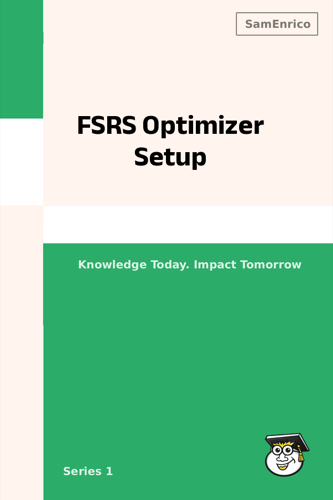
FSRS Optimizer Setup eBook
Teaches using Free Spaced Repetition Scheduler for
by Hacker Risa
Teaches using Free Spaced Repetition Scheduler for personalized review timing.
Formats
Free sample
Chapter 1: The 60-Second Betrayal--You have already wasted time today. Not the minutes spent scrolling or the hours lost to meetings you didn’t need to attend. Worse than that. You have forgotten something you studied last week. Something you were sure you knew.
Something that, right now, is slipping out of your brain like water through a cracked cup. And here is the cruelest part: you will not even notice it is gone until the moment you need it most—during an exam, a presentation, a conversation with a colleague who expects you to know your stuff.This is not your fault. You were taught to study wrong. Every flashcard you ever made, every textbook you highlighted, every late-night cram session you powered through—they all worked against the biology of your own brain. The system betrayed you.
And the worst part? You kept using the same broken tools, believing that if you just tried harder, just studied longer, just reviewed more times, you would finally make it stick.You won’t. Not with the old way.This book is about a different way. A way that learns from you—not from some generic average of how someone else’s memory works. It is called the Free Spaced Repetition Scheduler, or FSRS.
And before you roll your eyes at another piece of software promising to change your life, hear this: FSRS is not a study method. It is not a motivational system. It is a mathematical engine that models your personal forgetting curve with enough precision to predict, within a few percentage points, whether you will remember a specific fact three months from now. Then it schedules your next review for the exact moment before you would have forgotten it.You are about to set it up. It will take sixty seconds.
And when you finish, nothing about your studying will ever feel the same again.The Lie You Were Sold Let us rewind to the last time you learned something new. Maybe it was a set of medical terminology: brachial plexus roots, trunks, divisions, cords. Maybe it was a language: irregular past tense of “to go” in Spanish—fui, fuiste, fue. Maybe it was a programming concept: closure, callback, promise, async. You studied it.
You reviewed it an hour later. You reviewed it again the next day. You felt good. You felt prepared.Then, two weeks later, someone asked you the question. And your mind went blank.What happened?
According to the story we tell ourselves, you simply didn’t study enough. You needed more repetitions. More discipline. More hours. But the data says something different.
In 1885, a German psychologist named Hermann Ebbinghaus did something no one had done before: he memorized lists of nonsense syllables—meaningless combinations like ZOF, WUB, QAX—and tested himself at regular intervals to see how quickly he forgot. What he discovered became the foundation of everything you are about to learn.The forgetting curve is not linear. It is not gentle. Within twenty minutes of learning something new, you have already lost nearly half of it. Within one hour, more than half is gone.
Within twenty-four hours, if you have done no review, you will remember less than thirty percent. This is not a flaw in your brain. This is how memory works for every human being on the planet. It is a feature, not a bug. Your brain evolved to discard information that seems irrelevant to survival.
And unless you deliberately convince it otherwise, most of what you learn will be tagged as irrelevant within a single day.Here is where the lie comes in. Every traditional study method—cramming, re-reading, highlighting, summarizing—assumes that if you just expose yourself to the material enough times in a short period, it will eventually stick. But Ebbinghaus also discovered something else. The shape of your forgetting curve changes with each successful review. Each time you recall a piece of information just before you would have forgotten it, the next forgetting curve becomes shallower.
The information becomes more stable. It lasts longer before fading again.This is spaced repetition. And it is the most empirically validated learning method in the history of cognitive science.But there is a catch. For spaced repetition to work optimally, you need to review each piece of information at precisely the right moment—not too early (wasting time) and not too late (forcing relearning). That timing depends on you.
Your sleep quality. Your stress levels. Your prior knowledge of related material. Your age. The time of day you study.
How engaged you feel. All of it.The old algorithm—the one built into Anki for fifteen years, called SM-2—ignored all of that.Why Your Flashcard App Has Been Lying to You If you have used Anki, you know the default settings. A new card appears. You answer “Good.” The next interval is one day. You answer “Good” again.
The next interval is six days. Then fifteen days. Then thirty-two days. The intervals roughly double each time, multiplied by something called an “ease factor” that starts at 2.5.This system, invented by Super Memo founder Piotr Woźniak in 1987, was revolutionary for its time. It was better than nothing.
Much better. But it has a fatal flaw: it assumes that every card, every subject, every learner follows the same pattern. A 2.5 multiplier means that if you find a card easy, your intervals double. If you find it hard, your intervals shrink. But this adjustment is coarse and slow.
It takes many reviews for the ease factor to change meaningfully. And it never learns your personal forgetting dynamics. It just applies the same rule to everyone.The result is what users call “ease hell.” Cards that you know perfectly well become scheduled months or years apart—fine. But cards that you struggle with become trapped in a cycle of short intervals that never quite get short enough to actually help you learn. You fail a card, press “Again,” and the algorithm gives you a slightly shorter interval.
You fail again. It shortens a little more. But because the underlying assumption is that all learners are the same, the adjustment is never aggressive enough for the cards that really need it.Worse, the old algorithm cannot tell the difference between a card that is genuinely difficult because of its content and a card that you keep forgetting because you are tired, stressed, or distracted. It treats all failures the same. So your “hard” cards accumulate artificially high ease factors, your intervals become unpredictable, and eventually, you give up on those cards entirely.FSRS solves this by abandoning the fixed-multiplier model entirely.
Instead of asking “how many days until this card’s interval doubles?”, FSRS asks a much more sophisticated question: given everything I know about this specific learner’s memory, what is the optimal day to show this specific card again?To answer that question, FSRS builds a mathematical model of your memory with three parameters for every card: Difficulty, Stability, and Retrievability. These are not abstract concepts. They are numbers that the algorithm calculates from your review history. And they change after every single review, not after every few reviews.What You Are About to Do…
This is the end of the free sample. Get the eBook to keep going. Buy now
About this book
Details
- Author
- Hacker Risa
- Publisher
- SamEnrico
- Language
- English
- Genre
- Non-Fiction, Self-Help, Spaced Repetition
- Released
- 2026-06-05
- Pages (approx.)
- 141
- Available as
- eBook, Audiobook

Read better in the ZLOADR app
Your eBooks on your phone or tablet. Sign in with your SamEnrico account and start reading.
More by Hacker Risa
 Social Media Fast BenefitsHacker Risa$11.99
 Glass Fracture Pattern GuideHacker Risa$11.99
 Lawyer Workaholism GuideHacker Risa$11.99
 CPR for AirportsHacker Risa$11.99
 The Folate and Folic Acid GuideHacker Risa$11.99
 Persuasion For WritersHacker Risa$11.99
 Emotional Vulnerability GuideHacker Risa$11.99
 The Lion of the North: Harald Hardrada and the Viking Age of ExpansionHacker Risa$11.99
 The Lion and the Rose: The Courtly Splendor of BurgundyHacker Risa$11.99
 French Bulldog: Stubborn & PlayfulHacker Risa$11.99
 How to Produce Saxophone Pegs and StandsHacker Risa$11.99
 How to Produce a Flame Supervision DeviceHacker Risa$11.99
You may also like
 Hong Kong Handover 1997Dunn Johnnie$11.99
 Zumba For Postnatal Recovery CourseNeal Christian$11.99
 Zumba for BeginnersLadner Nikia$11.99
 YouTube Comment Mining GuideHumes Pandora$12.99
 Worry Box MeditationCarlin Rudy$11.99
 Workplace Stress MeditationNguyen Lynn$11.99
 Workplace Stress and Sleep RepairHawley Ivory$11.99
 Workplace Perfectionism CureDelaney Jeffry$11.99
 Workplace Injustice Anger GuideWallen Isabelle$11.99
 Work Addiction and Burnout LinkGreenwood Ester$11.99
 Women in Yoga and WellnessBeattie Galina$11.99
 Women in Stand Up ComedyChun Evangeline$11.99