
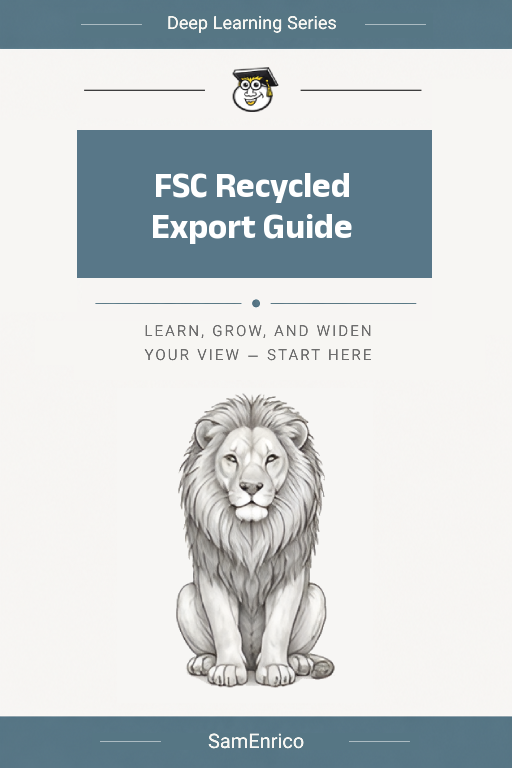
FSC Recycled Export Guide eBook
Certify paper and packaging under FSC Recycled for
Certify paper and packaging under FSC Recycled for US and EU markets, meeting recycled content claims for eco-conscious corporate buyers.
Formats
Free sample
Chapter 1: The Million-Dollar Label--–- It was 3:47 PM on a Tuesday when the email arrived. A mid-sized Mexican corrugated box exporter—let’s call them Empaque del Sur—had been negotiating for seven months with a German e-commerce fulfillment company. The deal was worth €4.7 million annually. Terms were agreed. Pricing was set.
The only remaining item was a single line in the specification sheet: “All packaging must carry FSC Recycled certification. Third-party verification required. No exceptions.”Empaque del Sur had been in business for twenty-three years. They had sold successfully into the United States, Canada, and Central America. Their boxes were strong, their prices competitive, and their recycled content claim—printed on every box—read “Made from recycled paper.” They had never been asked for proof before.The German buyer’s sustainability director, a woman named Klara Weiss, had been polite but firm in every call.
“Your recycled claim,” she said during the final review, “is not certified. We cannot accept it. Our own net-zero targets require FSC Recycled. Do you have the certificate?”Empaque del Sur’s sales director hesitated. “We use recycled fiber,” he said.
“Our supplier told us it’s recycled.”“That is not sufficient,” Klara replied. “Our legal team has reviewed the EU Packaging and Packaging Waste Regulation. Generic claims without third-party certification expose us to greenwashing liability. We need your FSC license number.”There was no license number. There was no certificate.
There was only a supplier who had once said, “Don’t worry, it’s all recycled.”The deal died seven days later. The German buyer signed with a competitor from Turkey who had obtained FSC Recycled certification eighteen months earlier. That competitor charged 22 percent more per box. They won because they had the label. Empaque del Sur lost because they did not.This chapter is about why that story is becoming the norm, not the exception.
It is about the convergence of three unstoppable forces—corporate procurement mandates, tightening regulations, and consumer pressure—that have transformed the FSC Recycled label from a niche environmental badge into a commercial necessity for any exporter of paper or packaging to the United States or European Union. If you export without it, you are not saving money. You are leaving money on the table for competitors who have already made the investment.The Great Convergence: Three Forces Reshaping the Market To understand why FSC Recycled certification has shifted from “nice to have” to “must have,” you need to understand three distinct but reinforcing trends. Each trend alone would be significant. Together, they have created a tipping point.Force One: The Corporate Procurement Revolution Between 2020 and 2025, the world’s largest buyers of paper and packaging fundamentally rewrote their supplier requirements.
This was not a gradual evolution. It was a cascade.In 2020, Amazon announced its Climate Pledge, committing to net-zero carbon by 2040. Buried deep in the fine print of its packaging guidelines was a quiet but powerful requirement: all private-label packaging must use FSC-certified materials, with a strong preference for recycled content where available. By 2023, Amazon had expanded this requirement to its entire fulfillment network. Any third-party seller using Amazon’s packaging services must now comply.IKEA followed a similar path.
The Swedish furniture giant has long been an environmental leader, but its 2022 circular economy strategy explicitly prioritized FSC Recycled over virgin FSC. “Using recycled materials reduces pressure on forests,” the strategy document stated, “and FSC Recycled gives us the assurance we need.” By 2024, IKEA had mandated that all paper-based packaging for its European distribution centers carry FSC Recycled certification.Nestlé, the world’s largest food and beverage company, set a target of 100 percent recyclable or reusable packaging by 2025. But recyclability alone was not enough. The company’s “Recycled Content Commitment” requires that all paper packaging contain a minimum percentage of post-consumer recycled content, verified by third-party certification. FSC Recycled is the preferred mechanism for that verification.Mc Donald’s, serving billions of customers annually, announced in 2023 that all guest-facing packaging—burger wrappers, fry boxes, carryout bags, and drink carriers—would transition to FSC-certified materials globally by 2027.
The company explicitly named FSC Recycled as the target label for most applications.These are not isolated examples. They are the leading edge of a wave. A 2024 survey of 250 corporate procurement executives in the US and EU found that 68 percent now require some form of third-party certification for recycled content claims. Among companies with annual revenue exceeding $1 billion, that figure rises to 84 percent.The message is unambiguous: if you sell paper or packaging to large corporations, your self-declared “recycled” claim is no longer credible. They will not accept your word.
They want a certificate. They want a license number. They want FSC.Force Two: The Regulatory Hammer While corporate mandates create demand, regulations create consequences. Exporters who ignore the regulatory landscape do so at their own financial peril.The European Union has been the most aggressive regulator of packaging claims. The Packaging and Packaging Waste Regulation (PPWR), which entered into force in 2025 with full implementation by 2026, is the most consequential piece of packaging legislation in a generation.
It does three things that directly affect exporters of FSC Recycled paper and packaging.First, it sets mandatory recycled content targets for packaging placed on the EU market. For paper packaging, the targets are 65 percent recycled content by 2030 and 70 percent by 2040. These are not aspirations. They are legal requirements. If your paper packaging does not meet the target, you cannot sell it in the EU.Second, it prohibits vague environmental claims.
The regulation explicitly states that claims like “eco-friendly,” “green,” or simply “recycled” without substantiation are illegal. All recycled content claims must be verified by an independent third-party certification scheme. FSC is explicitly named as an accepted certification body.Third, it introduces the Digital Product Passport (DPP). By 2027, most packaging sold in the EU will require a DPP—a digital record containing detailed information about the product’s composition, recyclability, and recycled content. Your FSC Chain of Custody number will be a mandatory data field in that passport.
Without it, your product cannot be legally sold.The United States has taken a different but no less significant approach. Rather than mandating recycled content targets, the Federal Trade Commission enforces truthfulness in environmental marketing through the Green Guides. While the Green Guides themselves are not legally binding regulations, the FTC enforces them under Section 5 of the FTC Act, which prohibits unfair or deceptive acts or practices. Violations carry penalties of up to $50,120 per violation.The Green Guides have specific requirements for recycled content claims. You cannot simply say “recycled.” You must disclose the percentage of recycled content.
You must distinguish between pre-consumer and post-consumer recycled content. And crucially, you must have competent and reliable evidence to support your claim. Self-declaration is not sufficient. Third-party certification like FSC provides that evidence.In 2023, the FTC brought its first major greenwashing enforcement action against a paper products company. The case involved a manufacturer of office paper that claimed “100 percent recycled” on its packaging when a significant portion of the fiber came from virgin sources.
The company paid $5.5 million in penalties. The FTC’s press release made clear that third-party certification would have prevented the violation.The two regulatory systems—mandatory targets…
This is the end of the free sample. Get the eBook to keep going. Buy now
About this book
Details
- Author
- Smoot Cassondra
- Publisher
- SamEnrico
- Language
- English
- Genre
- Non-Fiction, Business Brief
- Released
- 2026-06-01
- Pages (approx.)
- 151
- Available as
- eBook, Audiobook

Read better in the ZLOADR app
Your eBooks on your phone or tablet. Sign in with your SamEnrico account and start reading.
More by Smoot Cassondra
 Staffing Agency Transaction AnalysisSmoot Cassondra$11.99
 183 Day Rule AvoidingSmoot Cassondra$11.99
 Engineers Guide to Creative ThinkingSmoot Cassondra$11.99
 Arnold Palmer Army StorySmoot Cassondra$11.99
 The Amazon Forest VictimSmoot Cassondra$11.99
 Innocence Project Identification CasesSmoot Cassondra$11.99
 Alcohol and Cancer RiskSmoot Cassondra$11.99
 Checking OCD GuideSmoot Cassondra$11.99
 The Great Bitcoin Heist: How a Rogue Trader Bankrupted Mt. GoxSmoot Cassondra$11.99
 The King and the Crown: The Divorce That Shook Middle Eastern FootballSmoot Cassondra$11.99
 How to Produce a Hot PlateSmoot Cassondra$11.99
 A Collector's Handbook to the Ford Zodiac Ii 206eSmoot Cassondra$11.99
You may also like
 Hong Kong Handover 1997Dunn Johnnie$11.99
 Zumba For Postnatal Recovery CourseNeal Christian$11.99
 Zumba for BeginnersLadner Nikia$11.99
 YouTube Comment Mining GuideHumes Pandora$12.99
 Worry Box MeditationCarlin Rudy$11.99
 Workplace Stress MeditationNguyen Lynn$11.99
 Workplace Stress and Sleep RepairHawley Ivory$11.99
 Workplace Perfectionism CureDelaney Jeffry$11.99
 Workplace Injustice Anger GuideWallen Isabelle$11.99
 Work Addiction and Burnout LinkGreenwood Ester$11.99
 Women in Yoga and WellnessBeattie Galina$11.99
 Women in Stand Up ComedyChun Evangeline$11.99