
Non-FictionSelf-HelpFrustration
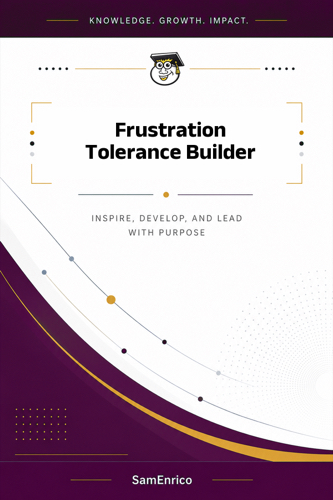
Frustration Tolerance Builder eBook
Builds capacity to handle daily frustrations witho
by Gould Jasmin
Builds capacity to handle daily frustrations without reacting.
Formats
Free sample
Chapter 1: The Half-Second Window--–- You are standing in a grocery store checkout line. The person in front of you has seventeen items in the “ten items or fewer” lane. Your ice cream is melting. Your phone battery is at 12 percent. Behind you, someone sighs loudly—whether at you or at the situation, you cannot tell, but your shoulders tense anyway.
The cashier moves with the deliberate pace of a worker who has stopped caring. And somewhere inside your chest, a small furnace of frustration ignites.In the next half-second, something extraordinary happens inside your body and brain. A cascade of chemicals floods your system. Your heart rate increases. Your palms may moisten.
Your jaw might clench. And before you have consciously decided to feel anything at all, you are already frustrated—perhaps even angry. This half-second window—from trigger to emotional ignition—is the most important moment in the entire story of your frustration tolerance. It is also the moment that most people never even know exists.This chapter is about that half-second window. It is about the ancient neurobiology that shaped your brain to react instantly to threats, the modern world that constantly triggers that ancient system by mistake, and the single most important skill you can develop: inserting a deliberate pause between the trigger and your response.
By the end of this chapter, you will understand why your brain confuses a slow cashier with a predator, how to recognize the difference between a genuine crisis and a mere inconvenience, and how to use the “10-Second Rule” to fundamentally change your relationship with daily frustrations.The Amygdala Hijack: Why Your Brain Mistakes a Cashier for a Tiger Let us begin with a thought experiment. Imagine you are walking through tall grass on a savanna ten thousand years ago. Suddenly, the grass rustles. Before you consciously think, “That might be a lion,” your body has already reacted: your heart pounds, your muscles tense, your pupils dilate, and you either freeze, flee, or prepare to fight. This response takes approximately half a second.
It is entirely automatic. It is also the reason you are alive today.The architect of this lightning-fast response is a small, almond-shaped cluster of neurons deep inside your brain called the amygdala. The amygdala’s job is not to think. It does not reason, analyze, or consider context. Its job is to detect potential threats and activate the body’s emergency response system faster than your conscious mind can intervene.
Neuroscientists call this process the “low road” of emotional processing—a direct, unconscious pathway from sensory input to emotional output that bypasses your thinking brain entirely.Here is where the trouble begins. The amygdala evolved in a world where threats were physical, immediate, and usually obvious: predators, hostile humans, falling branches, venomous snakes. It was not designed to distinguish between a lion and a rude email, between a charging enemy and a slow-loading website, between a genuine physical threat and a passive-aggressive text message from your sibling. The amygdala simply detects something that feels like a threat—something unexpected, something blocking your goal, something violating your expectations—and sounds the alarm.This is what neuroscientist Daniel Goleman famously called the “amygdala hijack.” Your amygdala essentially takes control of your brain’s response systems before your prefrontal cortex—the thinking, planning, reasoning part of your brain—has a chance to evaluate whether the threat is real. The result is that you react to a slow cashier with the same physiological intensity your ancestors reserved for saber-toothed tigers.
Your body releases cortisol and adrenaline. Your blood pressure rises. Your digestion slows (because fighting a tiger requires no digestion). Your peripheral vision narrows. Your muscles prepare for action.
All of this happens in less than one second.The frustrating irony is that this response is completely inappropriate for most modern frustrations. A slow cashier will not eat you. A traffic jam will not chase you. A broken printer will not disembowel you. But your amygdala does not know that.
It is using ancient software to process modern problems. And until you learn to manually override this system, you will continue to experience daily inconveniences as though they were existential threats.The Myth of the Instant Reaction Most people believe that frustration works like this: something annoying happens, and then they feel frustrated. The event causes the emotion. This seems obvious. But it is also wrong—or at least, incomplete.
What actually happens is far more interesting and far more hopeful for anyone who wants to change.Between the event (the slow cashier) and the emotion (frustration) lies an invisible middle step: interpretation. Your brain does not react to events directly. It reacts to the meaning it assigns to events. And that assignment of meaning happens in the half-second window between trigger and response. Here is what that half-second actually contains:First, your sensory systems register the event.
Your eyes see the cashier moving slowly. Your ears hear the sigh behind you. Your body feels the melting ice cream dripping onto your hand. This raw sensory data travels to your thalamus, a relay station in the center of your brain. From there, it splits into two pathways.
The “low road” goes directly to the amygdala for an immediate, unconscious threat assessment. The “high road” goes to your prefrontal cortex for slower, more deliberate processing.In the half-second window, both pathways are active simultaneously. But the low road is faster. So your amygdala fires first, flooding your body with stress hormones before your prefrontal cortex has even received the complete data packet. This is why you feel frustrated before you think, “Maybe the cashier is new.” The feeling comes first; the thinking comes later.Here is the crucial insight that transforms everything: the half-second window is not a trap.
It is an opportunity. Because while you cannot stop the amygdala’s initial alarm from sounding, you can learn to insert a deliberate pause before you act on that alarm. You can learn to let the initial cortisol spike begin to subside before you speak, type, or clench your fist. The pause does not prevent the frustration from arising. But it does prevent the frustration from controlling you.The 10-Second Rule: Your First Tool The simplest and most powerful way to insert this pause is called the 10-Second Rule.
Here is how it works: when you feel the first surge of frustration—the heat in your chest, the tightness in your jaw, the urge to say something you will regret—you stop. You do not act. You do not speak. You do not send the email. You do not honk the horn.
For ten seconds, you do absolutely nothing except breathe and notice what you are feeling.Ten seconds is a very short amount of time. But in the world of neurobiology, it is an eternity. Your initial cortisol and adrenaline surge peaks approximately six to eight seconds after the triggering event. By the time you have counted to ten, the chemical intensity of the frustration has already begun to decline. Your prefrontal cortex has had time to receive the “high road” data and offer its slower, more considered assessment.
You are no longer purely in the grip of the amygdala. You have the capacity to choose your response rather…
This is the end of the free sample. Get the eBook to keep going. Buy now
About this book
Details
- Author
- Gould Jasmin
- Publisher
- SamEnrico
- Language
- English
- Genre
- Non-Fiction, Self-Help, Frustration
- Released
- 2026-06-07
- Pages (approx.)
- 151
- Available as
- eBook, Audiobook

Read better in the ZLOADR app
Your eBooks on your phone or tablet. Sign in with your SamEnrico account and start reading.
More by Gould Jasmin
 Equifax's Georgia Congressional HearingGould Jasmin$11.99
 Senior Technology Esteem GuideGould Jasmin$11.99
 Vaccine Duration of ProtectionGould Jasmin$11.99
 John Wayne Gacy Childhood Home InvestigationGould Jasmin$11.99
 The Unbroken Chain: Plato’s Academy and the Birth of Western ThoughtGould Jasmin$11.99
 Technical Program AnalystGould Jasmin$11.99
 Wegmans Supply GuideGould Jasmin$12.99
 AI Financial KPI DashboardGould Jasmin$12.99
 How to Start a Building Research and Experimental Development Business (Beginners Guide)Gould Jasmin$11.99
You may also like
 Hong Kong Handover 1997Dunn Johnnie$11.99
 Zumba For Postnatal Recovery CourseNeal Christian$11.99
 Zumba for BeginnersLadner Nikia$11.99
 YouTube Comment Mining GuideHumes Pandora$12.99
 Worry Box MeditationCarlin Rudy$11.99
 Workplace Stress MeditationNguyen Lynn$11.99
 Workplace Stress and Sleep RepairHawley Ivory$11.99
 Workplace Perfectionism CureDelaney Jeffry$11.99
 Workplace Injustice Anger GuideWallen Isabelle$11.99
 Work Addiction and Burnout LinkGreenwood Ester$11.99
 Women in Yoga and WellnessBeattie Galina$11.99
 Women in Stand Up ComedyChun Evangeline$11.99