
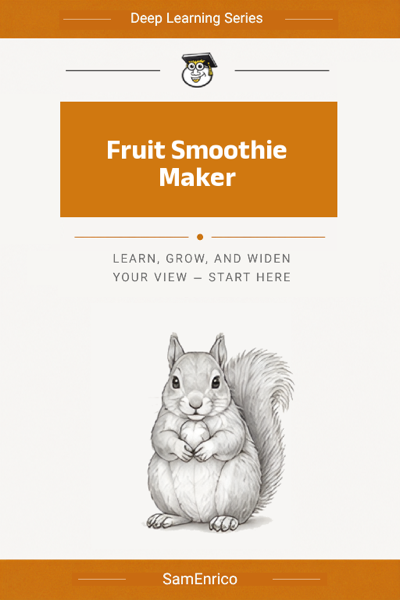
Non-FictionInformativeEducational
Fruit Smoothie Maker eBook
A Coursebook on Fruit Smoothie Maker
A Coursebook on Fruit Smoothie Maker
Formats
Free sample
Chapter 1: The Blender Lie--You have been lied to about smoothies. Not maliciously, not by any single person or company, but by a fog of half-truths, marketing hype, and well-intentioned but misinformed advice that has turned one of the most powerful nutritional tools on the planet into either a guilty pleasure or a glorified sugar delivery system. Walk into any grocery store and you will see rows of bottled smoothies boasting about antioxidants and “real fruit” while hiding thirty or forty grams of sugar behind a leafy green label. Scroll through social media and you will watch influencers blend kale and pineapple into vibrant green concoctions, promising weight loss and glowing skin, but never explaining why your own attempts taste like lawn clippings and leave you hungry an hour later. Open most smoothie cookbooks and you will find recipes that call for expensive superfoods, specialized equipment, and fifteen ingredients you have never heard of, let alone know how to source.This book is going to dismantle all of that.Before we blend a single ingredient, before we discuss blenders or bananas or the perfect ratio of liquid to fruit, we need to address the fundamental misunderstanding that has kept millions of people from experiencing what a truly great smoothie can do.
That misunderstanding begins with a simple question: Is a smoothie a food or a drink? The answer, as you will discover throughout this chapter and this entire coursebook, is that a smoothie is neither and both. A smoothie is a delivery system. It is a vehicle for nutrients, a canvas for flavor, and when constructed correctly, a tool for transforming how you feel from morning until night. But when constructed poorly—and most people construct them poorly without even knowing it—a smoothie becomes just another high-sugar beverage that spikes your blood sugar, crashes your energy, and leaves you wondering what all the fuss is about.I have spent years analyzing the top-selling smoothie books, the peer-reviewed nutritional research, and the practices of professional blenders and health coaches.
What I found was a landscape of contradiction. One bestseller says to load up on fruit. Another says fruit is poison. One expert insists you must buy a five-hundred-dollar blender. Another claims any old machine will do.
One camp preaches the gospel of green smoothies. Another warns that raw greens are destroying your digestion. The result is paralysis. People who want to improve their health, lose weight, or simply enjoy a delicious morning meal end up doing nothing because they cannot trust any single source.This chapter, and this book, is that trusted source.We are going to start by rewriting everything you think you know about smoothies. We will look at their surprisingly radical history.
We will dismantle the juice versus smoothie debate once and for all. We will confront the fear of fruit sugar with actual science, not Instagram anecdotes. And most importantly, we will introduce a framework—a way of thinking about smoothies that will guide you through the next eleven chapters and, more importantly, through every smoothie you make for the rest of your life.By the end of this chapter, you will understand why your previous smoothies failed. You will know exactly what a smoothie can and cannot do for your body. And you will be ready to build a pantry, buy a blender, and start blending with purpose rather than guesswork.Let us begin.The Secret History of the Smoothie The smoothie, as it turns out, is not a product of the twenty-first century wellness industry.
It is not a millennial invention, nor is it a byproduct of the juicing craze. The first recognizable smoothies appeared in the 1930s, not in California health food stores, but in the soda fountains of America, where a man named Stephen Poplawski invented the blender. Poplawski’s machine was designed to make malted milkshakes and fruit drinks, and for decades, that is exactly what smoothies remained—desserts disguised as refreshments, blended from ice cream, syrup, and a token piece of fruit for legitimacy.The transformation began in the 1960s and 1970s, when the counterculture movement discovered the blender. Health food pioneers, many of them associated with vegetarian and macrobiotic communities, started experimenting with whole fruits, raw vegetables, and plant-based milks. The word “smoothie” itself was popularized by the Smoothie King chain, founded in 1940 but rebranded in the 1970s to capitalize on the growing interest in natural foods.
Still, these early health smoothies were a niche product, consumed by a small subset of the population who shopped at co-ops and had names like Sunshine and Meadow.The real explosion happened in the 1990s and early 2000s, driven by three forces. First, the scientific establishment began publishing research on the health benefits of fruits and vegetables, particularly their role in reducing chronic disease. Second, companies like Jamba Juice and Smoothie King expanded aggressively, making blended fruit drinks available in every shopping mall in America. Third, and most importantly, the high-performance blender market emerged, with brands like Vitamix and Blendtec convincing consumers that they needed thousand-dollar machines to achieve restaurant-quality results at home.By 2010, the smoothie had gone mainstream. But something was lost in translation.
The original health food smoothie was a meal replacement, carefully calibrated to provide sustained energy and complete nutrition. The commercial smoothie, by contrast, was a sugar bomb dressed in athletic clothing. A medium-sized smoothie from a popular chain could contain eighty grams of sugar—more than two cans of soda—along with fruit concentrates, added syrups, and frozen yogurt that added fat and calories without contributing meaningful nutrients.This is the contradiction we inherit. The smoothie is simultaneously one of the healthiest things you can consume and one of the unhealthiest, depending entirely on how it is made. This book exists to teach you how to make them the healthy way.Smoothie Versus Juice: The Fiber Revolution If you take only one concept from this entire chapter, make it this: Fiber is the difference between a health drink and a dessert.Juicing extracts the liquid from fruits and vegetables and discards the pulp.
That pulp is not waste—it is the insoluble fiber that your digestive system needs to function properly. When you drink a glass of fresh juice, you are consuming the vitamins, minerals, and sugars of several pieces of fruit, but you are consuming them without the fibrous bulk that would normally slow down your body’s absorption of those sugars. The result is a rapid spike in blood glucose, followed by a crash that leaves you tired, hungry, and craving more sugar.A smoothie, when made correctly, retains the entire fruit or vegetable. Everything goes into the blender: the flesh, the skin, the seeds, the fibrous strands that your teeth would normally have to break down. The blender does the chewing for you, but it does not remove anything.
That fiber remains in the glass, and it performs three critical functions.First, fiber slows gastric emptying. When you drink a smoothie that contains fiber, the liquid moves through your digestive system more slowly, giving your body time to process the sugars and release them into your bloodstream at a manageable rate. This is why a properly…
This is the end of the free sample. Get the eBook to keep going. Buy now
About this book
Details
- Author
- Wiseman Catharine
- Publisher
- SamEnrico
- Language
- English
- Genre
- Non-Fiction, Informative, Educational
- Released
- 2026-05-09
- Pages (approx.)
- 151
- Available as
- eBook, Audiobook

Read better in the ZLOADR app
Your eBooks on your phone or tablet. Sign in with your SamEnrico account and start reading.
More by Wiseman Catharine
 Self Hypnosis Progressive Relaxation CourseWiseman Catharine$11.99
 Beginner's Kettlebell SwingWiseman Catharine$11.99Beginner's Kettlebell SwingWiseman Catharine$11.99
 Anger in Long Distance RelationshipsWiseman Catharine$11.99
 Student Panic Attack ManagementWiseman Catharine$11.99
 Chunking for Bulletin JournalingWiseman Catharine$11.99
 Quantum Dreams in the Desert: The Pioneers of Middle Eastern Quantum ScienceWiseman Catharine$11.99
 The Silk Road’s Last Emperor: A Forgotten Dynasty’s RiseWiseman Catharine$11.99
 Understanding EndometriosisWiseman Catharine$17.99
 Scrum for Google StartupsWiseman Catharine$12.99
 AI Art Niche SelectionWiseman Catharine$12.99
 How to Start a Continuous Cast Products Made of Steel Business (Beginners Guide)Wiseman Catharine$11.99
You may also like
 Hong Kong Handover 1997Dunn Johnnie$11.99
 Zumba For Postnatal Recovery CourseNeal Christian$11.99
 Zumba for BeginnersLadner Nikia$11.99
 YouTube Comment Mining GuideHumes Pandora$12.99
 Worry Box MeditationCarlin Rudy$11.99
 Workplace Stress MeditationNguyen Lynn$11.99
 Workplace Stress and Sleep RepairHawley Ivory$11.99
 Workplace Perfectionism CureDelaney Jeffry$11.99
 Workplace Injustice Anger GuideWallen Isabelle$11.99
 Work Addiction and Burnout LinkGreenwood Ester$11.99
 Women in Yoga and WellnessBeattie Galina$11.99
 Women in Stand Up ComedyChun Evangeline$11.99