
Non-FictionHealth & WellnessFructose
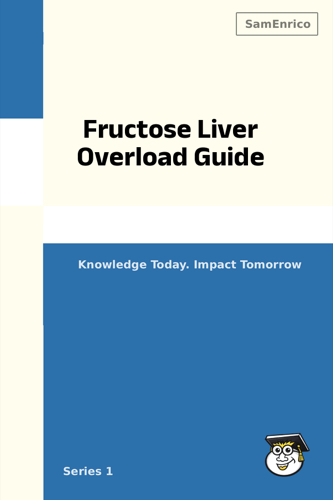
Fructose Liver Overload Guide eBook
Explains how high fructose intake drives insulin r
Explains how high fructose intake drives insulin resistance.
Formats
Free sample
Chapter 1: The Silent Epidemic--–- Sarah was forty-four years old, a dedicated mother of two, a regular at her local yoga studio, and she was slowly dying. Not in the dramatic, cinematic sense—there were no ambulances, no crash carts, no last-minute confessions. She was dying in the way most modern people die: quietly, metabolically, and with the full approval of her doctor, who kept telling her that her labs were “borderline” and that she should “eat less and move more.”She had tried. God knows she had tried.For breakfast, she ate oatmeal with a drizzle of honey and a sliced banana—heart-healthy, she had been told. For lunch, a turkey sandwich on whole wheat bread with a side of low-fat yogurt.
For dinner, a grilled chicken salad with low-fat raspberry vinaigrette. She exercised three times a week. She was not overweight by clinical standards. And yet, her energy was evaporating like morning dew. She could not lose the ten pounds that had settled around her midsection like a permanent tenant.
Her brain fog was so thick some afternoons that she forgot the names of her children’s teachers. Her fasting blood sugar had crept from 85 to 98 to 104 over three years. Her doctor mentioned “insulin resistance” and “metabolic syndrome” but offered no solution beyond a prescription for metformin, which Sarah declined because she did not want to be “on drugs for the rest of her life.”She felt ashamed. She felt confused. She felt like her body had betrayed her despite her best efforts.Sarah is not real.
But she is also every third person reading this book.The Unspoken Crisis There is an epidemic happening right now, and almost no one is talking about its true cause. You have heard the warnings: obesity rates are climbing, type 2 diabetes is exploding, non-alcoholic fatty liver disease now affects one in four adults worldwide, and children as young as ten are being diagnosed with conditions that were once seen only in middle-aged alcoholics. You have been told to eat less, move more, cut calories, count points, eliminate fat, eliminate carbs, eliminate gluten, eliminate everything. You have tried diets that worked for three weeks and then stopped. You have blamed yourself for lack of willpower.Here is the truth that Sarah’s doctor never told her: none of this is your fault.You are not lazy.
You are not weak. You are not broken. You are the victim of a biological hijacking so clever, so evolutionarily ancient, and so perfectly exploited by the modern food environment that resisting it is like trying to hold your breath while someone holds your head underwater. The hijacker is a simple sugar called fructose, and the battlefield is your liver.This book is not another diet. It is an owner’s manual for your metabolism.
It will explain, in plain language, why your liver has become a fat factory, why your insulin has stopped listening, and exactly how to flip the switch back to health. But before we get to the solution, you must understand the problem. And to understand the problem, you must first unlearn almost everything you have been told about sugar.The Great Sugar Deception When most people hear the word “sugar,” they think of the white granules in the ceramic bowl on the kitchen counter. They think of candy, cookies, cake, and the occasional soda. They assume that all sugars are metabolically equivalent—that a calorie of sugar from an apple is the same as a calorie of sugar from a candy bar.
This assumption is wrong. And it is the foundation upon which an entire industry of metabolic disease has been built.Let us start with a simple fact: not all sugars are the same. The two most common sugars in the human diet are glucose and fructose. They are both “simple sugars,” meaning they are single molecules that do not need to be broken down further before absorption. They appear together in most sweet foods: table sugar (sucrose) is exactly one glucose molecule bonded to one fructose molecule.
High-fructose corn syrup is a slightly different ratio of glucose to fructose, typically 55% fructose and 45% glucose. Honey is roughly half and half. Fruit contains both, with the ratio varying by type.Here is where the deception begins. Glucose and fructose are processed by the body in entirely different ways. Entirely.
Completely. Fundamentally.Think of glucose as the body’s universal currency. Every single cell in your body—from the neurons firing in your brain to the muscle fibers pulling on your skeleton to the immune cells patrolling your blood—can use glucose for energy. Your body has sophisticated systems for regulating glucose. When you eat glucose, your pancreas releases insulin, which does two critical things: it tells your cells to open up and absorb glucose from the bloodstream, and it tells your brain that you are full.
This is why eating a baked potato (mostly glucose, once digested) makes you feel satisfied.Fructose, on the other hand, is not a universal currency. It is a specialized substrate that can only be metabolized in one place: the liver. Your muscle cells cannot use fructose directly. Your brain cannot use fructose directly. Your heart cannot use fructose directly.
Fructose must be shipped to the liver for processing, like raw crude oil sent to a single refinery.This is where the first problem emerges.The Liver’s Burden Imagine, if you will, a factory designed to process a certain amount of raw material per hour. This factory has a conveyor belt, a series of machines, and a quality control system. As long as the raw material arrives at a steady, manageable rate, the factory hums along efficiently, producing the desired output. But if raw material suddenly arrives in a flood—ten times the normal rate—the conveyor belt jams, the machines overheat, and the factory starts producing waste products that damage the equipment.Your liver is that factory.When you eat fructose, it is absorbed from your small intestine and transported directly to your liver via the portal vein. Unlike glucose, which is regulated by insulin and can be taken up by cells throughout the body, fructose has no such regulation.
It bypasses the normal satiety signals. It does not trigger insulin release. It does not tell your brain that you have eaten enough. You can consume fructose endlessly without ever receiving the “stop eating” signal.Once fructose arrives at the liver, it encounters an enzyme called fructokinase. This enzyme is the gatekeeper of fructose metabolism, and it has a peculiar property: it is not regulated by the energy state of the cell.
Unlike the equivalent enzyme for glucose (phosphofructokinase), which slows down when the cell has enough energy, fructokinase keeps working at full speed regardless of how much fructose has already been processed. This is the biochemical equivalent of a gas pedal stuck to the floor.The result is a flood of carbon molecules pouring into the liver’s metabolic pathways with no off switch. These carbon molecules are rapidly assembled into fat through a process called de novo lipogenesis—literally, “making new fat.” Your liver takes the fructose you ate and converts it directly into tiny…
This is the end of the free sample. Get the eBook to keep going. Buy now
About this book
Details
- Author
- Crittenden Romelia
- Publisher
- SamEnrico
- Language
- English
- Genre
- Non-Fiction, Health & Wellness, Fructose
- Released
- 2026-06-06
- Pages (approx.)
- 142
- Available as
- eBook, Audiobook

Read better in the ZLOADR app
Your eBooks on your phone or tablet. Sign in with your SamEnrico account and start reading.
More by Crittenden Romelia
 AI Deck Myths DebunkedCrittenden Romelia$11.99
 Asian Body Image GuideCrittenden Romelia$11.99
 Latvian Biomass Energy PotentialCrittenden Romelia$11.99
 Cost Of Recall AnalysisCrittenden Romelia$11.99
 Breath Focus Trance Induction GuideCrittenden Romelia$11.99
 Mindfulness for New MomsCrittenden Romelia$11.99
 Strength Training For TeensCrittenden Romelia$11.99
 Tooth Loss Dream MeaningCrittenden Romelia$11.99
 The Vanishing of the Sky Princess: The Last Flight of Sarah JaneCrittenden Romelia$11.99
 The Vanishing Hiker: The Last Broadcast of the Lost ExplorerCrittenden Romelia$11.99
 Golden Serpent: The Untold Empire of the Gambling EmpressCrittenden Romelia$11.99
 Factoring Disclosure Notification GuideCrittenden Romelia$12.99
You may also like
 Hong Kong Handover 1997Dunn Johnnie$11.99
 Zumba For Postnatal Recovery CourseNeal Christian$11.99
 Zumba for BeginnersLadner Nikia$11.99
 YouTube Comment Mining GuideHumes Pandora$12.99
 Worry Box MeditationCarlin Rudy$11.99
 Workplace Stress MeditationNguyen Lynn$11.99
 Workplace Stress and Sleep RepairHawley Ivory$11.99
 Workplace Perfectionism CureDelaney Jeffry$11.99
 Workplace Injustice Anger GuideWallen Isabelle$11.99
 Work Addiction and Burnout LinkGreenwood Ester$11.99
 Women in Yoga and WellnessBeattie Galina$11.99
 Women in Stand Up ComedyChun Evangeline$11.99