
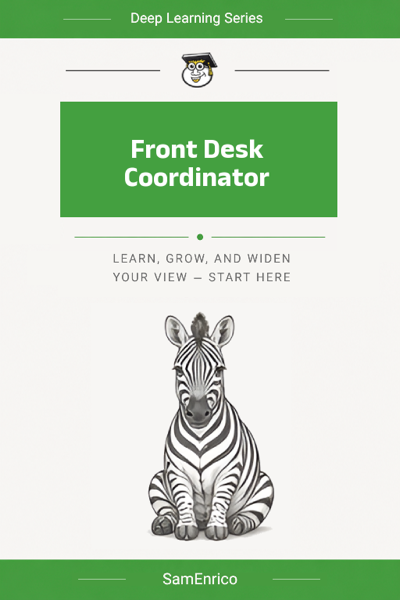
Non-FictionInformativeEducational
Front Desk Coordinator eBook
A Coursebook on Front Desk Coordinator
by Gallo Yetta
A Coursebook on Front Desk Coordinator
Formats
Free sample
Chapter 1: The Flinch Window...--–- The customer is three steps from your desk. You haven't spoken yet. Their eyes sweep across your posture, your expression, the cleanliness of your counter, the angle of your shoulders, the presence or absence of a smile. In the time it takes to inhale once, they have already decided whether to trust you, respect you, or dismiss you. This is not an exaggeration.
This is the Flinch Window—the first five seconds of every interaction—and it determines everything that follows. If you lose the Flinch Window, you spend the next fifteen minutes climbing uphill against a customer who has already decided you are incompetent, indifferent, or hostile. If you win the Flinch Window, the customer enters the conversation already inclined to forgive small errors, wait patiently, and assume good intent. The difference between those two outcomes is not training. It is not experience.
It is not even skill. It is awareness—the ability to see yourself as the customer sees you before they say a single word.The Flinch Window is named for the micro-moment when a customer's brain decides "safe" or "threat." This decision happens in the amygdala, the brain's ancient fear center, which processes visual input in as little as 33 milliseconds. Your customer is not consciously choosing to judge you. Their brain is doing it automatically, below the level of thought, based on pattern recognition accumulated over a lifetime of front desk interactions. Every slouched posture they have ever seen, every distracted glance they have ever received, every dirty counter they have ever leaned on—these memories have been compressed into a split-second template.
When you walk into view, their brain compares you to that template. If you match the negative pattern, you are flagged. If you match the positive pattern, you are approved. The entire process happens before you have arranged your face into a smile.This chapter is about controlling what happens in those five seconds. It is about understanding that your professional presence is not a collection of arbitrary rules imposed by management but a strategic tool for shaping perception.
You will learn the three channels of the Flinch Window—visual, auditory, and energetic—and how to optimize each one without feeling fake or robotic. You will learn how to audit your physical environment because the customer judges not just you but everything within their line of sight. You will learn the difference between deference and guidance, and why the old model of passive order-taking is a career killer. And you will learn the Lead versus Follow Matrix, a decision tool that tells you exactly when to take charge and when to step back. By the end of this chapter, you will never again walk into a customer interaction unaware of the judgment already underway.The Three Channels of the Flinch Window The Flinch Window operates through three distinct channels, each processed by a different part of the customer's brain.
Visual cues go to the occipital lobe, auditory cues to the temporal lobe, and energetic cues to the limbic system. All three channels are evaluated simultaneously, and a failure in any single channel can override successes in the other two. You can have perfect posture and a warm voice, but if your energy signals fear or irritation, the customer will feel unsafe. You can have impeccable grooming and high energy, but if your voice is flat or rushed, the customer will feel unimportant. The goal is alignment across all three channels.The visual channel is the most immediate.
Within the first 33 milliseconds, the customer's brain has registered your posture, your expression, your grooming, your uniform, and the state of your workspace. Posture alone communicates status and confidence. A spine that is straight but not rigid, shoulders back but not raised, chin level but not tilted upward—this combination signals competence without arrogance. Slumped shoulders signal fatigue or low status. A tilted chin signals condescension.
Leaning backward signals disinterest. Leaning too far forward signals aggression. The ideal posture is what military trainers call "relaxed readiness": weight evenly distributed, feet flat, hands visible and still, torso open to the customer rather than turned toward a computer screen.Facial expression is the most powerful visual cue because the human brain has dedicated neural architecture for reading faces. The expression that works best at a front desk is not a full, teeth-baring smile but what researchers call the "soft smile"—lips gently closed or slightly parted, the corners turned upward but not stretched, the eyes engaged (known as the Duchenne marker, where the orbicularis oculi muscles create crow's feet). A full smile can read as forced or insincere, especially when held for more than a few seconds.
A neutral face reads as cold or annoyed. The soft smile reads as warm, competent, and calm. It signals that you are happy to see the customer but not desperate for their approval.The auditory channel activates the moment you speak, but the customer's brain begins processing ambient sound even before that. The quality of the sound environment—background music, phone ringing, colleagues chatting, printers humming—sets a baseline expectation. A space that is too quiet feels sterile or tense.
A space that is too loud feels chaotic or understaffed. The ideal ambient sound level allows conversation without strain but masks the sounds of other customers' problems. Many front desks make the mistake of silence, which means every frustrated word from a nearby customer is clearly audible to everyone waiting. Low, instrumental music without lyrics is the standard for good reason: it covers incidental noise without demanding attention.When you speak, your voice communicates through three sub-channels: pitch, pace, and tone. Pitch is the highness or lowness of your voice.
A pitch that is too high signals anxiety or youth. A pitch that is too low signals exhaustion or disinterest. The optimal pitch is your natural speaking voice, slightly lowered, which signals calm authority. Pace is the speed of your speech. A pace that is too fast signals nervousness or a desire to be done with the interaction.
A pace that is too slow signals disengagement or low intelligence. The optimal pace is slightly slower than casual conversation, with deliberate pauses between sentences. Tone is the emotional color of your voice. A flat tone signals indifference. An overly bright tone signals insincerity.
The optimal tone is warm but steady, as if you are speaking to a trusted colleague who has just walked into your office.The energetic channel is the most subtle and the most powerful. Energy is not a metaphor. Humans are biologically wired to detect the emotional states of others through a combination of pheromones, micro-expressions, and autonomic nervous system cues that we process unconsciously. Have you ever walked into a room and immediately felt that two people had been arguing? That is energy detection.
Have you ever approached a desk and felt that the coordinator was annoyed before they said a word? Same mechanism. Energy is the congruence between what you feel and what you project. If you are internally frustrated but externally smiling, the customer will detect the mismatch as a vague sense of unease. They will not be able to…
This is the end of the free sample. Get the eBook to keep going. Buy now
About this book
Details
- Author
- Gallo Yetta
- Publisher
- SamEnrico
- Language
- English
- Genre
- Non-Fiction, Informative, Educational
- Released
- 2026-05-11
- Pages (approx.)
- 141
- Available as
- eBook, Audiobook

Read better in the ZLOADR app
Your eBooks on your phone or tablet. Sign in with your SamEnrico account and start reading.
More by Gallo Yetta
 Creative Worker Priority GuideGallo Yetta$11.99
 Loving Kindness Daily Practice WorkbookGallo Yetta$11.99
 Stress Induced Jealousy Recovery PlanGallo Yetta$11.99
 Self Hypnosis for Organization HabitsGallo Yetta$11.99
 Meditation for Beginner OverthinkersGallo Yetta$11.99
 The Bone Thief of Wadi Natuf: Unraveling a Prehistoric MysteryGallo Yetta$11.99
 Gold and Ghosts: The Untold Story of Eric MoussambaniGallo Yetta$11.99
 Understanding Deafness Mesenteric Diverticula of Small Bowel NeuropathyGallo Yetta$17.99
 How to Become a Die SinkerGallo Yetta$11.99
 Nonprofit Conflict of InterestGallo Yetta$12.99
 Circle Customization GuideGallo Yetta$12.99
You may also like
 Hong Kong Handover 1997Dunn Johnnie$11.99
 Zumba For Postnatal Recovery CourseNeal Christian$11.99
 Zumba for BeginnersLadner Nikia$11.99
 YouTube Comment Mining GuideHumes Pandora$12.99
 Worry Box MeditationCarlin Rudy$11.99
 Workplace Stress MeditationNguyen Lynn$11.99
 Workplace Stress and Sleep RepairHawley Ivory$11.99
 Workplace Perfectionism CureDelaney Jeffry$11.99
 Workplace Injustice Anger GuideWallen Isabelle$11.99
 Work Addiction and Burnout LinkGreenwood Ester$11.99
 Women in Yoga and WellnessBeattie Galina$11.99
 Women in Stand Up ComedyChun Evangeline$11.99