
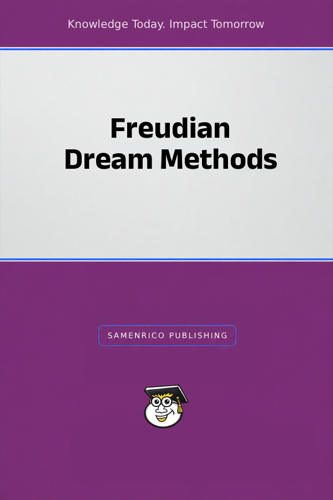
Freudian Dream Methods eBook
Interpret dreams for hidden desires and conflicts.
Interpret dreams for hidden desires and conflicts.
Formats
Free sample
Chapter 1: The Royal Road--–- It was three in the morning when Sarah jolted awake, her heart hammering against her ribs. She had been dreaming—something about standing in an empty train station, a ticket clutched in her hand, watching the last train pull away without her. She couldn't remember the face of the person who had been standing beside her, only that they had let go of her hand at the last moment. For the next twenty minutes, she lay in the dark, running the fragments through her mind, searching for meaning. Then, as dawn began to creep through the blinds, she sighed, rolled over, and told herself the same thing most people do: It was just a dream.
It doesn't mean anything.That single sentence—"It doesn't mean anything"—is perhaps the most common and most damaging phrase in the vocabulary of self-knowledge. It is the brick wall we erect between ourselves and the most direct path to our own unconscious minds. Every night, while you sleep, your brain produces a rich, layered, deeply personal narrative filled with images, emotions, characters, and conflicts. Every morning, you wake up, dismiss it as random noise, and go about your day slightly more disconnected from yourself than you were the night before. This book exists to stop that cycle.The central argument of Freudian Dream Methods—and of this opening chapter—is as radical today as it was when Sigmund Freud first published The Interpretation of Dreams in 1900: dreams are not meaningless biological noise.
They are psychic acts with genuine purpose, coherent structure, and discoverable meaning. Far from being random neural firings during REM sleep—the prevailing neurological explanation that reduces dreams to mere housekeeping for the brain—dreams are the most direct, unfiltered, and honest communication you will ever receive from the deepest parts of your own mind. They are what Freud called, in one of the most famous phrases in the history of psychology, "the royal road to a knowledge of the unconscious."This chapter will demolish the myths that keep you from taking your dreams seriously. It will introduce the foundational concepts that will guide every subsequent chapter of this book: the distinction between manifest and latent content, the critical role of day residue, and the revolutionary claim that your dreams are trying to tell you something specific about hidden desires and unresolved conflicts. By the time you finish this chapter, you will never again say, "It was just a dream." You will have your dream journal ready, and you will understand that every single image, every forgotten detail, every strange jump in logic is a clue waiting to be decoded.The Myth of Meaningless Noise Let us begin by naming the enemy.
The dominant scientific paradigm of the last several decades—often called the "activation-synthesis hypothesis" or, in its more modern forms, the "default network theory" of dreaming—holds that dreams are essentially epiphenomena. That is, they are side effects. According to this view, during REM sleep, the brainstem randomly activates various neural circuits. The higher cortical centers, desperate to make sense of this random input, stitch together a narrative after the fact. The dream, in this model, is like the shadow cast by a fire: it has a shape, but it contains no intentional content.
It is the foam on top of the beer—bubbles produced by fermentation, but without any meaning of their own.This is a seductive theory for several reasons. It relieves us of the burden of paying attention to our dreams. It excuses us from the uncomfortable work of self-examination. It allows us to say, with the authority of science, "My bizarre dream about failing an exam I haven't taken in twenty years doesn't mean I still feel like an impostor; it just means my brainstem was firing randomly."There is only one problem with this theory: it is demonstrably incomplete. It cannot explain why dreams so consistently draw upon the specific emotional concerns, conflicts, and memories of the dreamer's waking life.
It cannot explain why the same person, under the same neurological conditions, will have radically different dreams depending on their emotional state before sleep. It cannot explain why dreams so often refer—in compressed, symbolic form—to unresolved conflicts that the dreamer has been actively avoiding. And it certainly cannot explain why, when dreams are interpreted using the methods outlined in this book, people consistently report sudden insights, emotional releases, and lasting changes in their waking behavior.Freud's alternative—the one this book will teach you to apply—is that dreams are psychic acts. They have a purpose. They are produced by the same mental apparatus that produces your waking thoughts, feelings, and behaviors.
The difference is that while you are awake, your conscious mind acts as a gatekeeper, filtering out thoughts that are too threatening, too shameful, or too contradictory to your self-image. When you sleep, that gatekeeper relaxes its vigilance. The forbidden thoughts—the hidden desires, the unresolved conflicts, the infantile wishes you thought you had outgrown—slip through. But they cannot appear in their raw form, because that would jolt you awake. Instead, they undergo a transformation.
They become disguised. They become symbols. They become, in a word, dreams.To understand how this transformation works—and how to reverse it—we must first establish two foundational concepts that will appear in every subsequent chapter of this book.The Two Layers of Every Dream: Manifest and Latent Content Every dream you have contains two distinct layers of content. Understanding the difference between these two layers is the single most important conceptual step you will take in this entire book.The first layer is the manifest content. This is the dream as you remember it upon waking.
The manifest content is the story you tell yourself when you say, "I dreamed I was flying over a city," or "I dreamed my teeth were falling out," or "I dreamed I was back in high school and couldn't find my classroom." The manifest content includes the images, the actions, the colors, the people, the emotions you felt during the dream, and the sequence of events. It is the surface of the dream—the part you can describe to someone else in a few sentences.The second layer is the latent content. This is the hidden meaning beneath the manifest content—the unconscious wishes, fears, conflicts, and desires that the dream is actually expressing. The latent content is what the dream is really about, as opposed to what it appears to be about. You cannot see the latent content directly.
You cannot remember it upon waking. You can only uncover it through the methods of interpretation that this book will teach you—free association, symbol analysis, dream-work deconstruction, and the other tools of Freudian dream analysis.Here is the crucial insight that separates Freudian dream analysis from every other approach: the manifest content is never the real story. The manifest content is a disguise. It is a translation. It is the result of a complex psychic process that takes a simple, unacceptable, unconscious wish and transforms it into a bizarre, confusing, but ultimately tolerable image.
If you take your dreams literally—if you believe that a dream about a lost train ticket is only about a…
This is the end of the free sample. Get the eBook to keep going. Buy now
About this book
Details
- Author
- Redding Elvera
- Publisher
- SamEnrico
- Language
- English
- Genre
- Non-Fiction, Self-Help, Freudian
- Released
- 2026-06-10
- Pages (approx.)
- 157
- Available as
- eBook, Audiobook

Read better in the ZLOADR app
Your eBooks on your phone or tablet. Sign in with your SamEnrico account and start reading.
More by Redding Elvera
 Middle School Academic AnxietyRedding Elvera$11.99
 Muscle Loss Sarcopenia HGHRedding Elvera$11.99
 The Collaboration CharterRedding Elvera$11.99
 Psychology Theory PegsRedding Elvera$11.99
 Kicking Clutch Performance GuideRedding Elvera$11.99
 Chechen Hostage EscapeRedding Elvera$11.99
 Retirement Assets and 457bRedding Elvera$11.99
 Period Underwear GuideRedding Elvera$11.99
 Quetzalcoatl’s Shadow: The Serpent Spy of TeotihuacanRedding Elvera$11.99
 Blood Moon Over the Sacred Grove: The Druidess Who Defied RomeRedding Elvera$11.99
 The Billionaire's Floating Palace: The Untold Story of Paul Allen's OctopusRedding Elvera$11.99
 Growing Ricinus (Castor-oil Plant)Redding Elvera$11.99
You may also like
 Hong Kong Handover 1997Dunn Johnnie$11.99
 Zumba For Postnatal Recovery CourseNeal Christian$11.99
 Zumba for BeginnersLadner Nikia$11.99
 YouTube Comment Mining GuideHumes Pandora$12.99
 Worry Box MeditationCarlin Rudy$11.99
 Workplace Stress MeditationNguyen Lynn$11.99
 Workplace Stress and Sleep RepairHawley Ivory$11.99
 Workplace Perfectionism CureDelaney Jeffry$11.99
 Workplace Injustice Anger GuideWallen Isabelle$11.99
 Work Addiction and Burnout LinkGreenwood Ester$11.99
 Women in Yoga and WellnessBeattie Galina$11.99
 Women in Stand Up ComedyChun Evangeline$11.99