
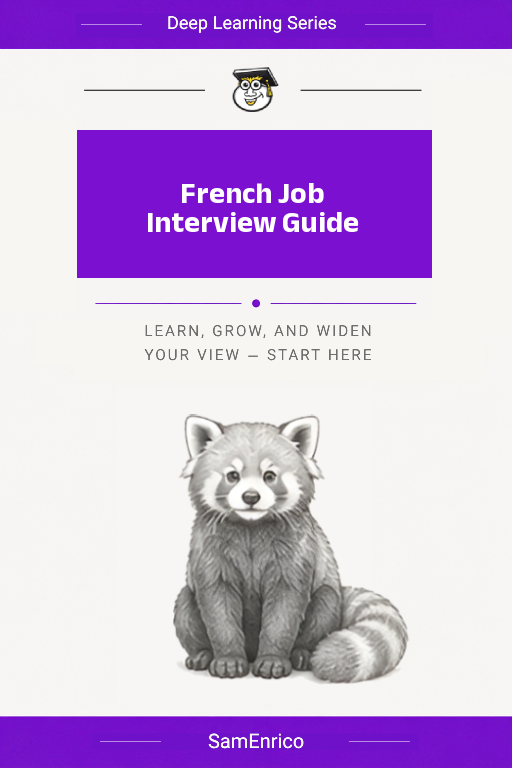
Non-FictionProfessional's Cheat SheetCultural Interviewing
French Job Interview Guide eBook
Master job interviews in France. Formalities, educ
Master job interviews in France. Formalities, educational credentials, and intellectual debate style.
Formats
Free sample
Chapter 1: The Handshake That Fails--–- The first time Marie lost a job offer, she never saw it coming. She had graduated from a top American business school, spoken fluent French, and prepared extensively for her interview with a Paris-based luxury goods company. She answered every question with confidence, smiled warmly, and even used the word vous correctly. When she walked out, she felt certain the job was hers. Three days later, the recruiter called to deliver a polite but firm refusal.
When Marie asked for feedback – a brave and unusual request – the recruiter hesitated, then said: "Votre poignée de main était... molle. Et vous avez regardé mon associé dans les yeux en répondant à ma question."Marie was stunned. She had lost a job not because of her skills, not because of her experience, but because of a handshake and eye contact. To her American sensibilities, this seemed absurd.
To the French recruiter, it was perfectly logical: a weak handshake signaled lack of character, and looking at the wrong person while answering signaled lack of respect for hierarchy. Marie had failed the first test before she had even spoken her first real sentence.This book exists because of Marie. And because of the hundreds of candidates – French and foreign alike – who have been rejected from French jobs for reasons they could not understand. The problem is rarely a lack of competence. The problem is a lack of cultural code.
France interviews differently. Not better or worse – differently. And if you do not understand the rules of the game, you will lose every time, even when you are the most qualified person in the room.The Three-Pillar Framework: What This Book Teaches Before we dive into the specific rules of formality, you need to understand the architecture of the French interview. Unlike American guides that focus on storytelling and personal branding, this book is built on a framework that reflects how French recruiters actually think. I call it the Three-Pillar Method: La Forme (The Form), Le Fond (The Substance), and Le Feu (The Fire).Pillar One: La Forme (The Form) – This is the subject of Part One of this book.
It covers everything that happens before you speak about your qualifications: the handshake, the vous, the dress code, the paper dossier. In France, how you present yourself is not separate from who you are – it is who you are, at least for the first fifteen minutes of an interview.Pillar Two: Le Fond (The Substance) – This covers your credentials, your CV, and your preparation. France is a diplomocracy – your degree is your identity. You cannot fake this. You must translate, validate, and present your educational background with precision and pride.Pillar Three: Le Feu (The Fire) – This is the intellectual debate.
The French interview is not a conversation; it is a soutenance (thesis defense). You will be challenged, interrupted, and tested on abstract topics. The goal is not to be liked – the goal is to be respected.This chapter addresses the first pillar: La Forme. Specifically, the most immediate and dangerous moment of any French interview – the first ten seconds.The First Ten Seconds: Why They Matter More Than Anything In American interviewing culture, the first ten seconds are often seen as a warm-up. You exchange pleasantries, comment on the weather, shake hands, and then ease into the conversation.
The actual evaluation, the thinking goes, begins when you sit down and start answering questions about your experience.This is completely wrong in France.In France, the first ten seconds are the interview. The handshake, the eye contact, the greeting, the posture – these are not preliminaries. They are the first test, and they are weighted heavily. A French recruiter will form a judgment about your personnalité (character), your sérieux (seriousness), and your savoir-être (professional comportment) within the first ten seconds. That judgment is difficult to reverse later, even if your answers are brilliant.Why is this true?
Because French corporate culture is rooted in a tradition of formal hierarchy that dates back to the Ancien Régime and was reinforced by Napoleon's administrative reforms. In this tradition, respect for hierarchy is not optional – it is the foundation of professional life. How you enter a room, greet a superior, and position yourself physically communicates your understanding of that hierarchy instantly. A person who does not know how to greet properly is a person who does not understand how French organizations work.Let me give you a concrete example. I once observed a mock interview between a senior French HR director and a candidate from a Scandinavian country.
The candidate entered the room casually, smiled broadly, and extended his hand while saying "Hey, nice to meet you." The HR director's face went flat. The interview continued for forty-five minutes, but the decision was made in the first three seconds. The candidate did not get the job. When asked why, the HR director said: "Il n'a pas pris le temps. Il n'a pas montré le respect." (He did not take his time.
He did not show respect.)This chapter will teach you exactly how to avoid that fate.The Handshake: Your First and Most Important Message Let us begin with the handshake – la poignée de main. This is the single most important physical gesture in French professional life. More than in Germany, more than in the United Kingdom, and certainly more than in the United States, the French handshake carries meaning. It is a ritual, not a formality.The Rules of the French Handshake Rule One: Shake hands with every adult in the room. This is non-negotiable.
If there are three interviewers, you shake three hands. If there is an intern observing in the corner, you shake their hand. If there is an assistant who lets you into the room, you shake their hand. The only exceptions are security personnel or cleaning staff who are clearly not part of the interview process. When in doubt, extend your hand.
A French person will never be offended by an offered handshake.Rule Two: The order matters. Enter the room. Stop. Make brief eye contact with the most senior person first (usually the one who greets you or sits in the center). Extend your hand to that person.
After shaking, move to the next most senior, and so on. Do not shake hands while walking or talking. Stop. Shake. Move on.Rule Three: Duration and firmness.
The handshake should last approximately two to three seconds – longer than an American handshake, shorter than a German one. Firmness should be moderate. A limp handshake (une poignée de main molle) signals weakness, lack of confidence, or worse, lack of respect. A bone-crushing handshake signals aggression or cultural ignorance. The correct pressure is that of a confident but respectful peer.
Practice with a French friend if possible.Rule Four: One pump, not multiple. American handshakes often involve two or three pumps. The French handshake is typically one clean pump – down and up – followed by release. Multiple pumps feel amateurish.Rule Five: Repeat upon exit. At the end of the interview, you will repeat the handshake ritual with every person in the same order.
Do not assume that the exit handshake is optional. It is not. It closes the interaction and leaves a final…
This is the end of the free sample. Get the eBook to keep going. Buy now
About this book
Details
- Author
- Guajardo Dalia
- Publisher
- SamEnrico
- Language
- English
- Genre
- Non-Fiction, Professional's Cheat Sheet, Cultural Interviewing
- Released
- 2026-05-29
- Pages (approx.)
- 152
- Available as
- eBook, Audiobook

Read better in the ZLOADR app
Your eBooks on your phone or tablet. Sign in with your SamEnrico account and start reading.
More by Guajardo Dalia
 Outdoor HIIT WorkoutsGuajardo Dalia$11.99
 TikTok Perfection Illusion HandbookGuajardo Dalia$11.99
 Consumer Surplus Business UseGuajardo Dalia$11.99
 Night Eating Syndrome RecoveryGuajardo Dalia$11.99
 The King Street Escape: Canada's First Notorious Prison BreakGuajardo Dalia$11.99
 Learn to Play the ZhuihuGuajardo Dalia$11.99
 Petzite MiningGuajardo Dalia$11.99
 10 Ways to Use Green Cabbage (Recipe Book)Guajardo Dalia$11.99
You may also like
 Hong Kong Handover 1997Dunn Johnnie$11.99
 Zumba For Postnatal Recovery CourseNeal Christian$11.99
 Zumba for BeginnersLadner Nikia$11.99
 YouTube Comment Mining GuideHumes Pandora$12.99
 Worry Box MeditationCarlin Rudy$11.99
 Workplace Stress MeditationNguyen Lynn$11.99
 Workplace Stress and Sleep RepairHawley Ivory$11.99
 Workplace Perfectionism CureDelaney Jeffry$11.99
 Workplace Injustice Anger GuideWallen Isabelle$11.99
 Work Addiction and Burnout LinkGreenwood Ester$11.99
 Women in Yoga and WellnessBeattie Galina$11.99
 Women in Stand Up ComedyChun Evangeline$11.99