
Non-FictionProfessional's Cheat SheetResume Formatting
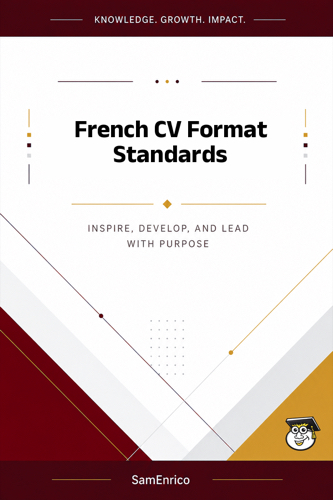
French CV Format Standards eBook
Include photo, age, and handwritten cover letter f
Include photo, age, and handwritten cover letter for traditional firms.
Formats
Free sample
Chapter 1: The Invisible Graveyard--–- Every morning, hundreds of resumes land in the digital trash bins of French HR departments. Most of their senders never know why. They check their email obsessively for weeks, refresh their spam folders, rewrite their cover letters, and eventually conclude that the French job market is simply impenetrable for outsiders. They are wrong. What they have actually encountered is not a wall of rejection but a door they did not know how to knock on.
The resume that got them interviews in New York, London, or Sydney is not just failing in Paris—it is actively offending the people who read it. And the most painful part is that no one will ever tell them why.This chapter is called The Invisible Graveyard because that is precisely where well-intentioned, qualified, ambitious candidates bury their chances when they apply to traditional French firms using Anglo-Saxon resumes. The graveyard is invisible because the victims never see their own mistakes. They blame the economy, their age, their nationality, or bad luck. But the truth is simpler and far more fixable: they are playing the wrong game by the wrong rules.
By the time you finish this chapter, you will understand exactly why your current resume is failing, what French recruiters are actually looking for when they scan a document in less than thirty seconds, and—most importantly—how to stop digging your own grave and start building a bridge instead.The French Resume Paradox To understand why Anglo-Saxon resumes fail in France, you must first understand a fundamental paradox. The English word "resume" comes from the French résumé, meaning a summary. One would think, then, that the French approach to resumes would be similar to the American or British approach. Nothing could be further from the truth. The American resume is a sales document.
It is designed to sell you as a product, to highlight your achievements in bold numbers, to show how you increased revenue by forty percent or cut costs by half a million dollars. The French CV is not a sales document. It is a biographical narrative. It tells a story of who you are, where you came from, which schools accepted you, how you have progressed logically through your career, and—most critically—whether you understand your place in the social and professional hierarchy.This difference is not minor. It is tectonic.
An American recruiter scanning a resume wants to see results: "Increased sales by 35% in first quarter." A French recruiter scanning a CV wants to see lineage: "Licence en droit – Université Paris II Panthéon-Assas, puis Master 2 en finance – Dauphine." The American recruiter is asking, "What can you do for me?" The French recruiter is asking, "Who are you, and where do you belong?" These two questions lead to two completely different document designs, two different philosophies of career presentation, and—for the unprepared candidate—two very different outcomes.Consider a real example. An American marketing manager with ten years of experience at three different companies applied for a senior role at a traditional French insurance firm in Lyon. Her American resume was flawless by US standards: one page, bolded metrics, action verbs, a professional summary at the top declaring her a "dynamic, results-driven leader." She sent it to fifteen French companies. She received zero responses. After working with a French career coach, she rewrote her CV to French specifications: two pages, no summary headline, a detailed education section listing every course she had taken, and a hobbies section mentioning her membership in a local running club.
She added a small professional photo in the top right corner. She wrote a handwritten cover letter. She applied to three of the same fifteen companies. She received two interviews and one job offer. The only thing that changed was the format.
Her qualifications were identical. Her experience was identical. But the first version was invisible—it landed in the graveyard—while the second version was legible to French eyes.The Five Deadly Sins of the Anglo-Saxon Resume in France Let us name the five specific ways your current resume is failing you. These are not opinions. They are observations drawn from interviews with twenty French HR directors across banking, insurance, luxury goods, and law firms—the traditional sectors where cultural codes matter most.The first deadly sin is the absence of a photo.
In American and British hiring, a photo on a resume is considered unprofessional at best and a discrimination risk at worst. In traditional French firms, the absence of a photo is read as evasive, incomplete, or—worst of all—foreign. The French HR director wants to see your face. They want to judge whether you look professional, whether you look like you belong in their office, whether you look bien dans votre peau (comfortable in your own skin). Without a photo, they assume you have something to hide.
This is not fair, and it is not legal in theory. But in practice, the hidden job market operates on its own rules, and the rule is simple: no photo, no interview.The second deadly sin is the chronological gap between education and experience. The American resume often lists experience first, pushing education to the bottom or even omitting graduation years to avoid age discrimination. The French CV does the opposite. Education comes first, always, and graduation years are mandatory.
The French recruiter wants to see the parcours—the path—starting with the baccalauréat (or its international equivalent), moving through higher education, and only then arriving at professional experience. Any deviation from this order signals that you do not understand French corporate culture. Worse, omitting graduation dates signals that you are trying to hide your age, which traditional recruiters interpret as dishonesty rather than discretion.The third deadly sin is the use of subjective, self-congratulatory language. Phrases like "dynamic," "results-oriented," "go-getter," "self-starter," and "passionate" are staples of American resumes. In France, these words are viewed with deep suspicion.
They are considered empty, boastful, and vaguely American in the worst sense of the stereotype—loud, superficial, and lacking in rigor. The French CV uses factual, neutral, almost minimalist language. Instead of "dynamic leader who drove team performance," you write "Encadrement d’une équipe de huit personnes. Gestion de projet de douze mois." The facts speak for themselves. The adjectives are deleted.The fourth deadly sin is the one-page obsession.
American career advice is fixated on the single-page resume. Cut, trim, condense, eliminate—do whatever it takes to keep it to one page. French traditional firms do not share this obsession. For a junior candidate with fewer than five years of experience, one page is appropriate. For a candidate with ten or more years of experience, two pages are not only acceptable but expected.
The French recruiter wants to see the full career narrative. Trying to cram fifteen years of experience onto one page by reducing font size to eight points and eliminating margins is not seen as efficient—it is seen as amateurish and disrespectful to the reader.The fifth deadly sin is the absence of a lettre de motivation or, worse, a typed one. The American cover letter has become increasingly optional, often replaced…
This is the end of the free sample. Get the eBook to keep going. Buy now
About this book
Details
- Author
- Mccune Francisco
- Publisher
- SamEnrico
- Language
- English
- Genre
- Non-Fiction, Professional's Cheat Sheet, Resume Formatting
- Released
- 2026-06-11
- Pages (approx.)
- 153
- Available as
- eBook, Audiobook

Read better in the ZLOADR app
Your eBooks on your phone or tablet. Sign in with your SamEnrico account and start reading.
More by Mccune Francisco
 Dental Trauma ShameMccune Francisco$11.99
 Dream Recipe CollectionMccune Francisco$11.99
 Immigrant Video Game StudioMccune Francisco$11.99
 Sponsor Family StrangenessMccune Francisco$11.99
 Teen Job Interview ConfidenceMccune Francisco$11.99
 Conversation Starters for First DatesMccune Francisco$11.99
 988 Suicide HotlineMccune Francisco$11.99
 The Wolf of the Danube: The Magyar Raid That Shattered EuropeMccune Francisco$11.99
 The Phantom of the Boardroom: Asia's Most Elusive Financial KillerMccune Francisco$11.99
 How to Produce Clothes ValetsMccune Francisco$11.99
 Travel ConsultantMccune Francisco$11.99
 How to Start a Cold Drawn Steel Bars Business (Beginners Guide)Mccune Francisco$11.99
You may also like
 Hong Kong Handover 1997Dunn Johnnie$11.99
 Zumba For Postnatal Recovery CourseNeal Christian$11.99
 Zumba for BeginnersLadner Nikia$11.99
 YouTube Comment Mining GuideHumes Pandora$12.99
 Worry Box MeditationCarlin Rudy$11.99
 Workplace Stress MeditationNguyen Lynn$11.99
 Workplace Stress and Sleep RepairHawley Ivory$11.99
 Workplace Perfectionism CureDelaney Jeffry$11.99
 Workplace Injustice Anger GuideWallen Isabelle$11.99
 Work Addiction and Burnout LinkGreenwood Ester$11.99
 Women in Yoga and WellnessBeattie Galina$11.99
 Women in Stand Up ComedyChun Evangeline$11.99